
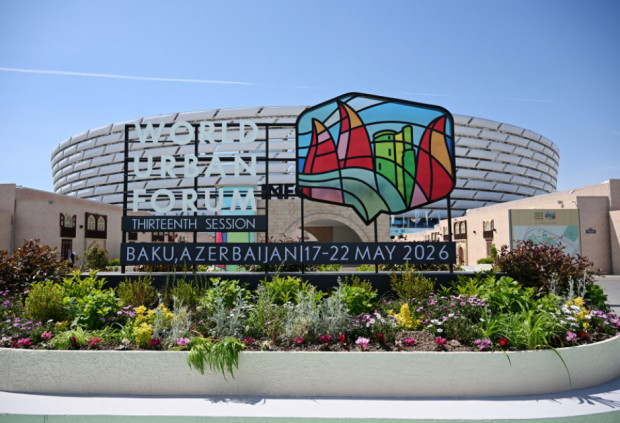
Following COP29, Azerbaijan is hosting yet another global event with its excellent organizational talent – the 13th Session of the UN World Urban Forum (WUF13). This prestigious event, held in the capital Baku, is being accompanied by records and active initiatives in the history of WUF. As President Ilham Aliyev emphasized in his speech at the opening ceremony of the 13th Session of the Forum, more than 45,000 participants from 182 countries is a record figure, and this is the second largest international event held in Azerbaijan after COP29.
Another factor increasing the importance of the event is that it coincides with a historical period in which the “Year of Urban Planning and Architecture” is being celebrated in Azerbaijan. Dedicated to the theme “Home for All: Safe and Sustainable Cities and Human Settlements,” the Forum is a clear expression of the international community’s unified intent and trust in Azerbaijan regarding modern urban planning activities worldwide. At the same time, it demonstrates the great commitment of Azerbaijan, which possesses rich architectural traditions, urban culture, and ancient history, to urban planning and its development.
WUF13 is primarily of great importance in terms of presenting Azerbaijan’s cultural vision, which possesses ancient urban architecture. The President touched upon this issue specifically in his speech, and this is not accidental, as Azerbaijan, with its ancient traditions of statehood, is also one of the centers of urban civilizations. Located between Europe and Asia, our country, which is a cultural bridge between East and West, has formed a unique architectural style. In our cities such as Baku, Nakhchivan, Gabala, Sheki, Ganja, and Shamakhi, the architectural heritage reflects elements of urban culture and infrastructure. The oldest church located in the village of Kish in Sheki or the water and sewage system built 15 centuries ago in Lahij are clear examples of this.
Azerbaijan approaches the urban landscape, one of the attributes of sustainable development, as an integral part of general progress, and creates a modern urban planning ensemble based on historical heritage in line with rapidly changing urbanization processes, preserving the requirements and order of the environment-city unity.
Thanks to the start of oil production two centuries ago, the country’s leadership, which is changing the damaged ecological landscape of historical areas such as the “Black City,” Bibiheybat, Boyukshor, and others with modern projects, is building the true urban image of Baku.
The “White City” and “Sea Breeze” projects, which are symbols of modern urban planning, are references for urban management and experience. Likewise, the renewal of road-transport infrastructure, the regulation of intra-city mobility, and the “green city” concept, which are in harmony with modern urbanization projects, are met with interest in international practice.
The Forum can also be characterized as an important promotional course in terms of introducing the innovative urban planning projects implemented by Azerbaijan in the liberated territories and the “smart construction” model to the world. When preparing master plans for cities, modern urbanization standards, ecological balance, and sustainable development principles are accepted as the main criteria, and these traditions and architecture, innovation, and technological approaches prevail in the reconstruction of Karabakh and East Zangezur, which makes this urban planning experience of special interest in the world.
As President Ilham Aliyev stated, holding three National Urban Planning Forums together with the UN in Aghdam, Zangilan, and Khankendi since 2022 has given us great experience. This close and reliable partnership, along with the restoration and construction process in the liberated territories, completes the urban planning approach in a unified concept, forming a completely new face of the “smart city” model.
The Forum can also be evaluated as an important platform in terms of introducing the face of Armenia, which committed urbicide and ecocide in the region by destroying Azerbaijani cities, architectural, and historical-religious monuments for 30 years, to the world in its nakedness.
Currently, as a state that well understands the need for the development of urban planning, Azerbaijan continues rapid city construction, while at the same time preferring to implement this demand, which is valid for capital cities, based on a cautious approach through exchange with global partners, and aims to implement joint programs with global partners. In this regard, meetings held within the framework of the Session with the support of UN experts and the participation of numerous guests will create new opportunities for the emergence of unique projects.
The holding of the Leaders’ Summit for the first time within the framework of WUF13 reflects that official Baku is also a stable space where socio-political issues are discussed. Against the backdrop of sharp conflicts and increasing geopolitical risks continuing in various parts of the world, Azerbaijan bringing together heads of state and government and high-level representatives from different parts of the world, and uniting them around a platform of stability, sustainable development, and solidarity, means a new example for the modern world.
Considering that the goal of the Forum is the impact of rapid urbanization, which is one of the most pressing problems facing humanity, on cities, economies, climate change, and policies, the gathering of leaders in Baku is of special importance in this critical period. As UN Secretary-General Antonio Guterres voiced in his video message, the meeting of leaders in Baku in an era of global crises, conflicts, rising energy costs, and rising food prices is a historic event. Or, as UN-Habitat Executive Director Anacláudia Rossbach stated, it is no coincidence that tens of thousands of people from different communities of the world have come together in Baku.
WUF13 is an opportunity to accelerate implementation through practical action, partnership, and investment. This means trials and opportunities for the state, the private sector, and small entrepreneurs alike.
In short, Azerbaijan continues the responsible mission entrusted to it according to a unique plan, and we are confident that the results of the 13th session of the World Urban Forum will be as successful as the results of COP29.
Ramid Namazov
Milli Məclisin deputatı