
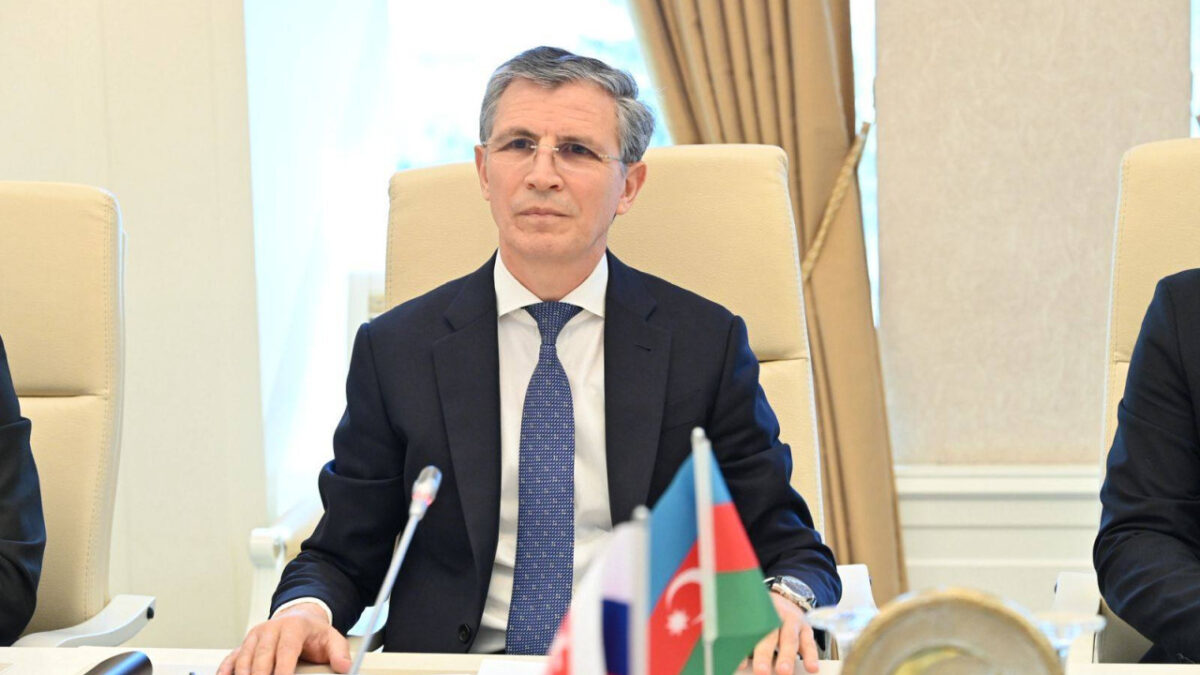
The discussion of the new Civil Service Code is of exceptional importance for the implementation of the Constitution throughout our country after our Victory in the Patriotic War, including for the fulfillment of the important tasks facing our people. The formation of a new representative institution in Azerbaijan after the Victory also proves that a new civil service policy has begun to be realized at a broader level by the head of state.
It should be recalled that the law adopted in 2000 was a product of a different era, a historical situation where we were subjected to occupation and coup attempts, and was taken from the Code formed by Russia in the 1990s. However, the neighboring country has a federal constitutional structure, a multi-tiered classification system, and mixed levels of positions. Azerbaijan is a unitary state. Therefore, the civil service system of our country should be directed towards the demands of our nation, the protection and advancement of professional staff, and their social security.
By the end of 2025, the number of civil servants in Azerbaijan was 27.3 thousand people. 44.2 percent of them are in administrative positions, specifically in the 7th classification, and the share of support positions is 23.2 percent. The proportion of people who have served in the civil service for 15 years or more is only 27.4 percent. That is, we are talking about approximately 7.5 thousand experienced civil servants.
Individuals who have worked in the civil service for a long time have gone through several structural and leadership changes, continuous legislative reforms, and important trials and exams for our statehood. The state invests resources and time in training and gaining experience for a кадр (cadre) for years. The purpose of the “Yüksəliş” (Ascent) competition is to create a cadre bank. Therefore, cadre stability in civil service is one of the most important requirements of management. A minister, committee chairman, or agency head can change within a certain period. Structural and institutional reforms are also a normal process. However, the fate of a civil servant should not depend on the subjective will of the first person to come to the sector. Otherwise, instead of creating a school of statehood, a system of teams that change from leadership to leadership will emerge.
The second major issue is recruitment into civil service. The example of a candidate scoring 95 points being unable to express their opinion in an interview is presented as a counter-argument. According to the results of 2025, there were 4,065 vacancies across the three main selection lines of the State Examination Center (DİM), 15,743 registrations were made, 7,350 people actually participated, 2,920 successful results were recorded, and 2,054 appointments were made. While there were an average of 7.11 registrations per vacancy in the competition stage, the ratio of appointments to vacant positions was only 46.8 percent. While there are thousands of people waiting for employment from the reserve list for years, more than 2800 vacant positions remain, likely filled by contract employees.
However, the purpose of the exam and interview should not be to exclude as many people as possible. If re-evaluation is structured with a more flexible mechanism that considers previous results, subsequent work experience, additional education, and professional development, the new Code will work in favor of both our people and those aspiring to be civil servants.
According to the new draft, an unsuccessful but successful candidate is kept as a reserve cadre for two years instead of five, and can be appointed during this period when an analogous vacancy arises. The draft also envisages holding test exams at least once a quarter. There is a proposal to apply a more balanced approach, i.e., the certificate’s validity period is 3 years, and by passing a simplified renewal test, providing certain transitional benefits for individuals who cannot find a vacancy would be beneficial. Because if the goal is to preserve professionalism, returning a candidate to the same exam is a bureaucratic and financial burden.
On the other hand, attestation and a permanent examination regime are different concepts. If a civil servant is subjected to various checks, internal exams, and evaluations several times a year, it is necessary to measure how much of their time and energy is left for their main work.
Another fundamental issue is the unified position system. In the service of a unitary state, work of the same value should not have completely different career statuses in different institutions. The levels of responsibility and authority of the “consultant,” “leading consultant,” “senior consultant,” and “chief consultant” positions do not have significant differences. Instead, although the number of titles increases, the powers do not grow and remain the same. There is a need for a unified job classification that covers all state bodies.
Salary and career issues are also inseparable. In 2025, the average monthly nominal salary of civil servants was 2,059 manats, an increase of 4.5 percent compared to the previous year. The more systematic connection of service tenure with salary levels in the new Code is a noteworthy change. However, if the state wants to compete with the private sector for highly qualified lawyers, economists, data analysts, engineers, and IT specialists, it is essential that civil service has higher financial provision.
Thousands of people serve our nation with dignity, professionally implement state policy on a daily basis, and protect the legal interests of citizens. It is possible to demand quality service from a civil servant by consistently maintaining their prestige. Being a civil servant of a victorious state should also become an honorable and competitive position in society.