
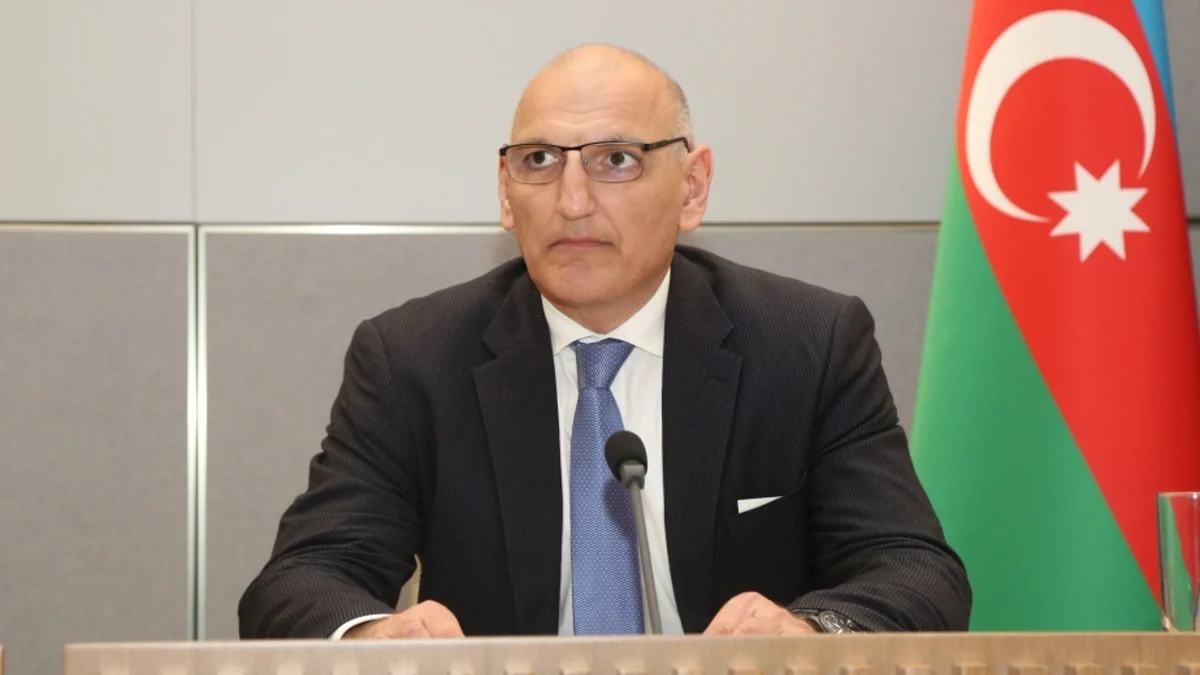
During an interview with “CNN Prima News”, the President’s Representative-at-Large Elchin Amirbayov stated that a Strategic Partnership Agreement has been signed between Azerbaijan and the Czech Republic since 2015.
“Elchi” reports that this was stated by Elchin Amirbayov, the Representative-at-Large of the President of Azerbaijan, who is on a visit to the Czech Republic, while touching upon Czech-Azerbaijani relations in an interview with the “CNN Prima News” (CNN’s Czech-language branch) TV channel.
“Since 2015, our countries have been bound by a Strategic Partnership Agreement, and we have traditional areas of cooperation such as energy, but there is still very important untapped potential in other areas such as industry, agriculture, and tourism,” he noted.
E. Amirbayov emphasized that the new Prime Minister of the Czech Republic and the President of Azerbaijan had the opportunity to meet earlier this year within the framework of the Davos Economic Forum: “Therefore, I think that in the coming weeks and months, we will see more active interaction at the highest level with visits and a large number of contacts.”
According to him, these relations with the Czech Republic are highly valued due to the country’s industrial base, technological expertise, and its membership in the European Union and NATO. On the other hand, today Azerbaijan can benefit the Czech Republic as a gateway to very important regions such as the South Caucasus and Central Asia. “We have been playing a very important role in ensuring Europe’s energy security for decades and have also become a key country in terms of regional connectivity,” E. Amirbayov emphasized, adding that the parties can talk about very productive and mutually beneficial cooperation:
“If we combine the Czech Republic’s technical know-how with the role that Azerbaijan can play in terms of its geo-economic and geopolitical position and infrastructure, as well as its role in the energy sector, we can do much more together.”
In response to the journalist’s question about energy security against the backdrop of processes in Ukraine and Iran, the President’s Representative-at-Large stated that Azerbaijan can further expand its energy portfolio. “Along with the traditional area of crude oil exports from Azerbaijan, it would be fair to say that about a third of the oil used by the Czech Republic comes from Azerbaijan, and this cooperation can be expanded to other areas as well,” the President’s Representative-at-Large said.
E. Amirbayov recalled that Azerbaijan is one of the leading countries in the world in terms of the number of countries to which it exports natural gas and stated that natural gas is exported to 16 countries of the world, 10 of which are members of the European Union. “Austria and Germany have also joined this list,” he said, adding that countries can expand their energy portfolio to include renewable energy sources: “Azerbaijan has great potential in the field of solar, wind energy, and electricity.”
According to him, additional investments are needed in the development of fields, as well as in expanding the transmission capacity of existing infrastructure, in order to increase the volume of gas to new countries: “The Southern Gas Corridor, through which we export our natural gas to Europe, is already fully reserved. Therefore, we need additional capacity, and for this, it is necessary for the EU and Azerbaijan to work together. Azerbaijan’s goal of becoming a long-term reliable energy partner for Europe has already been realized.”
Speaking about the instability in the region, E. Amirbayov highlighted that this situation makes the search for alternative energy sources important for some countries. “Azerbaijan is ready to continue playing the role of a reliable partner. Because despite all this market volatility and geopolitical turmoil, Azerbaijan remains a very responsible and reliable partner,” he stated.
E. Amirbayov also assessed the situation regarding Russia’s role in the South Caucasus:
“Of course, geography is a very important element here. In terms of Azerbaijan-Russia relations, we are trying to build mutually beneficial, pragmatic, and predictable relations based on mutual respect that will take into account the interests of both sides. This is also Azerbaijan’s position regarding all its neighbors, because we have always chosen a multi-vector, pragmatic, and independent foreign policy, and the main criterion for relations is our assessment of our national interests.”
He stated that the election of Donald Trump as President of the United States for a second term has opened a new page in bilateral relations with Azerbaijan. The documents signed during the visit of US Vice President J.D. Vance to Azerbaijan represent a charter on strategic partnership covering many areas between Azerbaijan and the United States:
“The second element that makes these relations important is the positive role the United States plays in promoting peace between Azerbaijan and Armenia. You know that after the 30-year conflict between the two countries, in August of last year, D. Trump invited the President of Azerbaijan Ilham Aliyev and the Prime Minister of Armenia Nikol Pashinyan to a summit that resulted in the initialing of a peace treaty by the foreign ministers of both countries.
However, they also signed a trilateral declaration mentioning the importance of strengthening the spirit of peace. The main issue was the opening of communications. Because the United States has supported this very strategically important project, such as the restoration of communications between Armenia and Azerbaijan and ensuring unimpeded movement between the main part of Azerbaijan and its Nakhchivan Autonomous Republic through the territory of Armenia. But it is not just about this; it is broader than this factor.
It is about creating a new or alternative connection route that will connect East Asia with Western Europe through the Caspian Sea and the South Caucasus in the future. So, I think if we put all this together, it will demonstrate how important the relationship with the United States is for Azerbaijan. We are ready to continue this positive momentum, and I think that in this regard, 2026 will be decisive for the South Caucasus region, because all this uncertainty, instability, and conflicts around us simply emphasize the importance of Azerbaijan and Armenia taking advantage of this historic opportunity, formalizing and legitimizing peace.
Therefore, I hope that the political events in Armenia that we will follow closely, the upcoming parliamentary election in June, and the subsequent referendum on a new constitution will allow Armenia and Azerbaijan to move to the signing of a peace treaty.”