
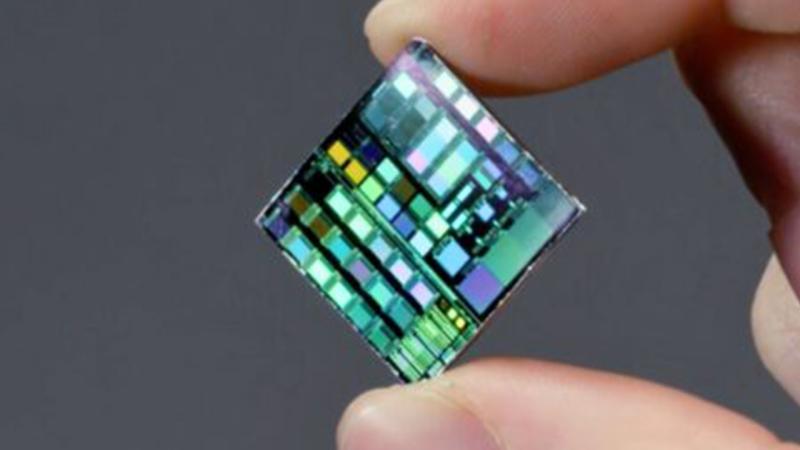
A study conducted by Peking University has developed a new memristor chip capable of modeling the complex surface of the human brain with high precision in less than 10 milliseconds. The research on the chip, developed in collaboration with the Shanghai Institute of Microsystem and Information Technology of the Chinese Academy of Sciences, was published in the journal “Science”.
elchi reports that artificial intelligence systems, which adapt neural networks to mathematical equations to track complex systems that evolve over time, are used in physical modeling, medical imaging, and 3D brain reconstruction.
However, in traditional computers, the constant data transfer between memory and processor slows down processing time and leads to high energy consumption.
Processing is performed directly in memory
The newly developed chip eliminates the need for data transfer between memory and processor by performing critical calculations directly where data is stored. This allows brain modeling processes to be completed faster and with less energy consumption.
Produced using a 40-nanometer manufacturing process and covering an area of 0.28 square millimeters, the chip operates at a frequency of 50 MHz. Demonstrating 3.82-36.27 times faster performance compared to advanced ASIC processors in neural dynamics calculations, the chip consumed 11.75-24.73 times less energy. In the processes of reconstructing the cerebral cortex surface, it achieved a speed increase of up to 478 times compared to the NVIDIA A100 GPU.
A new era for medical technologies
In tests, the chip successfully modeled the white and gray matter boundaries of the brain; it created smooth and topologically consistent 3D surface meshes while preserving complex brain folds.
This technology, which reduces complex AI-centric modeling to millisecond levels, is intended for use in brain-computer interfaces, digital brain twins, real-time intraoperative navigation systems, and research into neurodegenerative diseases such as Alzheimer’s and Parkinson’s.
Şayəstə