
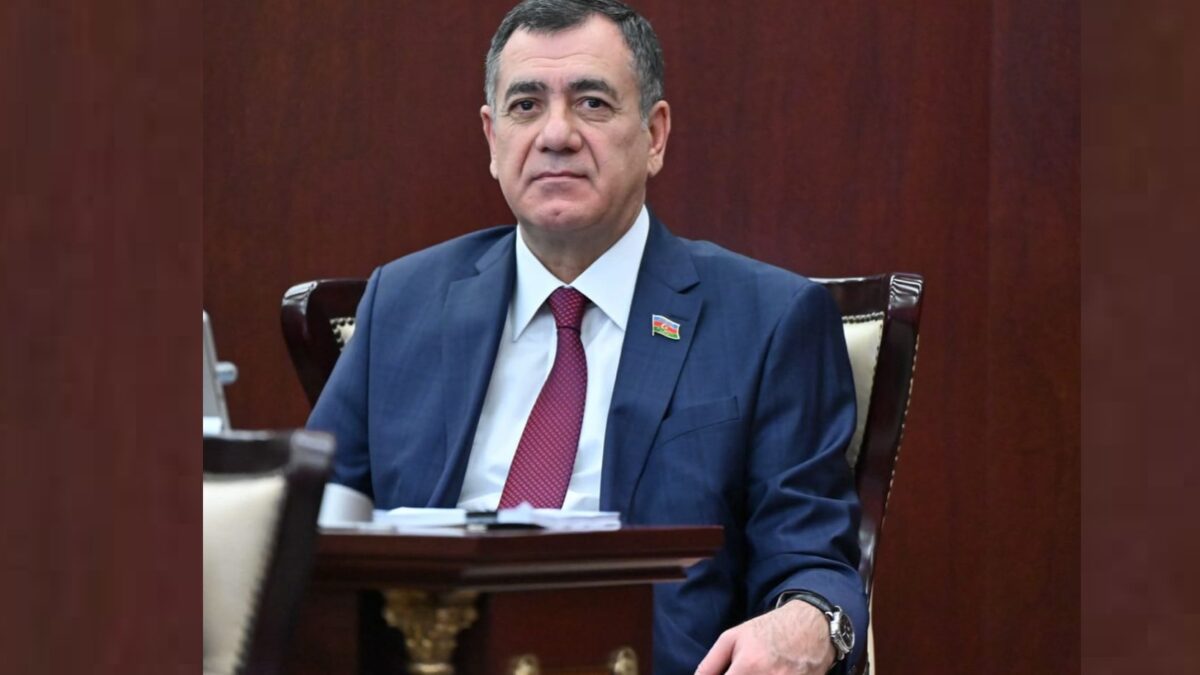
The chairman of the Justice, Law, Democracy (JLD) Party, Member of Parliament Qudrat Hasanquliyev answered the questions of the party’s press service.
elchi presents the interview:
– Mr. Qudrat, in a program broadcast on one of the internet TVs from abroad via YouTube, under the title “How is our attention stolen?”, it was claimed that the government ensures the widespread coverage of insignificant and secondary issues in the mass media to prevent public discussion of problems that make people’s lives difficult. Thus, they divert their attention from issues important to them. We would be interested in your thoughts on this matter…
– First of all, economic issues that directly affect people’s lives, job creation, demographic situation, healthcare, education, rising prices, social security of citizens, existing problems in transport infrastructure, the state of legality, and many other issues are constantly discussed in the media. We can talk about the volume of these discussions. Of course, any government tries to prevent public opinion from turning into political pressure. Every government is aware that diverting attention from problems is not a way out of the situation. To ensure citizen satisfaction, problems must be solved, and reforms must be expanded. No propaganda can distract people from their worsening living conditions. When children in the Soviet Union went to the first grade at the age of 6, they were declared “Oktyabryat” (born after the October Revolution) and a special badge was pinned to their lapels. By the 5th grade, they were called “Pioneers”, and they wore a tie along with a new, different badge. By the 8th grade, they were accepted into the Komsomol and given a different badge. At the age of 18, the best ones were accepted into the ranks of the Communist Party. Throughout this period, young people were educated based on communist ideology, in the spirit of loyalty to communism. At that time, in addition to closed borders, there were no alternative sources of information. But in the Soviet Union, whose economy depended on oil, as soon as the price of oil fell, corruption and false statistics (perepiska) flourished, dissatisfied peoples rose up and demanded freedom, and the Soviet Union collapsed. This is because the refrigerator has a much greater impact on public opinion than the media. The importance of ideological work is realized when the refrigerator is full and people have at least the minimum resources to meet their spiritual needs.
– How do you assess the President’s visit to Turkmenistan?
– Very good. Except for Tajikistan, other Central Asian republics are Turkic republics. Iran’s proposal for cooperation in the CIS+1 format and Kyrgyzstan’s proposal for a unified visa regime should be welcomed positively. Any format of cooperation between Azerbaijan and its neighboring countries should boost our country’s development and security. It would be good for Iran and Turkey to be full members of the CIS and for serious economic integration to occur within the Union. If there are no serious economic openings and freedoms in the CIS countries, friendship between peoples and countries will depend on the will of the heads of state. In this case, economic growth will not be rapid, and relations will not be stable.
– What is your opinion on the resolution adopted by the European Parliament regarding Azerbaijan yesterday?
– If the European Parliament wants to cooperate with Azerbaijan, then it should not resort to pressuring us or discrediting us. All issues should be resolved at the negotiating table. Just as some issues are being resolved. Diplomacy favors this. If the parties sincerely want to cooperate, they should abandon the approach of “I am right, so cooperation can only be on my terms” and reach an understanding through mutual concessions. If they don’t want to, each can remain in their position. If the conditions call into question Azerbaijan’s state independence, territorial integrity, and sovereignty, then no discussion is possible. Agreements can be reached on other issues. We have a serious need for close cooperation with the West because we sell them most of our oil and gas products, which constitute 90% of our exports. They may refuse this tomorrow, if not today. The combined GDP of the Central Asian Republics is approximately 543 billion dollars. Sweden, with a population similar to Azerbaijan, has a GDP of 623 billion dollars (58,529 dollars per capita). We need a liberal economy where the state’s intervention in economic processes is minimized, Western investment, and modern technology. For this, we need to expand relations with the West.