
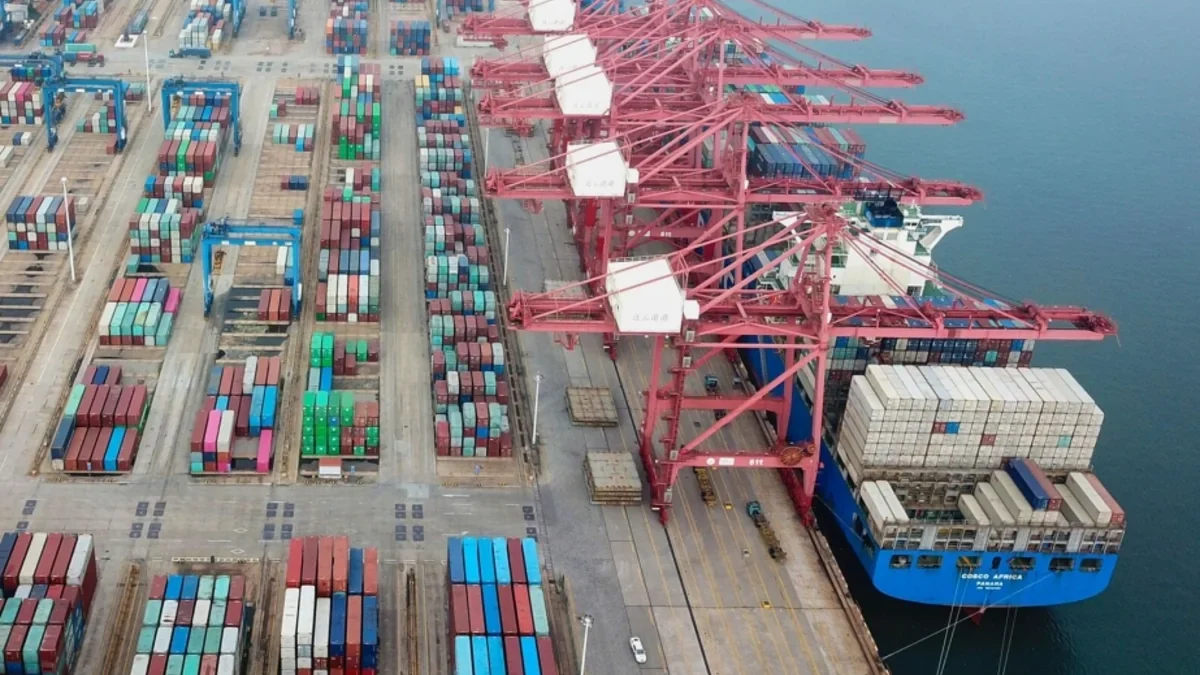
More than 25 billion US dollars in investment is needed for the physical infrastructure of the Trans-Caspian International Transport Route (TITR, Middle Corridor) by 2040, with priority areas for investment being railway networks, seaports, and access roads.
elchi reports that this was stated in the World Bank’s report titled “Integration: High-Level Trade Logistics along the Trans-Caspian Transport Route.”
“A large portion of the most significant investment projects are currently in the implementation or advanced preparation stage in the countries located along the corridor. At the same time, sustained improvement in competitiveness, increased freight volumes, and strengthened economic impact will require enhancing the corridor’s efficiency, improving the quality of services provided, and implementing institutional reforms in all participating countries. Furthermore, approximately 30 billion US dollars should be spent on ‘enabling’ investments, including connecting roads and railways that link the corridor to national economies, logistics hubs and inland terminals to accelerate cargo movement, as well as logistics equipment that ensures the uninterrupted operation of the entire transport network – rolling stock (locomotives and wagons), loading-unloading machinery, and digital platforms,” the report emphasized.
According to the Bank’s data, the ultimate success of the corridor will depend on how effectively countries and operators organize joint cooperation to minimize delays at border crossings, simplify document flow, coordinate the operation of transport hubs, and provide stable service.
“Strengthening partnerships between governments, transport operators, and the private sector will create the foundation for increasing the route’s reliability, attracting capital investments, and transforming the corridor into a platform for large-scale economic growth,” the bank’s experts believe.
The report identified four key directions for improving the management and operation of the corridor: creating a unified digital platform for the corridor intended to replace retail paper document flow with a “single window” for transport, transit, and trade data; forming or authorizing an integrated, market-oriented joint venture—a container rail and Caspian Sea shipping operator—to organize direct coordination of container and maritime services; strengthening coordination at the entire route level to monitor efficiency indicators, eliminate bottlenecks, and develop joint solutions; and modernizing corridor operators through improved corporate governance that allows state railway, port, and shipping companies to operate more on commercial principles, ensuring financial sustainability and regulatory changes.
“Unlocking the full potential of the corridor depends on practical steps that will ensure faster, more predictable, and convenient movement of cargo across state borders. Better integrated railways, ports, logistics centers, and digital systems, combined with deepened coordination between countries and operators, are capable of turning the TITR into a competitive route for business and a sustainable platform for regional development,” said Charles Cormier, Regional Director for Infrastructure in the Europe and Central Asia region at the World Bank.