
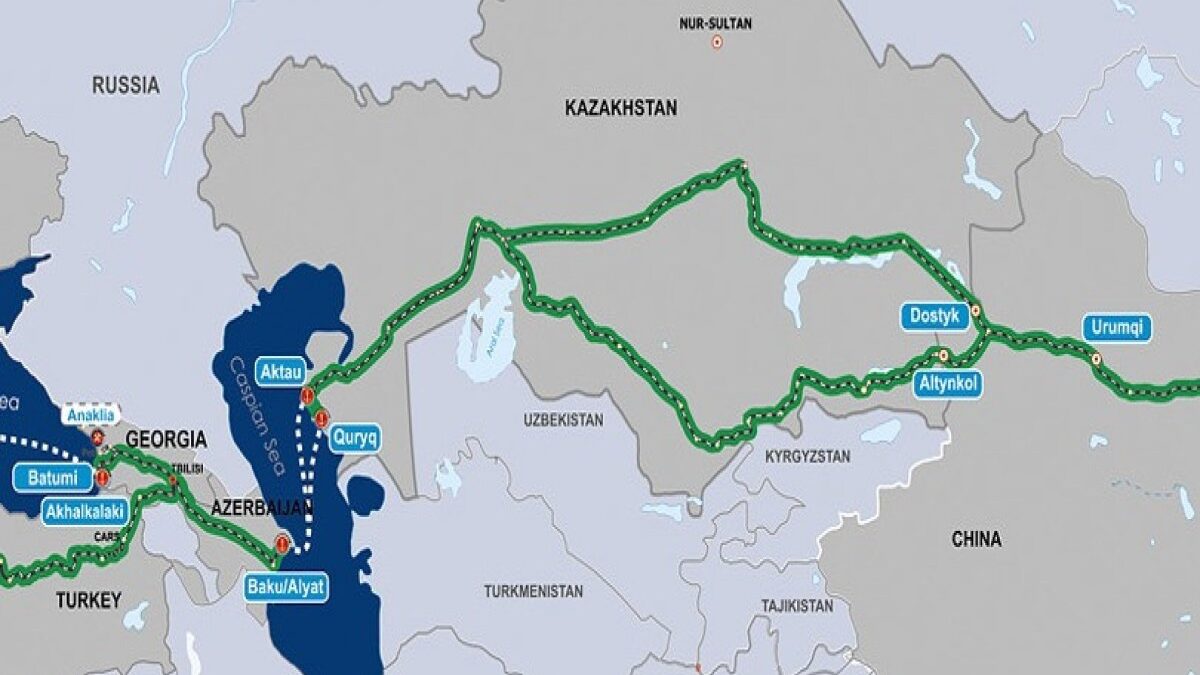
An article has been published in “The National Interest” regarding how an Iran war is leading to an increased role for the Middle Corridor.
According to a report by elchi, the article highlights as a key point that the outbreak of war between Iran, the US, and Israel in February 2026, followed by the crisis around the Strait of Hormuz, has elevated the role of the Middle Corridor from merely an alternative transport route to a necessity for the global economy.
Azerbaijan’s importance in this context is specifically emphasized, and it is presented as a crucial geopolitical hub of the Middle Corridor. This thesis is supported by facts. It is noted that Azerbaijan being one of the Caspian littoral states, and the transport of goods from China to Kazakhstan and then through Azerbaijan via the Caspian Sea to other regions, makes Azerbaijan’s role in this matter significant. In the author’s opinion, the Middle Corridor cannot function without a crossing over the Caspian Sea.
“After Iran imposed restrictions on the Strait of Hormuz, container transport via the Middle Corridor increased by up to 450-500% within a week compared to the same period last year. Cargo volumes are rising at the ports of Aktau and Baku,” the article emphasized.
Another important point mentioned is the Baku-Tbilisi-Kars railway. The article stresses that through this railway, Azerbaijan connects the Caucasus, Turkey, and Europe.
“The annual freight capacity of the Baku-Tbilisi-Kars railway has increased from 1 million tons to 4.5 million tons, and it is expected that this capacity will rise to 17 million tons by the mid-2030s. However, sufficient investment has not yet been raised for this,” the article noted.
It was also stated that increasing the potential of the Aktau port is essential, and for this, the port must be expanded.
“It is planned to increase the capacity of Baku’s Alat terminal from the current 150,000 containers to 260,000 containers,” the text stated.
Furthermore, it was noted that 80% of Kazakhstan’s oil exports are carried out through Russia’s Novorossiysk port, but recent Ukrainian drone attacks have made this route unreliable, making the Trans-Caspian route an important alternative for Kazakhstan.
In the opinion of the article’s author, the Middle Corridor also has “chokepoints” like the Strait of Hormuz, and Azerbaijan is one of them, as it provides the Caspian crossing and is a key element of the Baku-Tbilisi-Kars railway.
Other key passages are Georgia, due to its access to the Black Sea, and Turkey, due to the Bosphorus Strait and access to European markets.
From what is written in the publication, it can be concluded that the coordination between Baku and Ankara is very important for the Middle Corridor. This is because Turkey acts as a bridge between Western institutions and the Turkic world, while Azerbaijan is the main logistics hub of the corridor.
Additionally, trade and energy competition between the US, Russia, and China were mentioned, emphasizing that the US should support the Middle Corridor not only with statements but with practical steps and investments. Otherwise, it may lose in the competition with Russia and China.
The author of the article paid special attention to the need for serious investments by the US and Europe for the development of the main ports of the Middle Corridor, including those in Azerbaijan, and stated that the future development of the Middle Corridor will depend on the development of regional infrastructure and the volume of international investments directed toward this route.