
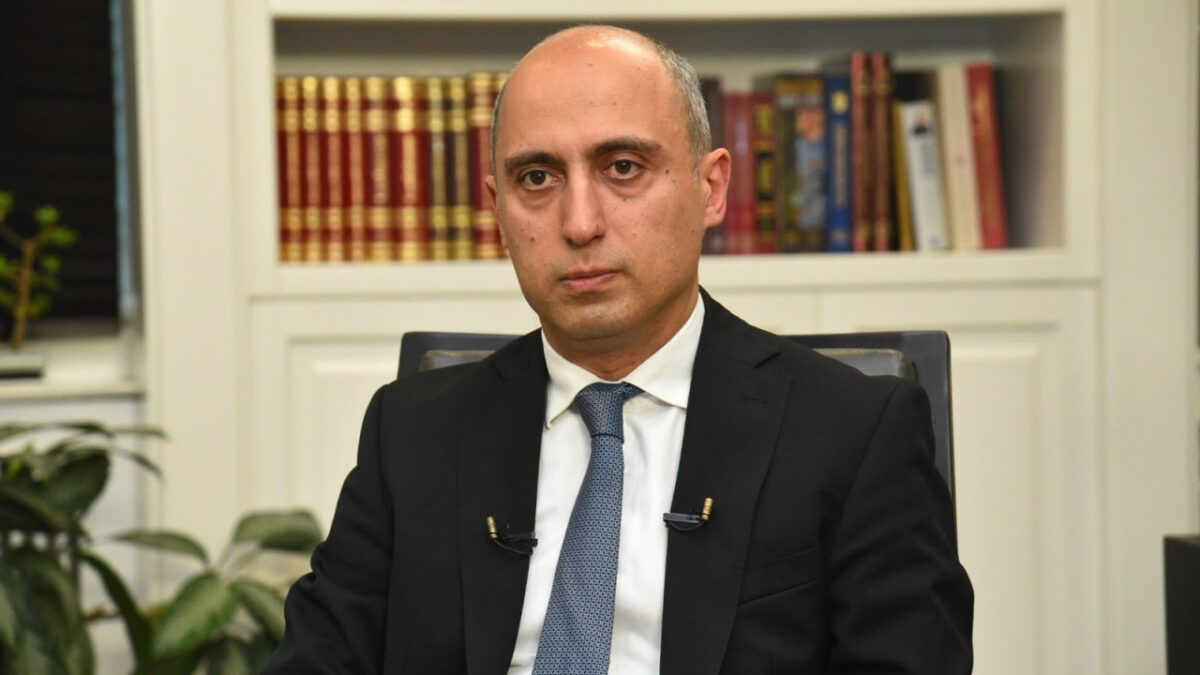
Minister of Science and Education Emin Amrullayev has clarified his views on tuition fees, which were misunderstood by the public during his recent interview.
Manset.az reports that the minister shared this statement on his Facebook social media account.
“In every interview, as the Ministry of Science and Education, we try to stimulate public discussion in the field of education by touching upon certain points, and as a government agency, we consider such discussions useful. We witness that after almost every interview, some of the expressed opinions are taken out of context and directed in the wrong direction, which in itself undermines the effectiveness of the discussion. Leaving aside whether this happens intentionally or out of ignorance, I will get to the point – that is, the re-interpretation of the opinions expressed about higher education costs in the last interview.
The point I made was that the tuition fee (read: education costs) per student in Azerbaijan is low compared to developed countries. Although low tuition fees are welcomed from a social point of view, they are a factor that affects the overall quality of education. That is, education, like other fields, requires investment, and one of the main factors affecting the quality of education is financing. Because in the higher education system, teachers’ salaries, material and technical base, research, and other issues depend on these costs. Some citizens who commented on these views claim that the opinions expressed do not reflect the truth, to put it mildly, by emphasizing that education is “free” in a number of countries. Some wrote comments, some condemned, and some made posters and tried to spread them to a wide audience. What is the truth of the matter?
First of all, there is no such thing as “free” education anywhere in the world. Education is always paid for. In countries like Austria, Germany, and France, which are cited as examples, the annual cost of higher education at the bachelor’s level is 10,000-18,000 euros (taking into account purchasing power parity). The 500-1000 euro amount paid by a student in Austria or France is a registration fee for 1 semester, not a tuition fee. In other words, tuition fees (or costs) are not low in these countries; this cost is covered by the state for a certain number of citizens. It is just that not all citizens want to have a higher education. Approximately 40-60% of graduates receive vocational education. You can check the link below for confirmation of what I have written and for more detailed information.
Source: https://www.oecd.org/…/how-is-tertiary-education...”
The Minister also explained the situation in the country:
“So how are these issues in our country? In Azerbaijan, a certain number of citizens (more than half of those admitted to the bachelor’s level each year, approximately more than 30,000 students) receive their education at the expense of the state, or in other words, study for free. This number is financed based on the state order. In other words, the state takes on the education of the necessary number of citizens by analyzing the future needs of the economy. Some specialties (e.g., medicine, agricultural specialties) are fully financed based on the state order because there is a serious need for these specialties. At the same time, in order to gradually achieve quality growth, funds equal to the amount of the state order for a number of specialties are added to the education cost every year within the framework of the SABAH program. Dual degree programs and programs taught in universities jointly with other countries also cost more compared to the state order. For information, I should note that in these types of programs, education costs are comparable to developed countries.
You may ask, why does paid education exist in Azerbaijan? This point is more related to the demand for higher education – almost everyone in the country wants to get a higher education, or the number of those who want to become lawyers is higher than the number of lawyers needed in the labor market. The state finances only the number of citizens it deems necessary. Let’s continue with the law specialty as an example: 600 students are financed each year based on the state order or study “for free”. However, in addition to the law specialty, 895 people are admitted on a paid basis. Although the scores obtained by these 895 people would allow them to study in other specialties on the basis of the state order (without paying), they choose the law specialty on a paid basis. That is, there are many applicants who prefer to study in their desired specialties at their own expense rather than free (state-funded) education.”
In his post, Emin Amrullayev emphasized that although the value of the state order is increased in stages, for many specialties, the funds paid by the citizen are lower than the state order:
“In other words, the annual tuition fee to become a computer engineer, financial specialist, or construction engineer in higher education institutions in Azerbaijan is 1500-2000 AZN. My argument is that it is impossible to prepare a high-quality specialist who can withstand global competition for this amount. That is, if the monthly salary of a high-quality IT specialist is 2,500-5,000 AZN, the graduate recovers the funds spent on their entire education (2,000 AZN x 4 years = 8,000 AZN) in 3-4 months. People with some understanding of finance would understand that such a level of profitability is not possible from any investment. In other words, the final result of education at a very low price can be a diploma at best.
What was the purpose of saying all this? The purpose is not at all to raise tuition fees in higher education institutions. The intention is to discuss this reality constructively. The reality is that the tuition fees (costs) of students studying within the framework of state orders, SABAH groups, dual degree programs, and university models together with other countries are covered by the state. The numbers needed for the economy are financed in this way. The state is increasing funding in this direction in stages. Since more people want to get a higher education, the opportunity to get a higher education on a paid basis is created for these individuals. Although low tuition fees for paid education may seem comfortable for that student in the short term, it does not result in anything useful for them or society in the long term.
As the Ministry of Science and Education, we are in favor of more Azerbaijani citizens receiving higher education. But along with numbers, one must also think about quality. Quality is related to quantity, finance, the overall quality of education, and other factors. We believe that in the long term, we can find a common balance of these factors in stages – this takes time. The message to the citizens is that in some cases, instead of getting a low-quality higher education diploma, they should also consider the option of getting a high-quality vocational education.”
The Minister of Science and Education emphasized that in these types of discussions, perhaps the easiest thing is to write baseless comments on social media:
“But comments and positions must be based on facts and sound arguments. Education policy is a fairly complex field, and decision-making always involves difficult choices. Understanding the registration fee paid by a student as an education cost and presenting it to the public as news is a wrong and very shallow position. Such a position does not move our citizens or our country forward. Our goal is development and progress.”
It should be noted that the Minister of Science and Education Emin Amrullayev gave a joint interview to Trend International News Agency, APA News Agency, and “Khazar TV” television channel. The opinions voiced by the minister regarding tuition fees in the interview caused discussions.