
The artificial intelligence company OpenAI has announced that its technology has successfully solved an 80-year-old mathematical problem, marking a new milestone in reasoning capabilities.
elchi reports that the company behind ChatGPT has announced a significant breakthrough in the “unit distance problem,” proposed by Hungarian mathematician Paul Erdős in 1946.
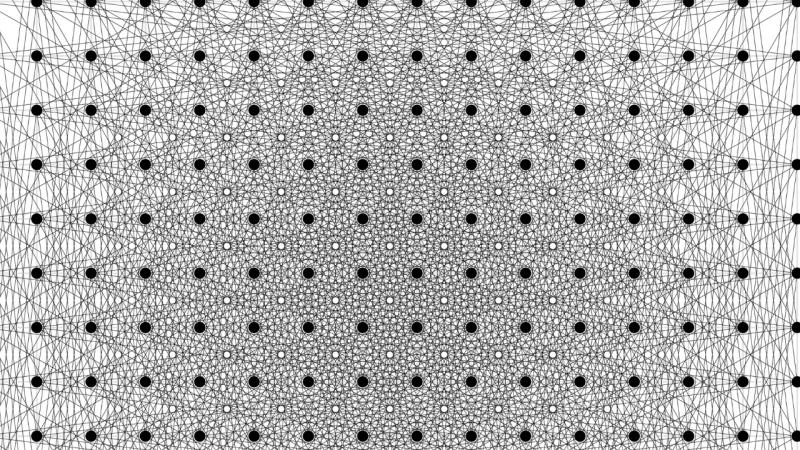
The question posed by Erdős is based on simple logic: when a certain number of points are placed on a piece of paper, how many pairs of points can be at exactly the same distance from each other?
Erdős suggested that the number of these pairs would grow only slightly faster than the number of points. However, the OpenAI model, using various branches of mathematics, discovered an entirely new family of arrangements that exceeds the limit in the Erdős conjecture, thereby refuting this theory.
The square grid conjecture was broken
OpenAI announced on the social media platform X:
“For nearly 80 years, mathematicians believed that the best possible solutions looked roughly like square grids. The OpenAI model refuted this belief and discovered an entirely new family of arrangements that works better.”
While this development has caused great excitement in the mathematical world, the general problem is not yet considered fully solved. Instead of finding a definitive and new answer to how quickly the number of point pairs grows, the artificial intelligence only proved that the upper bound proposed by Erdős was too low.
Şayəstə