
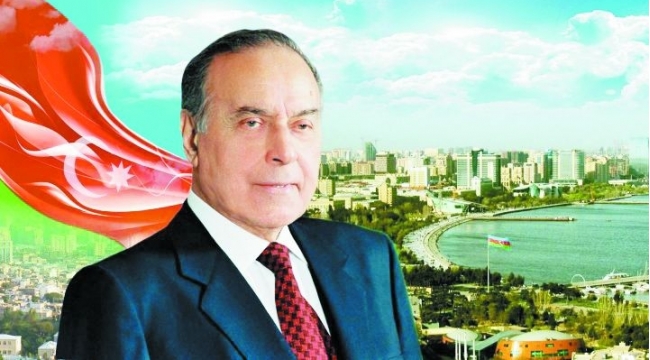
May 10 marks the 103rd anniversary of the birth of the National Leader Heydar Aliyev, the architect of modern independent Azerbaijan and the savior of our people. The rich and honorable life chronicle of Heydar Aliyev reflects a significant historical period of the political memory of the Azerbaijani state and its people, forming the basis of the philosophy of independence and the legacy of statehood.
Heydar Aliyev dedicated every moment of his life to the national destiny of Azerbaijan and worked tirelessly to ensure its unshakable development. Working in important state positions from a young age with incredible diligence and inexhaustible energy, Heydar Aliyev attracted attention with his innovative work style. Becoming a professional cadre with his deep knowledge, broad worldview, and innate talent, the great Leader’s years of service in the security agencies also went down in history as the most remarkable stage of his career.
The election of the National Leader as the leader of Azerbaijan in 1969 laid the foundation for a historical stage on the bright path to independence. His first period of leadership, along with economic and social development, also formed a new fundamental period in the awakening of national self-awareness and the establishment of Azerbaijan’s scientific-cultural and political relations with foreign countries. During those years, principled decisions aimed at protecting Azerbaijan’s national interests were made, the directions of international relations were determined, the solid foundations of diplomatic relations were laid, and useful cooperation was established with a number of countries.
In the 70s, sending Azerbaijani delegations to foreign countries, the participation of Azerbaijanis in cultural, artistic, and sports events, the display of works by well-known artists at international exhibitions, and other prestigious events were part of a well-thought-out foreign policy strategy. The Society for Friendship and Cultural Relations with Foreign Countries, which distinguished itself with its wide range of activities at that time, was a perfect model of cultural-humanitarian diplomacy, making deep contributions to Azerbaijan’s close contacts with influential organizations in foreign countries. In 1972, the Society sent more than 19,000 books, magazines, and albums to 62 countries of the world, which was a historical event that played an important role in conveying the truths of Azerbaijan to the world and in national-ideological propaganda. Likewise, the ideas of other humanitarian programs were actually based on foreign policy ideology.
Thanks to the successful continuation of that perfect political course, the visits of statesmen and government delegations from foreign countries to Azerbaijan increased in the 70s of the last century. These visits not only created a solid foundation for the establishment of foreign scientific-cultural relations within the framework of international cooperation but also made a deep contribution to the increase of Azerbaijan’s political influence in the world community. The visits of Azerbaijani delegations to foreign countries also had their positive benefits in establishing bilateral relations.
Even while working as the First Deputy Chairman of the Council of Ministers of the USSR, Heydar Aliyev carried out active work in developing Azerbaijan’s foreign economic-political relations with many countries and further expanding cultural diplomacy, building the architecture of independent Azerbaijan’s reliable foreign policy course.
Thanks to the high political influence and trust he gained during his time working in Moscow, well-known figures of foreign states sought to cooperate closely with Heydar Aliyev. Heydar Aliyev, called the “great Turk in the Kremlin,” was held in special respect by the leaders of world states. It was no coincidence that rumors were circulating about his candidacy for the supreme leadership of the USSR. All this reflected the National Leader’s giant political career in the system of international relations and his leadership charisma.
The solid foundations laid in those very years formed the future development and national ideological-political concept of the independent Azerbaijani state. Speaking about this, the National Leader noted that “Azerbaijan’s state sovereignty and economic independence, its systematically increasing foreign economic relations, and its gradual, deeper integration into the world economy are based on the potential whose foundation was laid in 1970–1985.”
Heydar Aliyev’s arrival in Nakhchivan, where he was born and raised, during the difficult and heavy period of Azerbaijan in the 90s, marked the beginning of a new era on the path to independence; at the same time, the pillars of relations with foreign countries were established, and political-economic and humanitarian connections were created with neighboring states.
On January 29, 1991, a protocol on cooperation between Azerbaijan and Turkey was signed in Nakhchivan, and the election of Heydar Aliyev as the Chairman of the Supreme Assembly of the Nakhchivan Autonomous Republic laid the foundation for a new stage in establishing relations with Turkey. The opening of a temporary bridge over the Araz River in October 1991, the signing of the Cooperation Protocol between the Republic of Turkey and the Nakhchivan Autonomous Republic in 1992, and the commissioning of the Sadarak-Dilucu bridge (Hope Bridge) on May 28 of that year brought Turkey-Nakhchivan and, in general, Azerbaijan relations to the highest level for that period.
In the complex socio-political and economic conditions that existed in the first years of leadership of independent Azerbaijan, the Heydar Aliyev factor played a decisive role in establishing relations with foreign countries. In his inauguration speech as President on October 10, 1993, he noted that our foreign policy consists of creating and developing equal, mutually beneficial relations with all states of the world, and our foreign policy is a peace-loving policy.
The signing of the “Contract of the Century,” the biggest economic event of that period, and the decision of foreign oil companies to make large-scale investments in the Caspian Sea were the result of deep trust, confidence, and the guarantee of the National Leader’s personality. Some foreign country companies and transnational corporations that were hesitant to work in Azerbaijan started their operations here by relying on their deep faith in Heydar Aliyev.
Based on his rich statehood experience, the National Leader determined the directions of Azerbaijan’s new rational foreign policy course in the 90s. The perfect energy diplomacy, which plays an important role in this policy, played an exceptional role in strengthening our country’s state independence, as well as ensuring its integration into the world community and strengthening its international position.
Using its favorable geographical position, natural resources, and geo-economic potential, Azerbaijan strengthened cooperation with numerous states and international organizations, and deepened its leadership in the region by creating the restoration of the Great Silk Road, and the Europe-Caucasus-Asia and North-South transport corridors.
Among the main goals of the National Leader in foreign policy were taking Azerbaijan out of international isolation, changing the negative public opinion created about our country, conveying the truths of Azerbaijan and its rightful voice to the world community, and ensuring our territorial integrity.
Achieving a ceasefire with Armenia in May 1994, the liquidation of illegal military formations, and the implementation of consistent measures to ensure solid stability ensured Azerbaijan’s political and economic resilience and opened a new stage in the construction of a regular and exemplary professional army.
One of the decisive steps taken towards the establishment and development of close relations with international and regional organizations was the signing of the framework document of the “Partnership for Peace” program on May 4, 1994. This created favorable conditions for cooperation between NATO military structures and the Armed Forces of Azerbaijan and contributed to the reconstruction of the army’s material-technical base at the level of NATO standards. The signing of the “Partnership and Cooperation Agreement between the European Union and its member states and the Republic of Azerbaijan” on April 22, 1996, became an important legal basis for expanding relations with European Union institutions and accelerating cooperation processes.
The National Leader also provided invaluable services in the development of Azerbaijan’s relations with the United Nations (UN), and by participating in the sessions of the UN General Assembly and other high-level events of the organization, he exposed Armenia’s policy of occupation and succeeded in increasing international efforts to eliminate the aggression. The adoption of the document defining the political-legal framework for the resolution of the conflict and defending Azerbaijan’s rightful position at the OSCE Summit held in Portugal on December 2–3, 1996, was remembered as a great political and diplomatic victory.
In total, during Heydar Aliyev’s leadership of the independent Republic of Azerbaijan, important issues related to ensuring Azerbaijan’s territorial integrity and bilateral and multilateral cooperation programs were discussed in more than 500 meetings with heads of state and government of about 80 countries, as well as at events of the UN, OSCE, Council of Europe, Organization of Islamic Cooperation, Economic Cooperation Organization, Summits of heads of state of Turkic-speaking countries, CIS, and other international and regional organizations.
The unique foreign policy course founded by the National Leader is being successfully continued by President Ilham Aliyev, and against the background of new challenges, it is becoming more dynamic, multifaceted, and based on national interests, ensuring the strengthening of Azerbaijan’s position in the world community.
The number one urgent task in Heydar Aliyev’s foreign policy strategy – the liberation of lands from Armenian occupation and the full restoration of Azerbaijan’s territorial integrity and sovereignty – was fulfilled with surgical precision by the Victorious Supreme Commander-in-Chief, President Ilham Aliyev.
Ramid Namazov
Milli Məclisin deputatı