
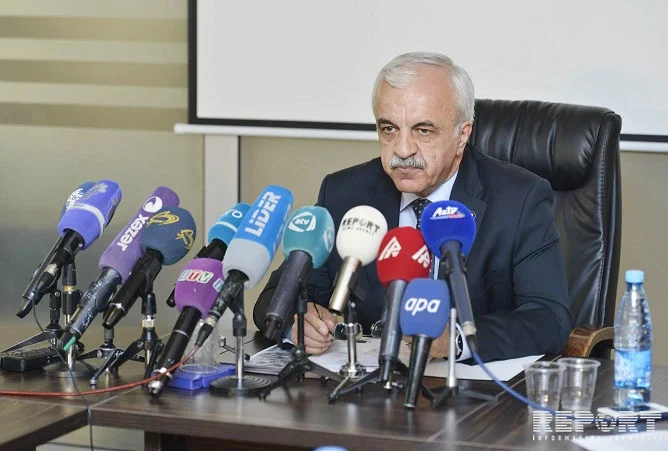
“At the end of March and the beginning of April this year, an exceptional natural phenomenon occurred in the northern region of the republic and the territories of the Absheron districts, with excessive rainfall falling across the country. In just 3 days, more than 50 percent of the annual statistical norm of rainfall was recorded on the Absheron Peninsula.”
elchi reports that Elkhan Asadov, a representative of the Ministry of Emergency Situations, stated this in a statement to journalists.
He noted that the floods caused various damages: “As soon as the incident occurred, on the instructions of President Ilham Aliyev, all structures of the Ministry of Emergency Situations, along with other agencies, switched to an enhanced work regime. Employees of the ministry and rescuers from other relevant agencies were immediately involved in the areas affected by the natural disaster.”
Elkhan Asadov stated that search and rescue operations were carried out in the initial stage: “In parallel with this, technical and engineering inspections of the areas were carried out by specialists from design institutes to determine the scale of the damage. In addition to the employees of the Ministry of Emergency Situations, representatives of the damaged infrastructure agencies and local executive authorities also participated in this process.
Within a short period, the results of the examinations were finalized and submitted to the relevant agencies. On April 28, by the relevant decree of President Ilham Aliyev, the implementation of important measures to eliminate the consequences of floods and inundations began. According to the decree, relevant financial funds were allocated to the Ministry of Emergency Situations and other state agencies.”
The MES representative noted that the allocated 85 million manats will mainly be directed to the construction of new individual residential houses for citizens whose homes were destroyed, the repair of 61 flooded houses, and the payment of rent to the victims: “In addition, the restoration of collapsed retaining walls and the reconstruction of other infrastructure are also planned. State agencies will spend the allocated funds both on strengthening the material and technical base and on eliminating the damage caused.
It should be noted that emergencies occur in all countries of the world. However, in many countries, compensation for damage is mainly carried out through insurance mechanisms. Insurance institutions are also developing in Azerbaijan, and the legislative framework in this area is being improved. In this regard, it is recommended that citizens and entrepreneurs insure their property in a timely manner. This allows for more prompt elimination of possible future damages.”
E. Asadov emphasized that in recent years, a large amount of state funds has been allocated by the country’s leadership to eliminate the consequences of natural disasters:
“Examples of this include the Kura floods in 2010, the earthquake in the northwestern region in 2012, as well as the earthquakes recorded in the Shamakhi, Ismayilli, and Agsu districts in 2019.
These steps are an indicator of the state’s humanitarian policy. Along with this, citizens acting responsibly and using insurance opportunities can contribute to reducing the overall burden.”