
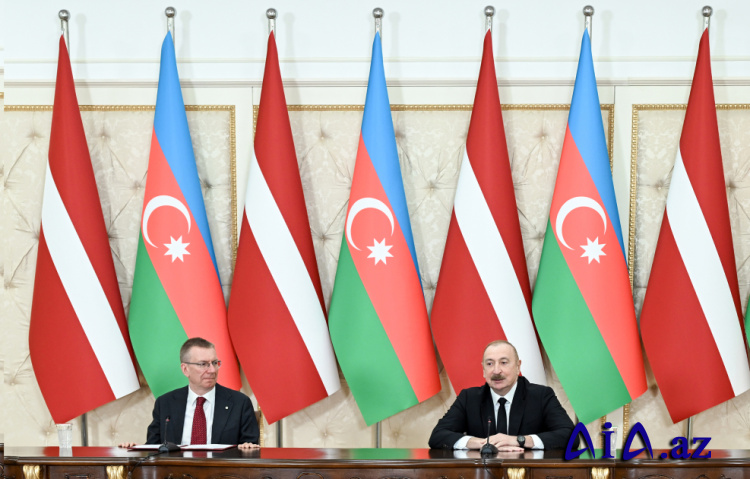
As friendly and close states, Azerbaijan and Latvia have long-standing, solid political, economic, and humanitarian historical ties. The existence of economic, scientific, and cultural relations between the parties as allied republics during the Soviet era played an important role in strengthening these contacts during the independence period. After gaining independence, both states developed their relations to a new level by establishing close diplomatic ties.
As a Baltic country, Latvia has played an important role in Azerbaijan’s relations with Europe, and the Embassy of the Republic of Azerbaijan was the first among the states of this region to begin operations in Riga. Latvia, which has always unequivocally supported Azerbaijan’s state interests, has also constantly declared its support for the resolution of the former Karabakh conflict within the framework of our country’s territorial integrity.
Having entered a new stage in the 2000s, Azerbaijan-Latvia relations were further developed by President Ilham Aliyev and elevated to the level of strategic partnership. The President’s official visit to the Republic of Latvia in 2017 opened a new chapter in bilateral relations, and the visits of the President and Prime Minister of Latvia to our country have reinforced the unshakable nature of these ties. Currently, political dialogue between the two countries continues through mutual visits at the highest level.
The official visit of the President of the Republic of Latvia, Edgars Rinkēvičs, to Azerbaijan and his meeting with President Ilham Aliyev on April 22 can be considered an opportunity for conducting good discussions on various issues against the backdrop of modern geopolitical and global economic challenges. As the President of Azerbaijan expressed at the expanded meeting, despite the processes taking place in various regions, very good political relations exist between Baku and Riga, and these relations were reaffirmed today. Likewise, as President Edgars Rinkēvičs noted, against the backdrop of political events in the Middle East and Europe and regional security issues, Latvia, which considers Azerbaijan a strategic partner and friend, intends to increase the real value of political and economic cooperation in practical terms under current circumstances.
In the statements of the heads of state to the press, it was noted that political, economic, investment, and regional cooperation issues have been identified as the main strategic target principles. In particular, Edgars Rinkēvičs’s visit is a significant event, creating new opportunities to strengthen bilateral relations and initiate cooperation in various fields.
Likewise, the demonstration of determination regarding the taking of principled steps against the backdrop of discussions on security issues in the South Caucasus and the Baltic region, regional development, and events happening around them, indicates the establishment of a multilateral development format. In this context, the prospective peace process between Azerbaijan and Armenia reflects a healthy and progressive vision of the security and prosperity environment in the region.
This normalization, while being an example of political will and wisdom, defines strategic views for the future and forms a broad cooperation architecture in the region. From this perspective, the factor of sustainable peace and high prosperity in the South Caucasus also promises fertile conditions and dividends for the joint integration prospects of the Baltic countries. As the President of Latvia noted, the peace process between Azerbaijan and Armenia is important not only for the security of the region but for the whole world in general.
Azerbaijan’s favorable geographical position, its important political and economic position connecting Europe and Asia, and its role as a corridor are also attractive to Latvia. At a time when global transport and logistics chains are disrupted, Azerbaijan, which has an important role in the Middle Corridor, and Latvia, considered one of the strategic logistics centers in the Baltic region, can unite more closely in the Baltic-Black Sea-Caspian connection.
It is no coincidence that President Rinkēvičs characterized Azerbaijan as a strategic asset for Latvia and the European Union in the Trans-Caspian transport corridor and energy routes. These cooperation formats open the door for Azerbaijan, a reliable and loyal state in the European Union’s energy and resource supply and communication connectivity, to diversify its energy exports.
In short, official Riga, understanding that Azerbaijan has special importance in regional issues and projects, is determined to reach the peak of strategic contacts by signing new political-economic framework agreements.
The “Joint Statement of the President of the Republic of Azerbaijan and the President of the Republic of Latvia” signed by the presidents can be considered an important legal-political document in terms of the relations between the states reaching the highest strategic level. Likewise, the “Memorandum of Understanding on cooperation in the consular field between the Ministry of Foreign Affairs of the Republic of Azerbaijan and the Ministry of Foreign Affairs of the Republic of Latvia,” the “Agreement on cooperation between the Ministry of Internal Affairs of the Republic of Azerbaijan and the Ministry of Internal Affairs of the Republic of Latvia,” the “Bilateral Cooperation Plan for 2026-2027 between the State Border Service of the Republic of Azerbaijan and the State Border Guard of the Republic of Latvia,” and the understanding documents on the agrarian sector and food security also create a strong basis for strengthening relations between our countries.
Very productive discussions were held at the meeting of the Intergovernmental Commission held in Shusha last week, and very successful results were achieved regarding increasing trade and mutual investments, and joint cooperation in energy, transport, defense industry, logistics, pharmaceuticals, digitalization, and other fields, which means new opportunities for the implementation of economic programs. Latvia’s rich forest resources are also of great importance in the modernization and reconstruction of Karabakh and East Zangezur, and in planting more forests.
The Azerbaijan-Latvia Business Forum held with the participation of the heads of state can be considered a manifestation of great potential in establishing business ties, finding opportunities for mutual investments, joint production, and a number of other activities.
Thus, President Edgars Rinkēvičs’s visit to Azerbaijan and the signed documents will go down in history as a new page in the development of relations between our countries.
Ramid Namazov
Milli Məclisin deputatı