
The major repair and reconstruction work at the dead-end of the “Hazi Aslanov” station of “Baku Metro” CJSC has been completed. The work done will allow for reducing train movement intervals in the future, operational dispatch of reserve trains, and the organization of six-car train movement on the “Red Line”.
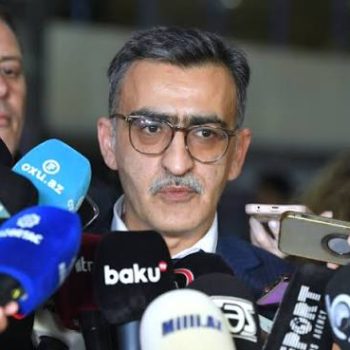
elchi reports that Bakhtiyar Mammadov, Head of the Press Service of “Baku Metro”, stated this in an interview with journalists.
He noted that the reconstruction work in the dead-end is an important innovation in terms of organizing train movement in the Baku Metro.
“First of all, I would like to note that after the presentation for media and public representatives is completed, voltage will be supplied to the area. Our passengers will be able to observe trains entering and exiting the dead-end throughout the day,” said B. Mammadov.
According to him, in the next stage, testing and adjustment work will be carried out across the entire infrastructure. This work is planned to be completed in the coming days. After that, based on the relevant announcement of the Baku Metro, train movement will be restored in the “Icherisheher” – “Hazi Aslanov” direction.
He stated that the commissioning of the reconstructed dead-end will create conditions for reducing train movement intervals, operational dispatch of reserve trains, and the quick removal of malfunctioning trains from the line.
“In case of a malfunction, it will be possible to remove the train from the line in a short time without making passengers wait and without causing other crisis situations. Also, minor repair work on trains is planned to be carried out in the area you see. All this will allow for raising the service level to a new stage,” emphasized B. Mammadov.
B. Mammadov noted that during the major repair work that began on November 30, 2024, trains operated in a shuttle mode between the “Hazi Aslanov” and “Ahmedli” stations. After the reconstruction work is completed and the relevant announcement is made, trains will move along the main line from the “Hazi Aslanov” station.
“On working days, during peak hours, train movement will be regulated with two-minute intervals. At other times, the intervals will not exceed two minutes and 30 seconds,” he added.
The head of the press service emphasized that one of the main features of the reconstructed dead-end infrastructure is that the railway tracks consist of four lines and have been extended by 20 meters compared to before. This change creates the basis for the future organization of six-car train movement on the “Red Line”.
According to him, along with the completion of work in the dead-end of the “Hazi Aslanov” station, a turning loop is also being built behind the “Icherisheher” station. This loop is also intended to have the capacity to accept six-car trains.
“Thus, the relevant infrastructure is being built at both the beginning and the end of the line. In the coming period, measures will be taken to adjust the train movement systems and adapt the station infrastructure to accept six-car trains. As a result, in the future, the “Red Line” of the Baku Metro will be able to accommodate six-car trains,” said B. Mammadov.
He recalled that when the Baku Metro started operating in 1967, three-car trains were in service. In the 1970s, the movement of four-car trains, and in the 1980s, five-car trains, was introduced.
“I am confident that this historical innovation will allow for ensuring a higher level of passenger comfort if the need arises,” he noted.
According to Bakhtiyar Mammadov, carrying out the major repair and reconstruction work at the dead-end of the “Hazi Aslanov” station based on a new construction approach will increase the durability and reliability of the infrastructure. This will create new opportunities for providing higher quality service to passengers.
He stated that the commissioning of the reconstructed dead-end will create conditions for reducing train movement intervals, operational dispatch of reserve trains, and the quick removal of malfunctioning trains from the line.
“In case of a malfunction, it will be possible to remove the train from the line in a short time without making passengers wait and without causing other crisis situations. Also, minor repair work on trains is planned to be carried out in the area you see. All this will allow for raising the service level to a new stage,” emphasized B. Mammadov.