
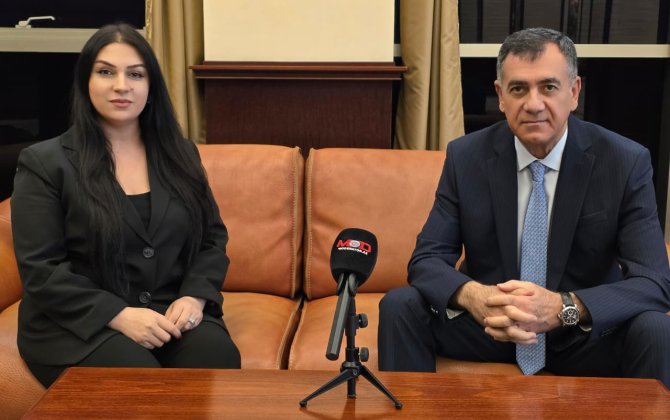
We present the next interview of Moderator.az‘s Pərvin Şakirqızı with the “Officials’ Position” column.
This time, we discussed the region’s political agenda with Qudrat Həsənquliyev, Deputy Chairman of the Milli Majlis Committee on Defense, Security, and Anti-Corruption, Chairman of the Justice, Law, Democracy (JLD) Party, and a Member of Parliament.
Our conversation focused on the current state of the Azerbaijan-Armenia peace process, the prospects for opening the Zangezur corridor, Armenia’s potential objectives in prolonging negotiations, and the changing geopolitical situation in the region.
At the same time, we learned the deputy’s position on the threats that could arise from Armenia’s armament, the impact of peace on Azerbaijan’s military spending and economic development, as well as opportunities for attracting foreign investment.
We present the interview:
— Mr. Qudrat, how do you assess Armenia’s position in the peace process? What do you attribute the delay in concrete steps towards signing a peace treaty and opening the Zangezur corridor to?
— Armenia is trying to buy time. This is unambiguous. I have said before that to sign a peace treaty with Armenia in a short period and achieve the opening of the Zangezur corridor, we must increase pressure on it. The statement on the trilateral ceasefire dated November 10, 2020, envisioned the opening of the Zangezur corridor and Russia’s control over it.
However, over time, we saw that Armenia is far from opening this corridor. Unfortunately, Russia did not exert serious pressure on Armenia in this regard.
In 2025, the United States strengthened its mediation mission, and at its initiative, a draft peace treaty was initialed in Washington. However, even after that, concrete work did not begin towards opening the Zangezur corridor, and the peace process was not advanced.
On the eve of the elections, to help Pashinyan, who was leading the peace process, secure victory, Azerbaijan opened a railway line to Armenia so that Kazakhstan and Russia could send their cargo to Armenia via Azerbaijan.
Azerbaijan began selling fuel to Armenia. This prevented the price of fuel, a strategic product, from rising there. In addition, strategic cargo such as fertilizer and grain were transported through Azerbaijan. In return, we saw that Armenia was playing a cunning game.
Although Armenia is a small country, the election results were not immediately announced, and the results were falsified. If the election results were falsified, Pashinyan could have secured a constitutional majority in parliament if he wanted to.
However, he did not do so purposefully. His objective was to later cite the possibility of the document not being adopted if the issue of a referendum was brought to parliament for discussion to change their Constitution for the peace treaty. Now he has started saying that if the decision on the referendum is not adopted by parliament, he will dissolve parliament and call new elections.
Thus, he is buying time, showing horns to the great powers interested in the region at one moment and bowing to them at another, extending his rule by maneuvering between them. But he does not think that one day this could have severe consequences.
Some revanchist forces in Armenia openly say that we occupied 20% of Azerbaijan’s lands, but Azerbaijan did not reconcile with the occupation, it waited for favorable international conditions to be created for itself. We should now prolong negotiations and create favorable conditions for ourselves.
They think that Azerbaijan, whose economy depends on oil, will run out of oil, and the country will face serious financial shortages, while we will become a stronger state over time through a free market economy and Western investment. They think they can become the Israel of the region. Then, with the support of their allies, they believe they will impose their terms on Azerbaijan.
Every time Azerbaijan increases pressure, Armenia begins to make hopeful statements about peace. As soon as the pressure decreases, everything is forgotten. I do not think that under the current conditions, Armenia will sign a peace treaty with us and begin the construction of the Zangezur corridor. Armenia also understands that neither Iran nor Russia is currently interested in the opening of that corridor.
Armenia is also waiting for the outcome of the Russia-Ukraine war and will determine its foreign policy course accordingly. If Russia emerges from the war as a weaker state, Armenia will unequivocally pursue a path of cooperation with the West and strive to strengthen its support.
If, however, Russia emerges stronger from the war and manages to force Ukraine into capitulation with the help of the United States, Armenia will pursue a completely pro-Russian policy and try to resolve the conflict again with Russia’s mediation.
Armenia will prolong this process as much as it can to sign a peace treaty with Azerbaijan on more favorable terms for itself. Armenia is not in a hurry in this matter. Azerbaijan must exert pressure. If pressure is not increased, a peace treaty will not be signed.
— And how important is the signing of a peace treaty for Azerbaijan from an economic point of view?
— It is necessary so that, first of all, we can reduce military spending. We should not keep the borders closed for security reasons and undertake major reforms. Currently, our defense spending is over 8 billion manats. If there is peace and regional states cooperate closely, we can reduce this amount at least twice. This is a very large sum.
For example, if we can save 4 billion manats, we can direct that amount to other sectors. When discussing the law “On Agriculture” in the Majlis, I also said that we invest approximately 563 million manats annually in agriculture. This is a very small figure.
Therefore, the import of food products is increasing year by year, and prices are also rising. The funds saved by reducing military spending can be directed towards the development of agriculture, ensuring the country’s food security, and the development of the processing industry.
In addition, as a result of the reforms to be carried out, foreign investors can also invest in our country and bring modern technology. However, as long as there is no peace in the country, it becomes difficult for foreign investors to come and invest. The President has also stated that peace is very fragile. In such a situation, it becomes more difficult for investors to make decisions.
— When we pay attention to Armenia’s armament, we observe that it is acquiring not only defensive but also offensive weapons.
What threats do you think this creates for the future?
In short, what does Armenia actually want: Peace, or to face the iron fist again?
— Armenia sees Azerbaijan’s economic development pace and highly values its development prospects. Billions of dollars are invested in Armenia, especially by the United States, where the Armenian diaspora is strong, and it is seriously supported and armed by nuclear states like India and France, and Iran.
Armenia closely monitors the processes in Azerbaijan and, at the same time, hopes that the West’s influence on Turkey will increase and that Turkey will not be able to provide the necessary support to Azerbaijan if the ceasefire is violated.
Since Armenia knows that Azerbaijan is very strong now, it tries to avoid confrontation by making statements that create hope for peace. To achieve peace, we must also work seriously with the countries of the region.
— Mr. Qudrat, thank you for your time and comprehensive answers.
— I thank you too.