
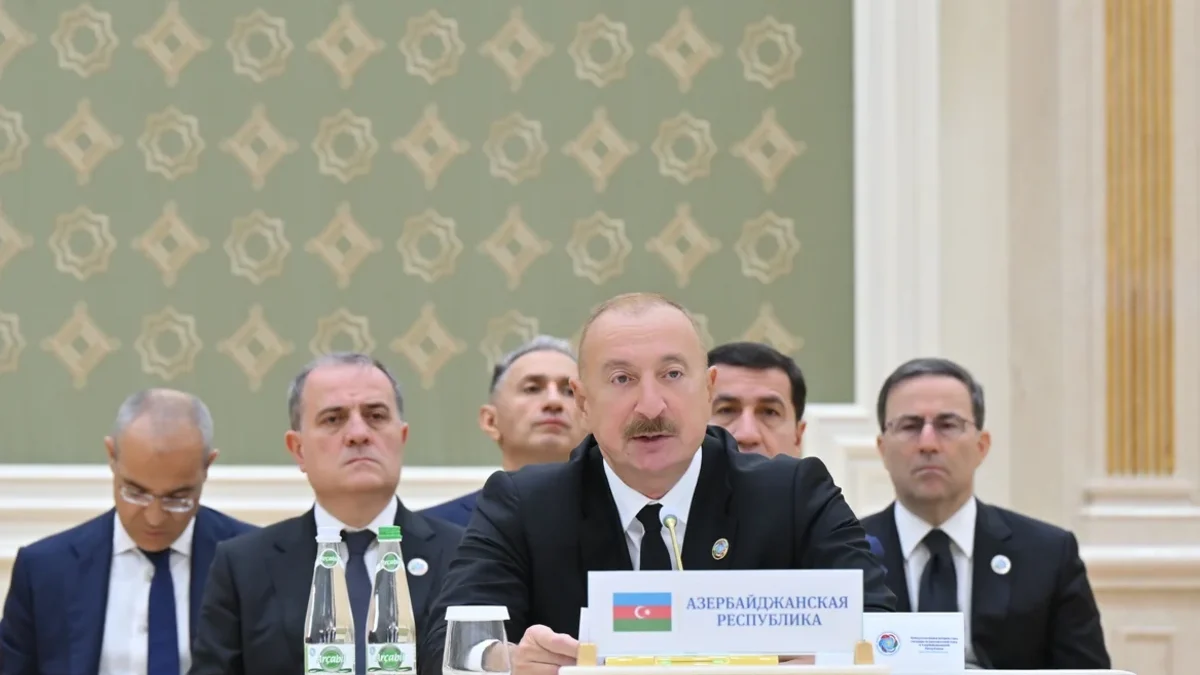
Azerbaijan, actively participating in multilateral cooperation formats, bases its relations with the Commonwealth of Independent States (CIS) on mutual respect and trust, and principles of equal partnership. Official Baku pursues a decisive policy within the organization that consistently ensures state interests, plays an active role in strengthening political dialogue and regional security, developing transport, energy, economic-trade, and humanitarian ties, and takes the initiative in forming the North-South international transport corridor.
Azerbaijan confirms its commitment to the principles of good neighborliness and mutually beneficial cooperation with all CIS states through its peace-loving and humanitarian policy. These and other factors clearly express our country’s position and influence within the CIS. Azerbaijan’s contributions to cooperation and its principled stance in ensuring peace and regional security are also noted at the summits of the CIS Council of Heads of State.
This plays an important role in strengthening mutual trust between the parties, advancing beneficial cooperation, discussing important strategic issues, and identifying new directions.
The important messages from our head of state at the limited and expanded meetings of the CIS Council of Heads of State held in Turkmenbashi on October 9 can be assessed as important and significant calls in the context of new geopolitical realities. As stated by the President of Azerbaijan, in recent years, the CIS has proven itself as a necessary platform for conducting political dialogue, developing mutually beneficial cooperation, and strengthening relations between our countries.
Azerbaijan has consistently supported these processes and earned the deep respect and trust of the CIS. The declaration of the city of Lachin as the cultural capital of the Commonwealth, as well as the decision to successfully hold the Third CIS Games in Azerbaijan, are a worthy expression of this respect, and have also become a landmark event for the entire Commonwealth. Such large-scale initiatives serve as an example of humanitarian cooperation and act as a strong bridge of friendship between peoples.
The trust placed in Azerbaijan to co-chair the CIS in 2027 and to chair it in 2028 is a manifestation of our country’s growing political weight within the organization and the high respect it has earned among partner states. Our state is ready to undertake this responsibility and host the next meeting of the CIS Council of Heads of State.
Azerbaijan also plays an active role in strengthening economic solidarity within the CIS, consolidating its positions as one of the region’s main transport hubs, and ensuring reliable transit along the North-South and East-West international corridors by consistently modernizing transport corridors, port, and railway infrastructure.
These continuous measures increase our country’s transit and economic potential. The volume of transit transportation through Azerbaijan in the first half of 2026 increased by 10 percent, reaching approximately 8 million tons. In the medium term, the goal is to increase the volume of cargo transportation through Azerbaijan along the East-West and North-South routes to 15 million tons in each direction.
The meeting of the Caspian Ecological Summit in an expanded format, another important event held in Turkmenistan, can be assessed as a new stage of five-sided cooperation. It is of strategic importance for increasing the potential of the five coastal states in joint integration as the Caspian Sea of solidarity, including ensuring its ecological, economic, and social future. Azerbaijan, a proponent of five-sided international legal documents, better understands and values the historical significance of the Convention on the Legal Status of the Caspian Sea, signed in 2018.
The increasing economic and strategic importance of the Caspian Sea in recent years, and the realization of important transport and energy routes and large international projects, expand the sea’s potential capabilities. The intensification of connections across the Caspian, including the Middle Corridor, ports, and logistics infrastructure, also raises the issue of the sustainability of transport routes in the future. In this context, a closer link is being established between the ecological and economic security of the Caspian.
In such circumstances, protecting the Caspian Sea as a space of peace, stability, and constructive partnership, and preventing the impacts of climate change, is becoming increasingly relevant as a fundamental issue.
The summit’s agenda once again confirmed the importance of this topic. As noted, all factors affecting the decrease in the Caspian Sea level and anthropogenic impacts must be thoroughly assessed. A flexible mechanism should be created from the general discussion of the problem to cooperation and monitoring the implementation of decisions. The application of such an approach can minimize the impact of further sea-level decline.
As evident from the views of other speakers at the summit, it is crucial to preserve the Caspian Sea as a space of peace, stability, and constructive partnership. This serves the interests of all Caspian littoral states and creates the necessary conditions for further development of cooperation. As President Ilham Aliyev recalled, protecting the unique ecosystem of the sea is a common duty of all Caspian littoral states.
Ramid Namazov
Member of Milli Majlis