
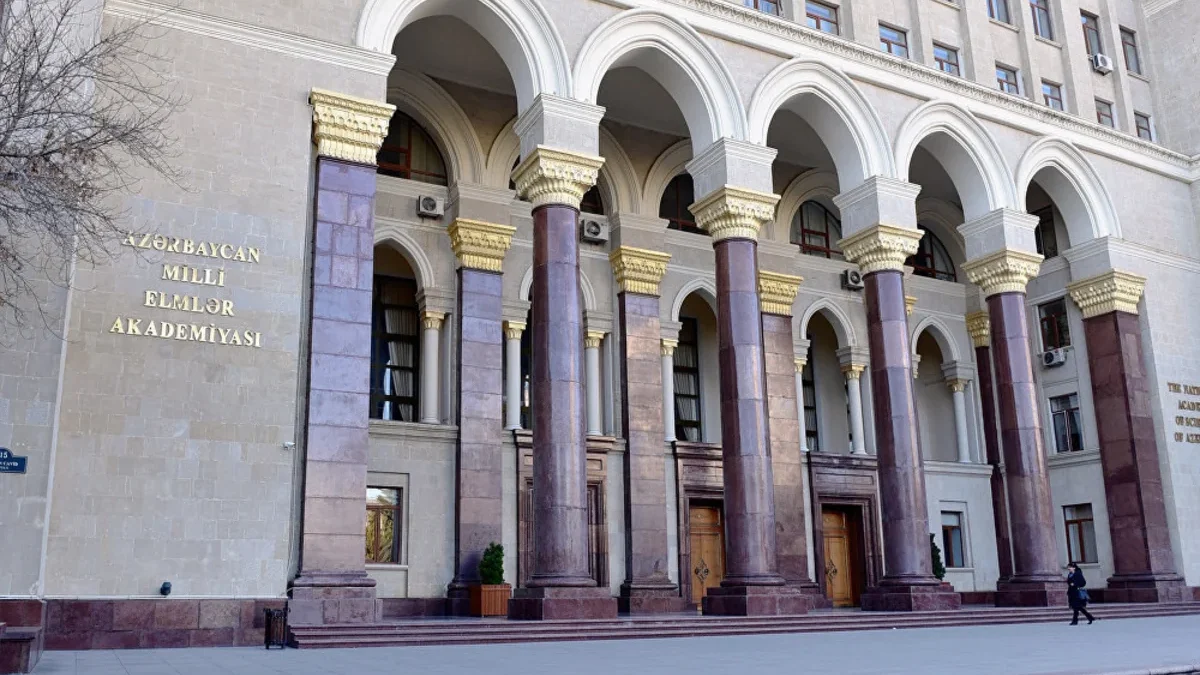
Employees of the Azerbaijan National Academy of Sciences have issued a statement regarding the scandal created in Armenia concerning the Gandzasar Monastery.
elchi presents the statement:
“In recent days, the artificially created and purposeful uproar in Armenia around the monuments of Caucasian Albania located in the Karabakh territory of Azerbaijan, especially the Gandzasar Monastery, consists of an attempt to create cheap and meaningless sensations that have no connection with historical scientific realities.
In fact, the Gandzasar monastery complex and its important component, the Gandzasar Monastery, is a historical monument belonging to Caucasian Albania, which has no connection with Armenian history. The fact that this monument belongs to Albania and its indigenous population, the Albanians, has long been proven by undeniable historical and archaeological facts. One of the most important facts confirming this is that the Gandzasar Monastery was built in the historical geographical territory of Caucasian Albania, which has no relation to Armenians. That territory was one of the main provinces of the Caucasian Albanian state and followed a path of historical development within it. After the collapse of the Arab Caliphate, the rule of the Albanian Kingdom was partially restored here. In the 12th-13th centuries, the Albanian-Khachen principality rose in this area. The ruler of this principality was Hasan Jalal (1215-1261), one of the prominent statesmen of Azerbaijan. Hasan Jalal and his wife belonged to the famous Albanian dynasty of the Mihranids by origin. Hasan Jalal, who held the title of Tsar or absolute ruler, was referred to in the sources of the time by titles such as ‘prince of princes’, ‘prince of the land of Khachen’, ‘Tsar of Albania’, etc.
During the time of Hasan Jalal, economic, political, and cultural progress took place in these historical lands of Azerbaijan, and his era is characterized as the Albanian Renaissance. The Gandzasar Monastery was also built as a magnificent example of this renaissance.
In the Gandzasar Monastery, the equilateral cross sign belonging to the Albanians was used. The equilateral cross sign served as the seal of the Albanians. The monastery was built with local construction materials of the region.
Furthermore, the epigraphic inscriptions on most of the monuments in the Karabakh territory and in the Gandzasar Monastery consist of texts belonging to the Albanians. These epigraphic inscriptions are the stone tablets of the Gandzasar Monastery. The book published in Petrograd in 1919 about the epigraphic texts of the Gandzasar Monastery, which was purposefully destroyed by Armenians at that time, also confirmed that these monuments belong to the Albanians. The frescoes (wall paintings) on the monastery also visually prove once again that this monument belongs to the Albanian heritage.
Armenians carried out purposeful measures towards the Armenization of the Gandzasar Monastery during the Soviet government period and later during the occupation process. Thus, the Albanian epigraphic monuments of the monastery were destroyed or dismantled and taken to Armenia and replaced with distorted Armenian texts. At the same time, the equilateral Albanian cross on the Gandzasar Monastery was turned into a Gregorian cross sign with a different shape. The graves belonging to Albanian catholicoses inside the monastery were also interfered with, and the original structure of the graves was changed. Also, during the occupation, Armenians damaged the original appearance of the monument by using construction materials brought from Armenia under the guise of restoration at the Gandzasar Monastery.
While the scientific and historical realities regarding the monuments of Caucasian Albania, including the Gandzasar Monastery, are as such, the fact that the distortions made by Armenians were observed during the visit of diplomats operating in Azerbaijan to the liberated territories causing dissatisfaction in Armenia is nothing more than covering up the truth.
We believe that the scandal raised by the Armenian side around the Gandzasar Monastery has no scientific-historical basis and currently aims to strike a blow at the peace agenda put forward by the Azerbaijani state. This act of provocation is a continuation of the policy of claiming Azerbaijan’s national-moral values and culinary samples and artificially appropriating our monuments, which has been carried out in Armenia for many years. This shows that the forces in Armenia that have not abandoned the delusion of a fictitious ‘Greater Armenia’ are currently intending to disrupt the steps being taken towards realities in their own country.
Azerbaijani scientists firmly condemn the campaign purposefully incited in Armenia around the Gandzasar Monastery and call on the Armenian side to approach scientific truths objectively, rather than artificial and false propaganda.
İsa Həbibbəyli, AMEA -nın prezidenti, akademik
Gövhər Baxşəliyeva, AMEA-nın vitse-prezidenti, akademik
İsmayıl Hacıyev, AMEA-nın Naxçıvan Bölməsinin sədri, akademik
Teymur Kərimli, AMEA-nın Məhəmməd Füzuli adına Əlyazmalar İnstitutunun direktoru, akademik
Nərgiz Axundova, akademik
Ərtegin Salamzadə, AMEA-nın Memarlıq və İncəsənət İnstitutunun direktoru, AMEA-nın müxbir üzvü
Hacıfəxrəddin Səfərli, AMEA-nın müxbir üzvü
Könül Bünyadzadə, AMEA-nın müxbir üzvü
Vəli Baxşəliyev, AMEA-nın müxbir üzvü
Cəfər Qiyasi, AMEA-nın müxbir üzvü
Kərim Şükürov, AMEA-nın Abbasqulu Ağa Bakıxanov adına Tarix və Etnologiya İnstitutunun direktoru, tarix elmləri doktoru, professor
İlham Məmmədzadə, AMEA-nın Fəlsəfə və Sosiologiya İnstitutunun direktoru, fəlsəfə elmləri doktoru, professor
Fərhad Quliyev, AMEA-nın Arxeologiya və Antropologiya İnstitutunun direktoru, tarix üzrə fəlsəfə doktoru, dosent
Kübra Əliyeva, sənətşünaslıq doktoru, professor
Qafar Cəbiyev, tarix elmləri doktoru, professor
Əliağa Məmmədli, antropologiya elmləri doktoru, professor
Allahverdi Əlimirzəyev, tarix elmləri doktoru, dosent
Ramil Ağayev, tarix elmləri doktoru, dosent
Rahibə Əliyeva, memarlıq doktoru
Natiq Alışov, tarix üzrə fəlsəfə doktoru, dosent
Təvəkkül Əliyev, tarix üzrə fəlsəfə doktoru, dosent
Taleh Əliyev, tarix üzrə fəlsəfə doktoru, dosent
Telman İbrahimov, sənətşünaslıq üzrə fəlsəfə doktoru, dosent
Ellada Bəkirova, tarix üzrə fəlsəfə doktoru, dosent
Vaqif Əsədov, tarix üzrə fəlsəfə doktoru, dosent
Ülviyyə Hacıyeva, tarix üzrə fəlsəfə doktoru
Gülanə Əliyeva, tarix üzrə fəlsəfə doktoru”.