
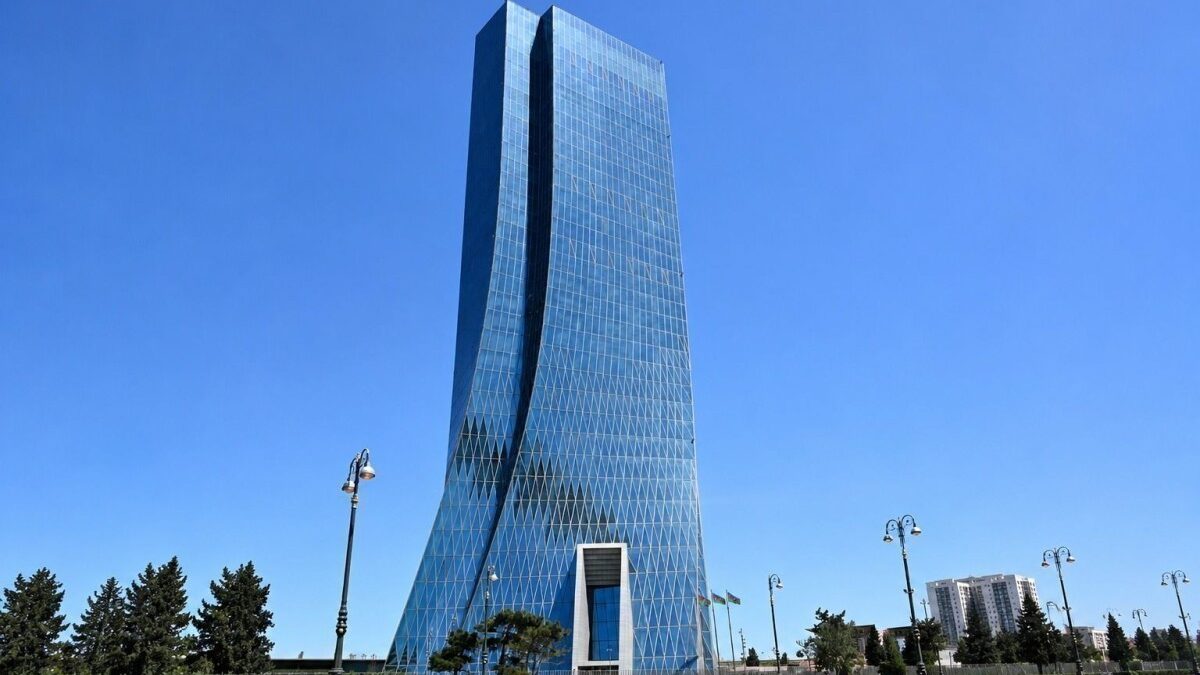
The Central Bank of Azerbaijan (CBA) has announced its decision regarding the discount rate once again today.
“Elchi” reports that, by the decision of the Central Bank’s Board, all parameters of the interest rate corridor have been kept unchanged. When making the decision on the interest rate corridor parameters, the dynamics of actual and projected inflation, as well as processes in the domestic financial market, were taken into account. While the upward revision of the inflation forecast necessitates a tightening of monetary policy, the fact that supply significantly exceeds demand in the foreign exchange market supports a loose monetary policy. The balancing of these factors necessitates keeping the interest rate corridor parameters unchanged.
Annual inflation is within the target range and is moving in accordance with the forecast trajectory under the baseline scenario. In June 2026, 12-month inflation was 5.8%. Annual price growth was 7.1% for food products, alcoholic beverages, and tobacco products, 5.6% for paid services, and 3.8% for non-food products. Annual core inflation was 5.5%.
During the past period of the current year, supply has significantly exceeded demand in the foreign exchange market. This has been evident in both cash and non-cash segments. In the first 6 months of 2026, the purchase of cash foreign currency by exchange offices from customers exceeded sales by 482 million US dollars. The dollarization level of deposits of resident individuals has decreased by 3.8 percentage points over the last 12 months, falling to 25.6% in June 2026.
In an environment where demand in the foreign exchange market has sharply decreased and supply has significantly increased, the Central Bank has carried out purchase-oriented interventions. During the past period of the current year, the Central Bank’s foreign exchange reserves increased by 2.2 billion US dollars, or 19.5%, reaching 13.8 billion US dollars.
External sector indicators remain favorable. According to customs statistics, a positive balance of nearly 8 billion US dollars was recorded in the country’s foreign trade in the first half of 2026. According to preliminary data, the balance of remittances (the difference between inflows and outflows) in January-June amounted to 540.6 million US dollars, an increase of 82.8% compared to the same period last year. The Central Bank’s forecast for the current account surplus for the end of 2026 and 2027 has been revised upwards. This is due to the rise in global energy prices in the current year, as well as the continuation of positive trends in the export of non-oil-gas commodities and services.
Monetary policy tools are applied taking into account processes in financial markets and liquidity indicators in the banking system. Short-term interest rates in the unsecured money market are formed within the framework of the Central Bank’s interest rate corridor. Thus, the average daily indicator for the AZIR rate was 6.43% in May and June 2026, and 6.39% in the past period of July. Excluding funds that must be kept as mandatory reserves, the sector’s structural liquidity surplus (the difference between the Central Bank’s liabilities to the banking system and its claims on banks) reached 6 billion manats by the end of the first half of the current year, an increase of 2.1 times compared to December of last year. This indicates that banks have a sufficiently high lending potential. To manage liquidity, the Central Bank mainly uses 7-day deposit operations. The share of these operations in the structure of the sterilization portfolio for open market operations accounted for 84.3% at the end of June. In addition, regular auctions for the placement of Central Bank notes are held. Over the last 3 months, a decrease has been recorded in the yield of notes across all maturities, as well as in the medium-term and long-term parts of the yield curve. At the same time, a decrease in interest rates on newly attracted manat-denominated term deposits and savings was observed in June of the current year compared to July of last year (the month when the discount rate was reduced).
The Central Bank forecasts that annual inflation will remain within the target range in the medium term. According to July forecasts under the baseline scenario, annual inflation is expected to be 6.1% at the end of 2026, 6% after 12 months (i.e., in June 2027), and 5.8% at the end of 2027. Thus, annual inflation is expected to return to the target from the second half of 2027. It should be noted that the deviation of the expected inflation from the target at the end of 2026 is at the level of forecast error. The upward revision of the inflation forecast mainly stems from the activation of the effects of direct and indirect external cost factors, which do not have a permanent character in the medium term.
In a complex global geopolitical environment, the risk of rising energy and food prices and the resulting expansion of imported inflation from trading partner countries remains high. The transmission of inflation from partners to domestic prices will also depend on the strengthening dynamics of the nominal effective exchange rate of the manat. In the next period, the probability of changes in the Central Bank’s inflation forecasts mainly depends on the scale of the realization of these risks. The probability of domestic demand factors creating inflationary pressures against the backdrop of current fiscal and monetary policy is not high.
Decisions regarding the interest rate corridor for the remainder of the current year will also be made taking into account the inflation forecast and the dynamics of macroeconomic indicators. Considering the uncertainties in the global environment, forecasts of macroeconomic indicators will be reviewed under several scenarios. When making decisions regarding the parameters of the interest rate corridor, processes in the foreign exchange market and the dynamics of liquidity in the banking sector will also be taken into account. In particular, the sustainability of strengthening pressures on the manat exchange rate and the scale of foreign currency surplus will also be kept in focus.
Recall that in its last decision, on June 24, the CBA kept the discount rate stable. The discount rate was kept unchanged at 6.5%, the lower limit of the interest rate corridor at 5.5%, and the upper limit of the interest rate corridor at 7.5%.