
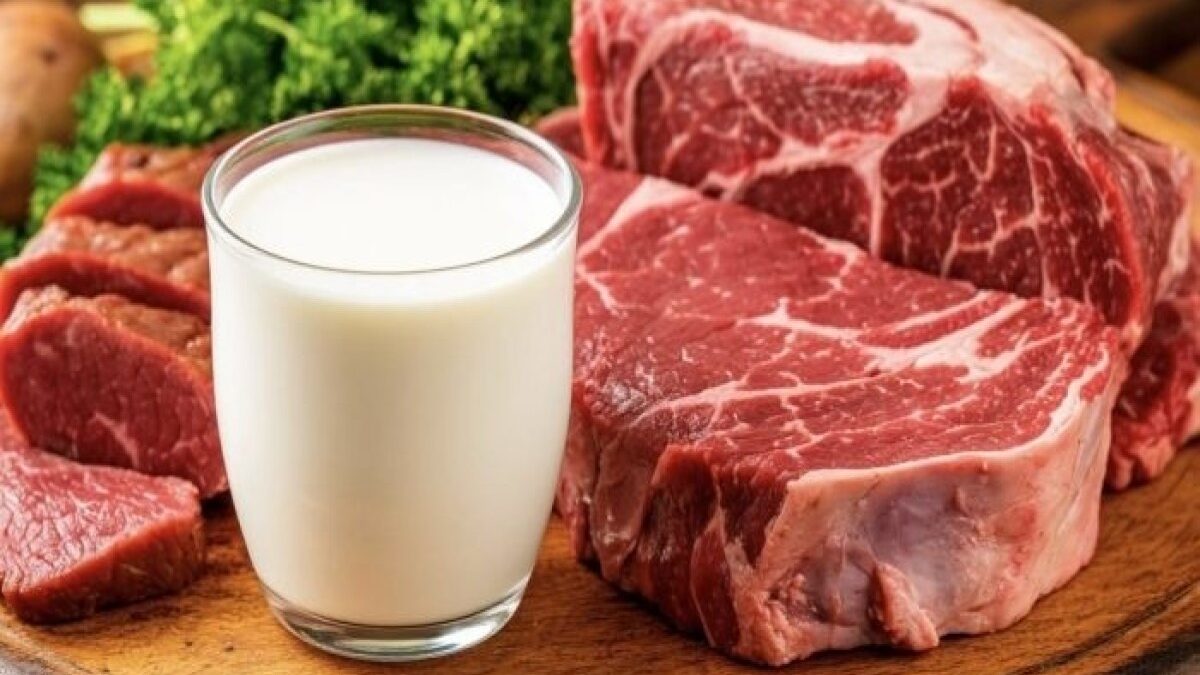
Livestock farming is one of the main directions of the State Program. In particular, increasing milk and beef production in the cattle breeding sector, increasing the share of purebred animals in the herd, reducing dependence on imports, and increasing the level of self-sufficiency have been identified as key targets.
This was stated by Deputy Minister of Agriculture Ilhama Gadimova at a regional meeting for the Gazakh-Tovuz economic region held in Shamkir regarding the discussion of the “State Program for the Development of Production and Processing of Agricultural, Fishery, and Aquaculture Products in the Republic of Azerbaijan for 2026–2030”.
She noted that by 2030, it is targeted to increase milk production by 10 percent and beef production by 20 percent. It is planned to bring the share of purebred animals in the herd to 10 percent. The goal is to reduce milk imports by 49.6 percent and beef imports by 40.2 percent. An increase in the level of self-sufficiency by 8.5 percent for milk and 11.5 percent for beef is also envisaged:
“To achieve these goals, it is planned to create dairy and meat clusters, form nearly 1,000 new farms of various capacities within the clusters, and support the provision of these farms with purebred breeding animals.
In addition, the creation of 90 milk collection and 15 leather collection points will be supported. This serves not only to establish production in livestock farming but also to build the supply, processing, and sales chain.
The identification of all cattle is also an important measure. Animal identification is essential for disease control, organization of breeding work, monitoring productivity, and transparent application of subsidies.
Improving the provision of feed production with machinery and technologies is also one of the main conditions in this field. Productivity in livestock farming does not depend solely on the breed of the animal. If the feed base is weak, it is impossible to obtain high productivity even from the best breed of animal. Therefore, fodder production, water supply, veterinary services, and farm management must develop together.
In this area, the application of breeding animal subsidies and livestock product subsidies is envisaged. These supports will encourage farmers to switch to more productive animals, increase milk and meat production, and transition their farms to a more intensive model.”.
Ilhama Gadimova also added that by 2030, it is planned to increase mutton production by 9 percent, increase the number of animals by 10 percent, reach an export volume of 2.9 thousand tons, and increase the level of self-sufficiency by 7 percent:
“In this direction, the creation of 300 new semi-intensive sheep farms is planned. This means a transition from traditional sheep farming to a more productive and manageable model.
At the same time, the creation of 10 wool collection points and 1 wool processing enterprise is envisaged. This is very important in terms of forming added value in sheep farming. We must ensure that not only meat production but also wool, leather, and other by-products are involved in economic circulation.
Improving the provision of feed production with machinery and technologies is also a key issue for sheep farming. Furthermore, the promotion of the restoration of 480 thousand hectares of grazing and pasture land is planned. Pasture restoration is necessary for the sustainability of livestock farming. If pasture areas degrade, animal productivity decreases, feed costs increase, and farm profitability drops.
To improve drinking water supply for animals, supporting the drilling of 100 sub-artesian wells is also planned. This is an important support, especially for the summer-winter pasture system, semi-intensive farms, and areas with water shortages.
The creation of an agropark to attract foreign investment in the field of sheep farming is also envisaged. This can contribute to the development of the sector with modern management, technology, and market opportunities.
For the successful implementation of this State Program, serious tasks fall upon all parties. Entrepreneurs and the private sector must also be more active in this process. Investment opportunities are vast in silos, cold storage warehouses, processing enterprises, milk collection points, wool collection and processing infrastructure, intensive horticulture, and livestock farms. State support mechanisms create favorable conditions for the realization of these investments.
Ultimately, the State Program for 2026–2030 is the beginning of a qualitatively new stage in the agricultural sector. The main essence of this program is that we must increase productivity not by using more land, but by using the existing land more efficiently.
The region’s land, water, human capital, and production traditions create great potential. The main issue is to turn this potential into real results through proper organization, state support, farmer responsibility, and private sector investment.
The importance of our joint activities in the mentioned directions is high, and as the Ministry of Agriculture, our meetings with the parties, information exchange, and measures to solve problems will continue.”