
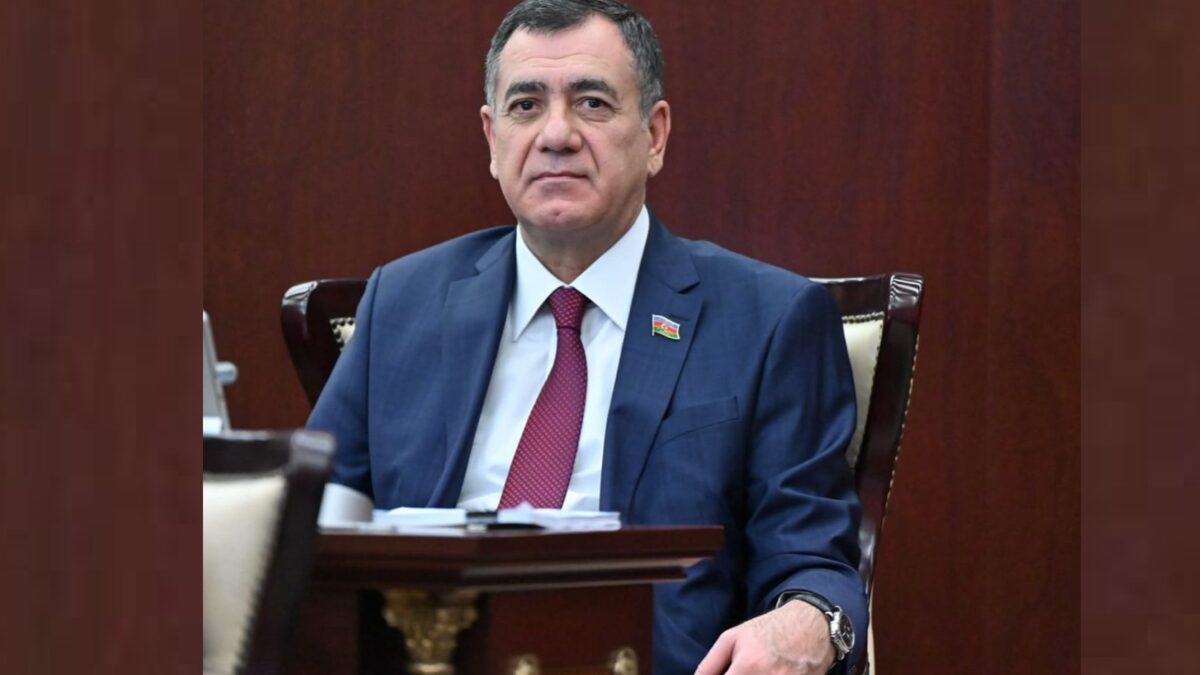
The chairman of the Justice, Law, Democracy (AHD) Party and member of parliament, Gudrat Hasanguliyev, has answered questions from the party’s press service.
“Elchi” presents the interview:
– Gudrat bey, 33 years ago, on June 4, 1993, a military mutiny took place in Ganja. How do you remember that period after so many years?
– To ensure that such an event never repeats in our country, that period must be investigated seriously and objectively. I recommend that young people read the novella “The Deceived Stars” (Aldanmış kəvakib), written by the great thinker and writer Mirza Fatali Akhundzade in the mid-19th century, to get at least a partial idea of that time. The leader of the National Liberation Movement, Abulfaz Elchibey, was the Yusif Sarraj of the mutiny period. Mirza Fatali presented Yusif Sarraj as a fair, patriotic, simple, and pure-intentioned person who was not power-hungry, had a reformist character, and suffered a tragic fate. Through that character, he shows that an honest person emerging from the people cannot remain in power for long in a corrupt governance system. Because a humiliated and intimidated people, accustomed to oppression and injustice, could not accept or support the humanitarian system of governance created by Yusif Sarraj, who instructed provincial governors to treat the people fairly. The socio-psychological basis for the mutiny should be sought here. Of course, we had also just gained independence, the international situation was extremely unfavorable for us, the era was complex, and Elchibey and his team lacked management experience. Ignorance also played its part. Those who were supposed to protect the government had disappeared due to external influences and the advice of fortune-tellers. Because of the Armenian factor, the West and the major powers of the region were not interested in Azerbaijan becoming a civilized state (as it would have developed rapidly) or in the strengthening of its independence. They are still not interested today. Therefore, each of them participated in the overthrow of the national government in an active or passive form as best they could. The USA, not wanting us to liberate our lands from occupation, imposed sanctions on us, while the European Union, Russia, and Iran openly defended Armenia. Brotherly Turkey, which was dependent on the West at the time, considered its job done by issuing a statement after the occupation of each district. It did not even give us two civilian helicopters, and to make matters worse, it even sent grain to the occupying state. Therefore, at that time, Elchibey’s government, which said “we are Turks,” could not survive. The most severe consequence of Elchibey’s departure from power was that democratic values were completely discredited, and the faith the people had somewhat gained during the Karabakh movement was shaken. It was as if they had not prevented Elchibey from coming to power for this reason. The consolation was that Elchibey took a wise step and stepped down from power without showing serious resistance, inviting the great statesman Heydar Aliyev to power. By returning to his native village and saying “I am the legitimate president,” Elchibey significantly reduced the external pressure on Heydar Aliyev. He, in turn, was able to reach an agreement with the great powers, skillfully neutralized the mutineers, separatists, and foreign-controlled armed groups by depriving them of foreign support, and despite great pressures and tempting offers, did not reconcile with the loss of our territories and protected Azerbaijani statehood. Even today, he managed to sign the “Contract of the Century,” which we live by and through which we liberated our lands from occupation, and made the great powers interested in stability in Azerbaijan. May God have mercy on both of them!
– Gudrat bey, how do you perceive the criticism of deputies?
– There can be no development in a society without criticism. But criticism must be well-founded and fair. One can discuss the lack of criticism in parliament, but to say that not a single person in the Milli Majlis speaks about the people’s problems is, to put it mildly, a very biased and unfair attitude. There is no problem concerning the public that is not raised in that parliament. Deputies may have successful and unsuccessful speeches. If you have the ability, it takes many years of experience to become a good parliamentarian. Young deputies have more right to make mistakes. In this case, one can criticize those who make unsuccessful speeches or whose performance is weak. Unfortunately, some resort to insults according to their own level. Criticism should not cross ethical boundaries. There is both criticism and a tolerant attitude towards it in the Milli Majlis. At different times, we see even representatives of the ruling party making serious critical speeches regarding the government. Sometimes some of your colleagues respond to your critical speeches within the framework of ethics, and this is very normal. It would be better if the sessions of the Milli Majlis were broadcast on television, as in all civilized countries, and every voter could follow the activities of the deputies.
Within the framework of reforms to be carried out in the direction of state-building, we must adopt a new Constitution and Election Code and switch to a proportional election system. For there to be opposition factions in parliament, at least 3 parties should be represented in the Milli Majlis regardless of the votes they receive, the number of opposition parties in parliament should not be less than one-third of the total number of deputies, and this should be enshrined in legislation.
– Is there a possibility of adopting a new Constitution in the country?
– This is necessary. According to the Constitution, executive power in the regions is exercised by the heads of executive authorities. But in some districts and regions, this work is carried out by the President’s authorized representatives. This is clearly visible during the President’s visits to Karabakh. At least for this reason, and also if we are to exchange territories with Armenia, this must be approved by a referendum, and there is a serious need for this. If constitutional reforms are to be carried out, the creation of regional local executive bodies formed through elections should be envisaged, and the powers of the parliament should also be significantly increased. It would be better to switch to a parliamentary republic model. Our state was also founded as a parliamentary republic in 1918.