
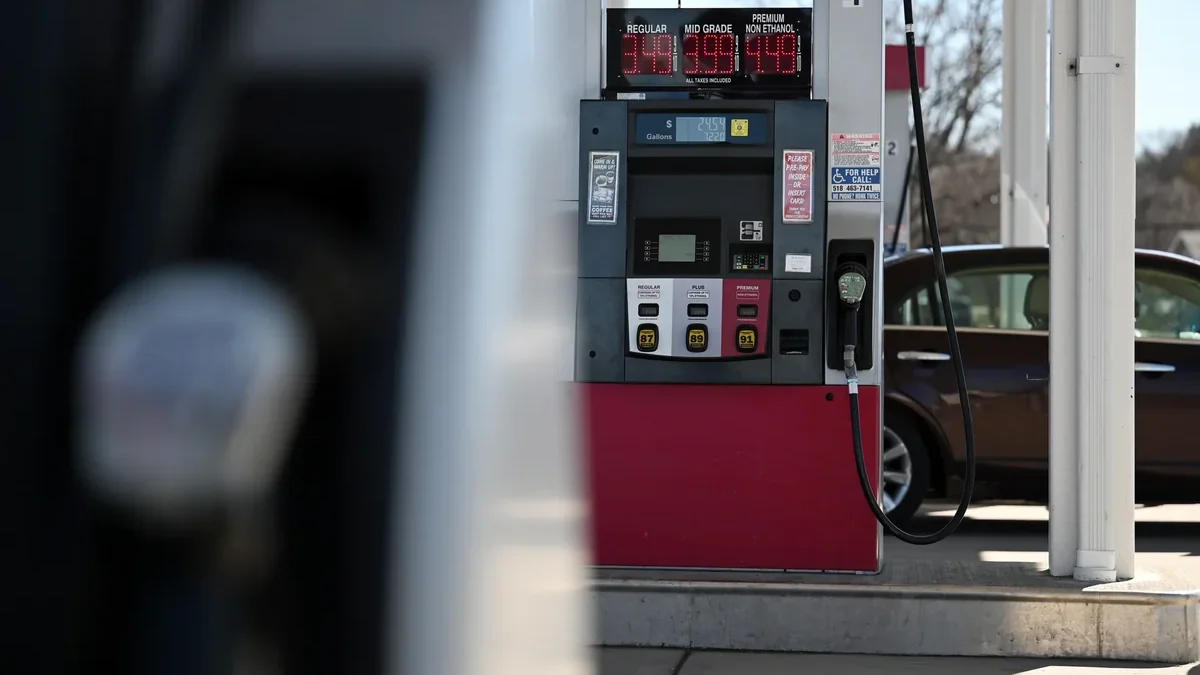
Against the backdrop of rising fuel prices and growing tension in the global oil market, the White House administration has almost exhausted available mechanisms to curb gasoline prices without causing serious political and economic consequences.
“Elchi” reports that “The Washington Post” (WP) newspaper provided this information, citing the results of sociological studies and analysts.
The publication noted that as a result of navigation restrictions in the Strait of Hormuz, the average price of gasoline in the US increased by more than 30 cents in just one week, rising to $4.39 per gallon (approximately 3.8 liters – ed.).
The rise in fuel prices is forcing American consumers to reduce their spending: according to a joint poll by “The Washington Post,” “ABC News,” and “Ipsos,” 44% of US residents admitted that they have started using personal transport less, 42% have reduced their daily expenses, and 34% have reconsidered their travel and vacation plans.
According to the publication’s sources, US President Donald Trump organized a meeting with representatives of the energy sector, attended by the Treasury Secretary, the White House Chief of Staff, and the Vice President, during which possible action scenarios were considered in case the crisis in the oil market drags on.
WP emphasized that the administration has already implemented a number of measures, including the release of strategic oil reserves, the temporary relaxation of some environmental standards, the partial suspension of sanctions against Russian oil, and the temporary lifting of requirements for the maritime transport of fuel.
“However, the opportunities for future maneuvers are extremely limited. Among the options being considered are the abolition of the federal fuel tax and the imposition of restrictions on the export of American oil, but both measures are assessed as having negligible impact against the backdrop of significant risks,” the material stated.
White House representatives claimed that the current price fluctuations are temporary and conditioned by the situation in the region. At the same time, according to analysts’ assessments, a solution to the main problem is possible only if agreements are reached that guarantee uninterrupted shipping through the Strait of Hormuz.
It should be recalled that the US and Israel launched military operations against Iran on February 28. As a result, Iran’s Supreme Leader Ali Khamenei and a number of high-ranking officials were killed. Following this, Iran began striking targets it identified in Saudi Arabia, Qatar, the United Arab Emirates, Oman, Bahrain, Iraq, and Cyprus, where military bases of the US and its allies are located, in addition to Israel.
Iran, the US, and their allies agreed on a two-week ceasefire on the night of April 8, 2026. On April 11-12, negotiations were held between Iran and the US in Islamabad with the mediation of Pakistan. The hours-long talks ended without results due to differences in the parties’ positions.
Media wrote that the next round of negotiations between Iran and the US was supposed to be held in Islamabad on April 27, and the White House had confirmed this. US President’s special envoy Steve Witkoff and the head of state’s son-in-law Jared Kushner were supposed to fly to Islamabad on Saturday, but shortly before that, Trump announced that he had canceled his representatives’ trip to Pakistan.
The situation around the Strait of Hormuz, the blockade of which has caused an energy crisis in the world, remains uncertain; both sides announce its opening at different intervals, but in fact, shipping in the region has been suspended.
To exert pressure on Tehran, the US has blockaded Iranian ports and passage through the Strait of Hormuz. Iran, in turn, has declared a blockade of the Strait of Hormuz for ships heading to the Persian Gulf. The dynamically changing situation in the region has caused a global energy crisis.