
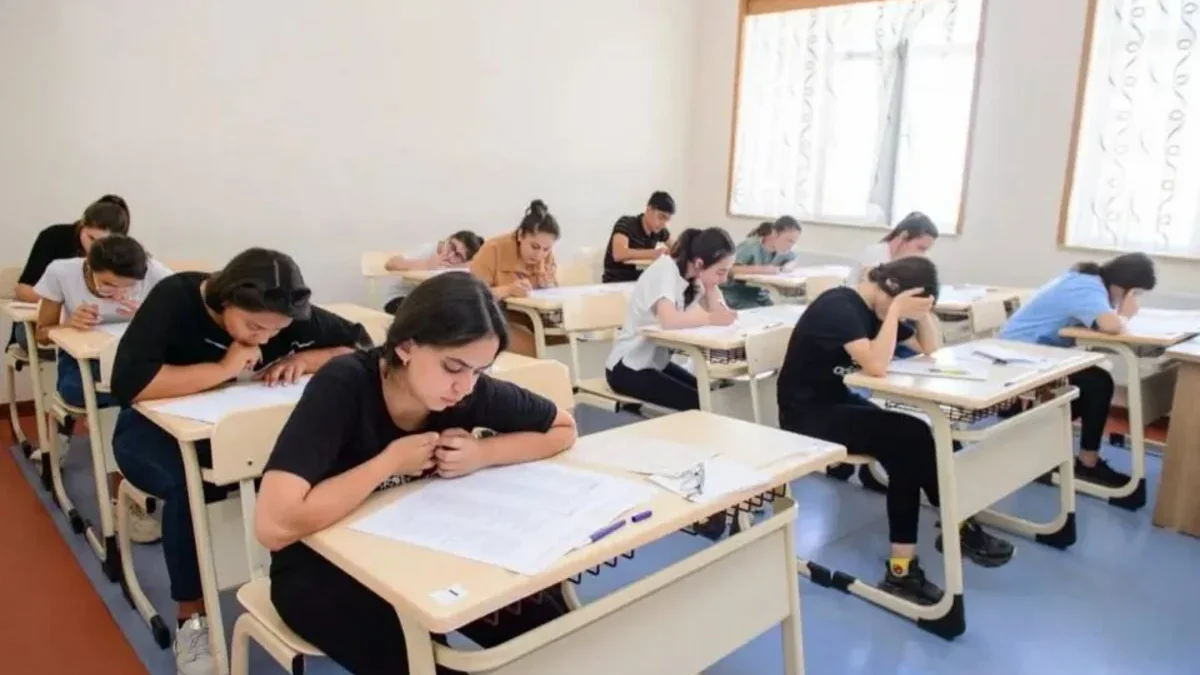
Today, the State Examination Center (SEC) will conduct an Azerbaijani language (state language) exam as part of the graduation exams for 9th and 11th-grade students of general education institutions where instruction is conducted in languages other than Azerbaijani.
Information about this was provided to elchi by the SEC.
It was stated that on the same day, an Azerbaijani language (state language) exam will also be held for graduates of previous years who are taking the entrance exam for higher and secondary specialized education institutions in a language other than Azerbaijani.
The exam will be organized in 129 buildings across 21 cities and regions in total.
The exam starts at the same time in all buildings – at 10:00 AM. The admission regime ends at 09:45 AM, 15 minutes before the start of the exam. Participants arriving after this time will not be admitted to the exam building. It is necessary to arrive at the exam building at the time indicated on the admission ticket.
9th and 11th-grade students of the current year can print their “Exam Admission Ticket” here, and graduates of previous years can print theirs here.
Participants must bring the following documents to the exam:
– exam admission ticket;
– original identity document.
a) Citizens of the Republic of Azerbaijan (including students under 16 years of age) must bring their ID card;
b) Foreigners and stateless persons must bring their residence permits issued by the State Migration Service, and foreign citizens who have received refugee status and their family members must bring their refugee cards;
– Persons without a photo on their ID card must bring, along with other documents, a certificate issued by the educational institution with a photo attached (a 3×4 cm photo of the student is attached to the certificate and stamped).
Participants are presented with 30 tasks in the exam:
- 1 text for listening comprehension and 4 tasks related to the text (3 closed-ended and 1 open-ended task requiring a written response);
- 10 closed-ended tasks to test knowledge and skills in language rules;
- 2 texts for reading comprehension and 8 tasks related to each text (7 closed-ended and 1 open-ended task requiring a written response).
The duration of the exam is 1 hour and 30 minutes.
The maximum score that current year exam participants can achieve is 100 points. The result of this exam will be recorded in the student’s final attestation document.
To be admitted to higher or secondary specialized education institutions, applicants are considered to have received a “pass” grade if their score is 50 or higher.
Graduates of previous years who take the entrance exam for higher and secondary specialized education institutions in a language other than Azerbaijani can score 30 points in the exam. For an applicant to receive a “pass”, their score must be at least 15.
In total, 29,182 students (applicants) are expected to participate in the exam (20,580 in Baku, 1,156 in Sumgayit, 1,189 in Absheron, 76 in Nakhchivan, 1,721 in Ganja, 91 in Shamkir, 212 in Tovuz, 211 in Mingachevir, 84 in Yevlakh, 175 in Shaki, 350 in Zagatala, 231 in Balakan, 191 in Gabala, 188 in Qakh, 235 in Barda, 232 in Goychay, 360 in Shirvan, 362 in Lankaran, 274 in Guba, 597 in Gusar, 667 in Khachmaz).
For the administration of the exam, 129 general exam supervisors, 339 exam supervisors, 2,709 invigilators, 399 admission regime staff (security), and 129 building representatives have been assigned.
55 students with limited health capacities (visually impaired, cerebral palsy, hearing impaired, and others) will also participate in the exam. Special halls have been allocated in exam buildings for their comfort, and individual invigilators have been appointed for persons determined to have visual impairment due to 81-100 percent impairment of body functions. Conditions have also been created for the entry and movement of students with mobility impairments into the building and hall. In addition, special training has been conducted for invigilators assigned to participants with limited health capacities.