
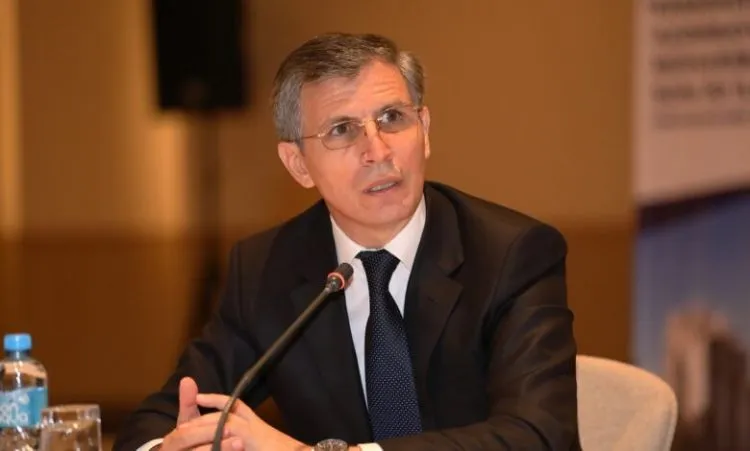
“Recently, while the European Parliament has been expressing its position on Azerbaijani conflicts and the Karabakh issue, we clearly see how those who repeatedly defended Ukraine’s territorial integrity justify the occupation of our lands. Euro-bureaucrats, who in the 90s claimed that only the Armenian population was facing a humanitarian crisis, masked the political roots of the conflict, supported separatism, and tried to legitimize the occupation and recognize the Karabakh regime using phrases like ‘the right to self-determination,’ ‘frozen conflict,’ and ‘status quo’.”
elchi reports that these thoughts were expressed by MP Zahid Oruj at the plenary session of the Milli Majlis.
According to him, after our victory in the Patriotic War in 2020, the European Parliament turned into a tribune for defeated states and increased the intensity of its attacks against our country with the topic of “protecting Christian heritage,” which even the Yerevan government did not bring up:
“Under the guise of historical works, the revanchist desires of former occupiers are presented in a different form. It is not surprising that they demonstrate a political position in this direction. With its decision yesterday, the European Parliament has taken an approach as if acquitting those convicted in Nuremberg, but this should not be considered unusual for us. The use of the term ‘Nagorno-Karabakh’ in yesterday’s document is proof of how the occupiers are fed through financial and political support not only in Karabakh but also in other regions within Armenia. The Armenian government still uses these expressions and terms like ‘Lachin-Baku road.’ The issue of strengthening Armenia’s internal democratic forces and protecting them from foreign interference and pressure from Moscow is also being highlighted.
If this was truly the goal and the allocated funds and aid were meant to be used in this direction, it is clear that such documents expose Armenia to foreign information attacks, deal a blow to peace in the region, and cause Pashinyan to be faced with a choice and disrupt the normalization process with Azerbaijan. This shows that the document does not serve Armenia’s interests and poses a threat to Azerbaijan’s role in the peace process. Of course, the possibility that some of those participating in these processes are under the influence of other states must also be taken into account. The activities of these Euro-bureaucrats and corrupt circles are aimed at continuing the enmity between the two peoples and ensuring their own interests. As the Karabakh issue leaves the agenda, the heirs of former imperial spheres of influence feel uneasy. The decrease in leverage over energy resources also increases this anxiety. After the Shusha Declaration and the future peace treaty are signed, and diplomatic, political, and trade relations between the two countries are restored, the position of these forces will remain as a negative page in history.
Those trying to bring the Karabakh issue back to the agenda do not take into account the Azerbaijanis living in Shusha and Khankendi. Pashinyan’s main problem is not the separatist groups shown internally, but rather the centers of pressure formed abroad. The representatives of 22 states who participated in the meeting held in Paris on April 11-12 and those who voted for the declaration yesterday are noteworthy in this context. For the first time in 35 years, traveling to Yerevan freely and conducting the delimitation process in safe conditions was an important step towards peace. At such a moment, the revenge intent of the forces opposing peace is clearly visible. So what should be our parliament’s response? We must declare that Yerevan and Baku should take the same position against the forces opposing the peace process. Armenia must officially declare that the infrastructure built to legitimize the occupation over the last 30 years, including the issue of protecting religious and national values, should not become a subject of foreign interference. The Azerbaijani state, on the other hand, must define the terms of peace and present them to the international community so that the identity of the forces wanting to bring war to the region is clearly visible. Honorable Chairman, it is requested that a special commission regarding the European Parliament be formed for the preparation of this statement and that the document be adopted as our next official response. Just as we voted on the decision adopted on April 14 last year, an adequate response must be given to this document.” (redaktor.az)