
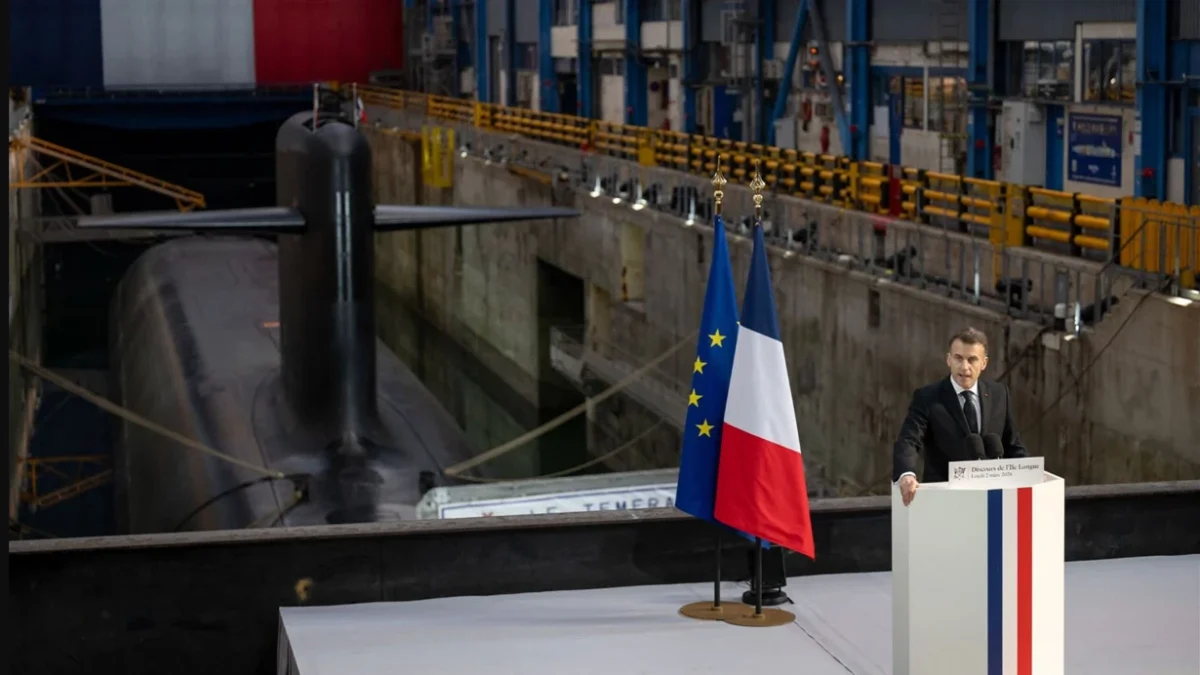
The “forward deterrence” plan presented by French President Emmanuel Macron lays the foundation for a new nuclear security architecture in Europe that reduces dependence on the US. Within the framework of this initiative, which includes 10 countries, including the United Kingdom, “Rafale” fighter jets capable of carrying nuclear weapons can be temporarily deployed in allied countries. The plan also envisages joint military exercises, the development of early warning systems for missiles, the sharing of intelligence, and the strengthening of long-range strike capabilities.
The “forward deterrence” initiative, announced by France on March 2, 2026, is planned to be expanded in October through new military and diplomatic arrangements. According to French President Macron’s statement, Paris will integrate its nuclear capabilities more broadly into European defense planning. Germany, Belgium, Denmark, Finland, Greece, Norway, the Netherlands, Poland, and Sweden have responded positively to this initiative; at the same time, work is underway on a separate nuclear coordination mechanism with the United Kingdom. The first meeting of the Nuclear Steering Group was held in Paris on October 14 between France and the Netherlands. Officials from the defense and foreign ministries of both countries, as well as government representatives, participated in the meeting.
Deployment of “Rafale” aircraft
According to the plan announced by the French Ministry of Defense, “Rafale” fighters can temporarily use airbases in allied countries for nuclear deterrence exercises, strategic power projection, or during crisis situations. These deployments are not permanent; the plan also does not envisage the permanent storage of French nuclear warheads on foreign soil. A report by the French Senate (document No. 950, dated September 16) notes that the nature of these joint activities will vary from country to country, and some operational details will be kept confidential. One of the main conditions of the plan is that the authority to decide on the use of nuclear weapons rests solely with the French President. Allied countries cannot demand automatic nuclear intervention from France; nor will Paris share with anyone the authority to determine which attacks constitute a threat to its vital national interests.
Satellites, missile shields, and intelligence networks
Macron’s plan specifically includes three military capabilities: early detection of missile attacks, airspace protection, and long-range retaliatory strikes. The “JEWEL” program, developed by France and Germany, aims to detect missile launches through satellites and radars. The “SAMP/T NG” air defense system will be used to strengthen Europe’s defense against ballistic missiles, aircraft, and other aerial threats. At the same time, the “ELSA” initiative, involving France, Germany, and the United Kingdom, envisages the development of very long-range missile systems. In addition, participating countries will establish joint threat assessments, secure communication channels, intelligence sharing protocols, and crisis management mechanisms.