
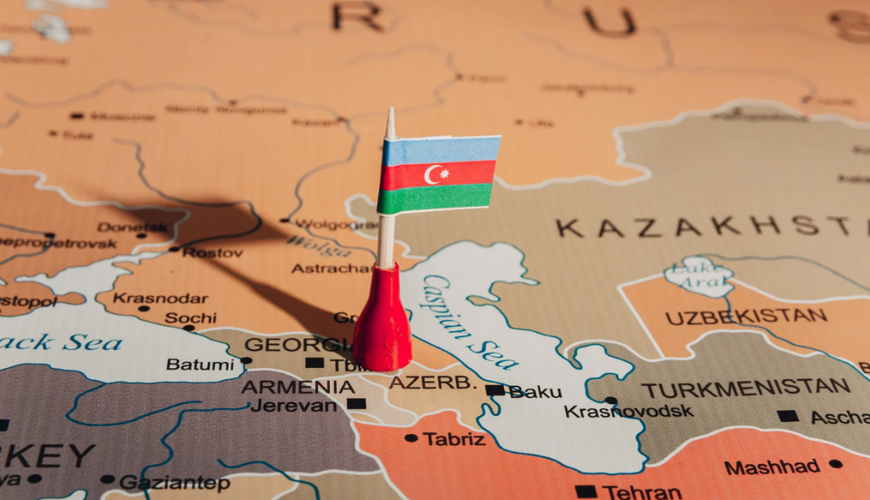
The attention of the world’s two superpowers, the US and China, towards Azerbaijan is not coincidental. Ostensibly, this can be linked to Azerbaijan’s geographical location on the map. However, this approach only partially reflects geopolitical reality. The focus on Azerbaijan is related not only to its current position on the map but also to its future place on the map. Today, Azerbaijan is an equal strategic partner with both superpowers – the US and China.
The passage of superpowers through Azerbaijan is a natural and geographical advantage. Azerbaijan having a say in determining the main conditions of these routes is a strategic gain. In other words, the main issue for Azerbaijan is its ability to leverage the attention of great powers. Geographical position gives Azerbaijan a certain advantage, a starting superiority; turning that superiority into sustainable geopolitical capital and political freedom requires effective diplomacy, transparent agreements, reliable infrastructure, and regional stability.
Generally, China’s policy is driven more by economic calculations. China needs alternative routes to deliver its export goods to Europe. The Northern Corridor is burdened with geopolitical risks, and sea routes are sensitive in terms of both time and security. Alternative routes allow for reducing the dependence of cargo transportation on political crises, security problems, and interruptions on individual transport lines.
The Middle Corridor, passing through Central Asia, the Caspian Sea, and the South Caucasus, is strategically important for Beijing in this regard. Connections through Central Asia, the Caspian Sea, and the South Caucasus create an additional option for Beijing. Azerbaijan is one of the most crucial links in that chain. Transit capabilities, Caspian ports, and access to Europe make Baku more than just a partner for China; it is a key link.
It appears that China’s primary interest concerning Azerbaijan is related to the reliability and accessibility of the routes and connections passing through our country. China is also planning routes passing through the region for the transportation of its export goods. In other words, Azerbaijan attracts Beijing’s attention both as a secure transit country and a reliable partner.
Explaining this visit with the approach that “Beijing does not want to cede Azerbaijan and the entire South Caucasus to Washington’s sphere of influence” seems appealing. It indicates that there is competition between superpowers in this region, and it is intensifying. However, this approach sidelines the geopolitical and economic interests of the region and Azerbaijan, and its political will as a state. The entire South Caucasus region, including Azerbaijan, is not a political space that one superpower can hand over to another. Azerbaijan, as a middle power, also influences regional processes, chooses partners, sets conditions, and tries to adapt foreign interests to its own goals.
Of course, the interests of the US and Russia in the region and in Azerbaijan cannot be overlooked, nor can the competition between them and China, or the nature of this competition.
Thus, routes passing through Azerbaijan and the region can serve both the transportation of Chinese goods and US-backed regional connectivity projects. In this sense, the overlap of interests at certain points seems natural. However, there are also many instances where interests clash. The clashes of interest and the main disputes arise not so much from the existence of the route itself, but around its financing, management, technological standards, and the political influence it creates. Here, an important opportunity arises for Azerbaijan to turn the interests of various partners into complementary projects. However, preserving this opportunity depends on economic cooperation not creating a monopoly over political choice. If closer ties with one partner become an obligation that automatically limits relations with another, Azerbaijan’s room for maneuver will narrow.
Russia’s interests and position in the region must also be noted. China’s increased activity in the region does not automatically mean its displacement. Although Russia and China hold similar positions on certain political issues, they have different interests in areas such as transportation, logistics, connectivity, and investment. Therefore, it is not enough to evaluate the changes in the region solely as the withdrawal of one power and the entry of another. Azerbaijan and the entire South Caucasus are becoming a space where multiple power centers show interest simultaneously. Moreover, these interests appear to be diametrically opposed. China wants to deepen its ties with Azerbaijan, Washington is more actively involved in regional connectivity, and Moscow is trying to protect its interests.
This geopolitical competition is both an opportunity and a difficult test for Azerbaijan. On the one hand, the simultaneous interest of power centers such as China, the US, the European Union, Russia, and Turkey in Baku increases the country’s diplomatic weight. On the other hand, maintaining balance in a space where these interests clash requires special skill. Baku’s success will lie in avoiding being forced to choose between these interests and deriving concrete national benefits from each cooperation. Azerbaijan’s multi-vector and balanced foreign policy, pursued for many years, is precisely designed for such moments.
Practically, the main issue for Baku is to increase the real volumes of Chinese investment and transit cargo. To achieve this, it is important to improve infrastructure, customs procedures, and inter-country coordination along the corridor. China’s interests align with Azerbaijan’s strategy as a transit hub and a middle power, but this alignment does not automatically yield results; it must be reinforced with working mechanisms.
China here seeks stable access to trade routes and logistics points rather than creating tension over spheres of influence. The success of this will depend both on Baku’s position and on the actions of other competing powers in the region. One thing is clear: the South Caucasus is now at the center of attention of great powers, and Azerbaijan’s role in this center is growing.
Qulamhüseyin Əlibəyli