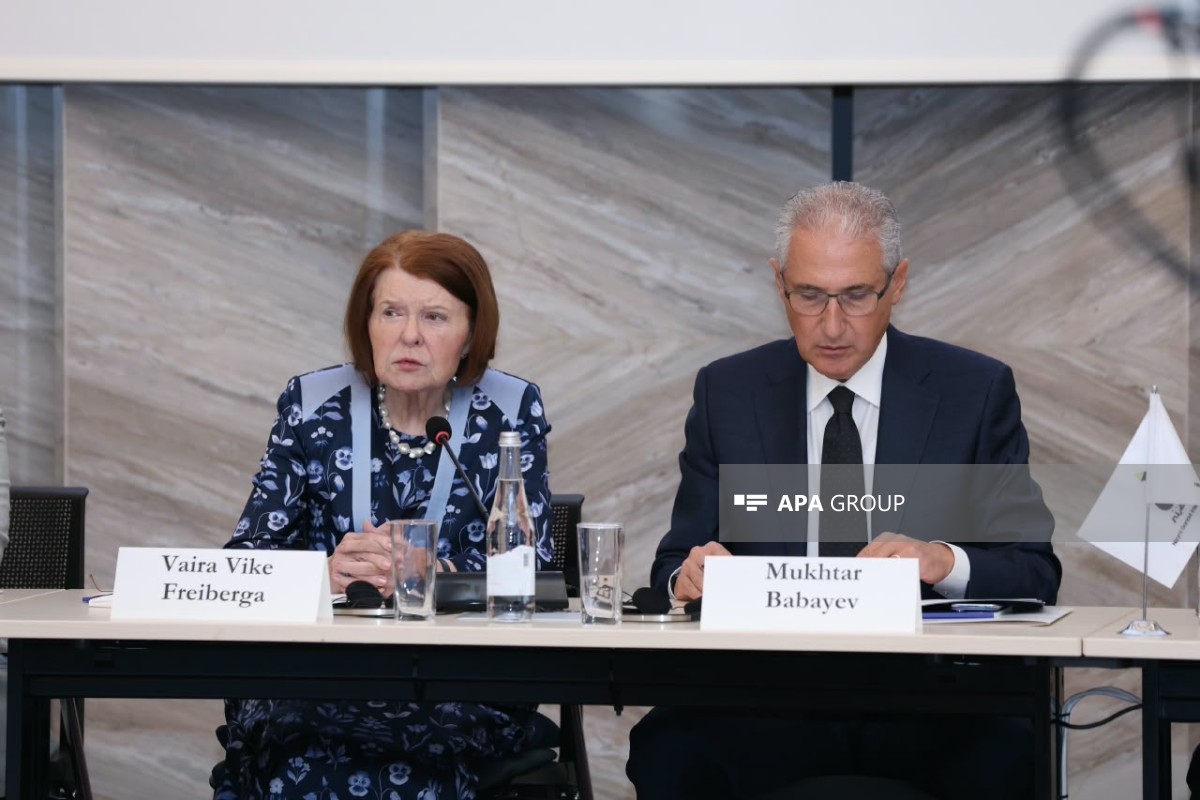
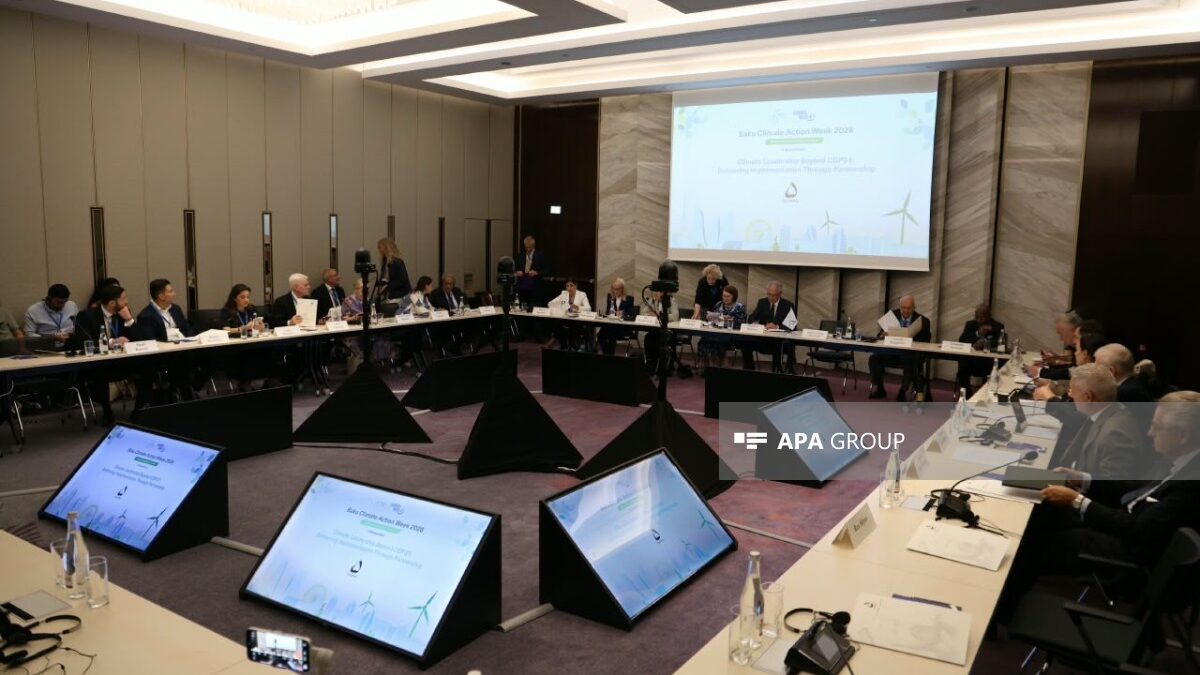
Within the framework of Baku Climate Action Week 2026, a high-level roundtable on “Climate leadership after COP31: ensuring implementation through partnership” was held, organized by the Nizami Ganjavi International Center.
“Elchi” reports that the roundtable, held in preparation for COP31, discussed the development of global climate leadership over the last decade and the experience gained since the Paris Agreement. Participants exchanged views on the impact of changing geopolitical conditions on international climate cooperation, the translation of climate commitments into concrete actions, and new partnership opportunities.
At the opening session of the event, Vaira Vike-Freiberga, Co-Chair of the Nizami Ganjavi International Center and former President of Latvia; Mukhtar Babayev, COP29 President and Representative of the President of the Republic of Azerbaijan for climate issues; and Mehmet Galip Ensarioğlu, Chairman of the Environment Committee of the Grand National Assembly of Turkey, delivered speeches.
Vaira Vike-Freiberga noted the excessive global use of oil and volcanic activity as factors contributing to pollution.
The speech also drew attention to the link between pollution and climate change. It was noted that policies and decisions prepared by experts and decision-makers should be explained to society in a clear and understandable way.
Mukhtar Babayev, Representative of the President of the Republic of Azerbaijan for climate issues, stated that extreme heat, drought, floods, and forest fires are putting serious pressure on cities, water and food systems, the economy, and infrastructure. It was noted that for this reason, international cooperation in the field of climate is being carried out in more difficult conditions compared to previous years.
He emphasized that climate policy should not compete with the national priorities of countries, but rather contribute to solving issues such as energy security, economic development, and food and water security.
Mehmet Galip Ensarioğlu, Chairman of the Environment Committee of the Grand National Assembly of Turkey, emphasized the importance of taking into account the different economic and social conditions of countries in the fight against climate change.
During the speech, it was stated that the effects of climate change are becoming increasingly visible, and therefore climate policy cannot be considered separately from energy, economic, food, water, technology, and development policies.
It was noted that in order to continue climate cooperation in preparation for COP31, it is necessary to develop practical and implementable policies that take into account the different economic and social capabilities of countries.
In the subsequent panel session, issues such as the impact of geopolitical changes on international climate cooperation, energy security, economic competitiveness, health, food systems, technology, and sustainable development were discussed. At the same time, views were exchanged on strengthening cooperation between governments, international organizations, financial institutions, business, and civil society, translating climate commitments into concrete results, and accelerating implementation on the road to COP31.