
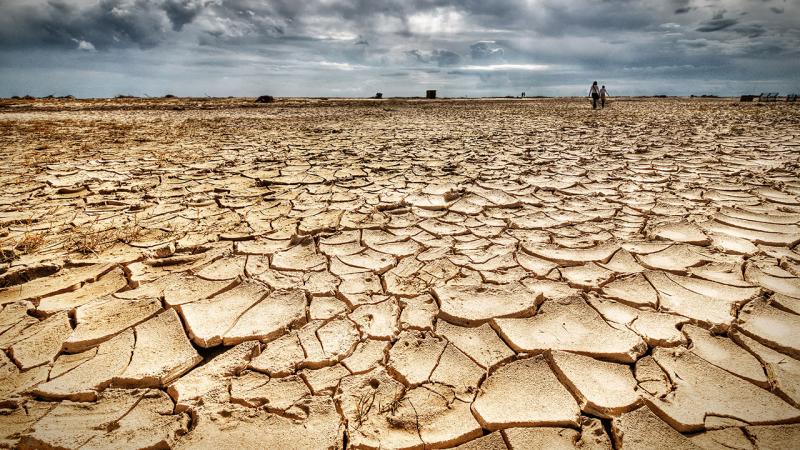
As global temperatures rise, the planet’s driest regions are expected to become even drier. A new study published in the environmental science journal *Environmental Research Letters* has revealed that more than 40 percent of the Earth’s land area could turn into arid zones by the end of the 21st century.
“Elchi” reports that the study, led by scientists from the Chinese Academy of Forestry, mapped the current distribution of global arid zones and used updated climate models to predict their future expansion. The analysis used the Aridity Index (AI), calculated by dividing regional precipitation by the potential water loss resulting from evaporation and transpiration.
Increased atmospheric carbon dioxide slows down aridity
Researchers found that high levels of atmospheric carbon dioxide (CO2), the main driver of climate change, cause plants to close their pores and lose less water, thereby slowing the expansion of arid zones more than previously expected.
Calculations taking this effect into account predicted that arid zones, which covered 38.58 percent of global land (excluding Antarctica) between 1994 and 2023, will expand to between 39.31 percent and 40.28 percent between 2071 and 2100, depending on greenhouse gas emission scenarios.
Previous studies that did not account for the effect of carbon dioxide had estimated that this figure could rise to 56 percent by 2100.
However, even in the highest impact scenario – at a rate of 40.28% – this implies the drying of a new land area covering 2.37 million square kilometers, equivalent to approximately 30% of the territory of Algeria or Australia.
The most significant change is expected in Australia and Brazil
Projections show that the most observed drought process in the coming century will occur in Australia, followed by Brazil and certain regions of Africa.
While semi-arid regions currently make up the majority of the world’s drylands, arid zones are widespread in China and Australia, and hyper-arid areas are common in countries such as Algeria, Libya, and Saudi Arabia.
Future scenarios predict that the most significant increase will occur in hyper-arid areas.
Şayəstə