
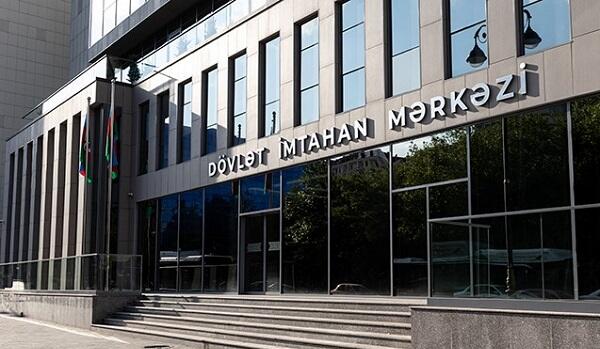
As is known, the State Examination Center announced the results of placement into higher education institutions of the Republic of Azerbaijan for the 2026/2027 academic year on August 24.
This year, 87,146 people participated in the competition for higher education institutions. Of them, 58,947 people (including 4,215 sub-bachelors) were admitted to higher education institutions. 28,108 (including 1,145 sub-bachelors) people gained the right to study on the basis of a state order, 317 (including 58 sub-bachelors) people on a state-funded basis, and 30,522 (including 3,012 sub-bachelors) people on a paid basis. The admission plan for higher education institutions was filled by 97.07%. These figures will increase even further after the selection of specialties for the remaining vacant spots is conducted.
If we compare the mentioned figures with the corresponding data of the previous year, we can observe that the number of those who earned the title of student this year is 1,711 more. At the same time, the number of those admitted on the basis of state order and state funding is 290 more than last year’s figure. As a result of the increase in the number of state-ordered spots in the admission plan in recent years, the number of students who have the opportunity to study for free continues to grow.
The plan spots were filled the most in the third specialty group (99.84%). In the TC subgroup, the indicator is 100%, and no vacant spots remain. The comparison of the number of competition participants and plan spots in Group III allowed us to predict in advance that the competition situation would be high, and it was also emphasized that the chances of sub-bachelors would be low. Based on the competition results, only applicants were able to earn the title of student in the III specialty group.
In the II specialty group, the plan spots were also filled sufficiently, reaching 97.52%. Sub-bachelors also had a chance here. The largest number of sub-bachelors (2,319 people) were admitted to specialties in Group II.
In the I specialty group, the plan spots were filled by 96.64%. Sub-bachelors also had opportunities in Group I specialties, and 1,197 people were admitted.
In the IV and V specialty groups, the plan spots were filled by 91.91% and 93.71%, respectively. 627 and 72 sub-bachelors were admitted to these groups, respectively.
Regarding individual higher education institutions, after the first stage, 12 out of 41 civil higher education institutions where student admission is conducted (Azerbaijan Medical University, Azerbaijan University of Languages, Academy of Public Administration, Azerbaijan State Academy of Fine Arts, Azerbaijan Tourism and Management University, Academy of the State Customs Committee, Azerbaijan Institute of Theology, Azerbaijan Cooperation University, “Azerbaijan” University, Baku Eurasian University, Baku Business University, and Azerbaijan Academy of Labour and Social Relations) had their plan spots filled by 100%, in addition, 20 higher education institutions were filled by more than 95%, and 5 higher education institutions by more than 90%.
Regarding sub-bachelors, we can note that they were able to be admitted to 30 different higher education institutions. The number of sub-bachelors admitted to higher education institutions this year is 4,215, which is 2,246 fewer than last year’s figure. Looking at the admission plan of higher education institutions and their filling percentage, we can see that 28.67% (412 people) of those admitted to Azerbaijan University of Technology, 25.22% (433 people) of those admitted to Mingachevir State University, and 23.28% (474 people) of those admitted to Lankaran State University are sub-bachelors.
We remind you that those admitted to higher education institutions must register electronically via the my.gov.az portal from August 28 to September 8 (at 18:00).
Failure to register within the specified period will be considered as the applicant’s refusal to be placed in the relevant specialty, and their admission order will not be sent to the university.
Let us note that after the first stage, 667* (639 for RK, 28 for RI) plan spots remained vacant in the I specialty group (see note).
Applicants with a total score of not less than 200 and a score of not less than 100 in the second stage of the exam are allowed to compete for the remaining vacant plan spots. The number of applicants who participated in the competition for the RK subgroup but could not be admitted to higher education institutions is 12. The corresponding number for the RI subgroup is 416. The number of applicants with a total score of not less than 150 and a score of not less than 50 in the second stage of the exam in the RK subgroup is 447. There are no vacant plan spots left for specialties that can be chosen by applicants with a total score of not less than 150 and a score of not less than 50 in the second stage of the exam in the RI subgroup.
395* plan spots remained vacant for the II specialty group (see note). Applicants with a total score of not less than 200 and a score of not less than 100 in the second stage of the exam are allowed to compete. The number of applicants who met this condition, participated in the competition, but could not be admitted to higher education institutions is 29. The number of applicants with a total score of not less than 150 and a score of not less than 50 in the second stage of the exam is 51.
25* plan spots (all for the DT subgroup) remained vacant for the III specialty group (see note). Applicants with a total score of not less than 200 and a score of not less than 100 in the second stage of the exam are allowed to compete. The number of applicants who participated in the competition for the DT subgroup but could not be admitted to higher education institutions is 3,379. Here, the only specialty that applicants can actually choose is Librarianship and Information (taught in English), and 5 plan spots remain. There are no vacant plan spots left for specialties that can be chosen by applicants with a total score of not less than 150 and a score of not less than 50 in the second stage of the exam.
407* plan spots remained vacant for the IV specialty group (see note). Applicants with a total score of not less than 200 and a score of not less than 100 in the second stage of the exam are allowed to compete. The number of applicants who participated in the competition but could not be admitted to higher education institutions is 138. The number of applicants with a total score of not less than 150 and a score of not less than 50 in the second stage of the exam is 161. These applicants can only choose Horticulture and Vegetable Growing (taught in English) and Water Bioresources and Aquaculture specialties.
288* plan spots remained vacant for the V specialty group. However, we once again draw the attention of applicants to the fact that applicants who have met the competition conditions for specialties requiring special aptitude (relevant commissions) can participate in the selection of vacant plan spots.
*Note. The list of vacant plan spots of higher education institutions has been published in the 7th issue of the “Abituriyent” magazine. The magazine presents only the list of specialties where admission can be conducted. Thus, if there are no state-ordered (DS) spots left for specialties that were included in the 4th issue of the “Abituriyent” magazine and where admission was conducted only on the basis of state order (YDS) as a result of the competition held, admission to these specialties (except for agrarian-oriented specialties) is not conducted and they are not provided in the “Abituriyent” 7 magazine. The magazine also provides extensive information on the distribution of exam scores of applicants who were not admitted to higher education institutions.