
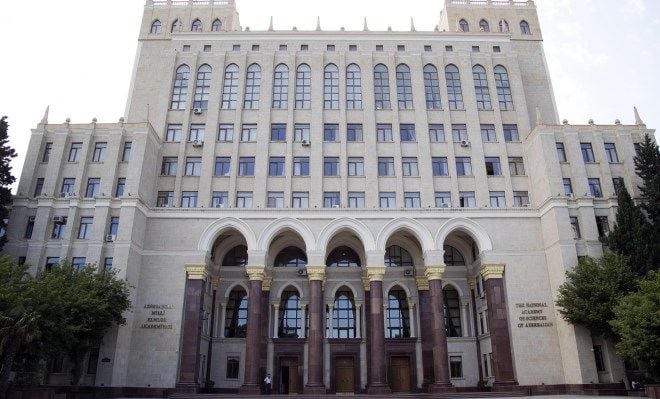
Discussions regarding the relocation of some state institutions outside the capital to reduce traffic congestion in Baku have returned to the agenda. One of these institutions is the Azerbaijan National Academy of Sciences (ANAS).
The relocation of the academy, which is considered the scientific center of the capital and gives its name to the surrounding area and the metro station, creates the impression of the end of an era.
Could the relocation of ANAS from Baku affect its prestige and international collaborations?
elchi reports that full member of ANAS, academician Nizami Jafarov, stated in an interview with Bizim.Media that the practice of moving scientific and educational institutions away from city centers has long existed in global experience:
“In some countries, administrative management continues in such historical buildings. More favorable and spacious environments are created outside for research and educational work.
If an opportunity is created to relocate ANAS, as well as universities, to a more suitable place tomorrow, and if such a decision is made, why not?
What makes the Academy of Sciences famous is not its building, but its prestige. The building can be a symbolic emblem of prestige in a conventional sense. But overall, it is not about the building itself, but about its activities. Buildings exist everywhere. The main thing is its work, achievements, and cooperation. Integration into the world in our science and education is proceeding rapidly, and we have quite significant successes.”
The academic also emphasized that branches of some universities already exist in other cities and regions:
“For now, it is difficult to say that the level of these branches is as high as in the center. Of course, there are problems. This cannot be denied. But if there is a general centralization, then naturally, the level will also rise. Because usually, renowned scientists and great experts are less represented in the regions. If the Academy of Sciences and prestigious universities themselves go to the regions, then the level of representation will increase significantly. Moreover, in the current conditions of modern information and communication technologies, there is in principle no difference between the center and the regions. That is, our scientific and educational institutions can work quite productively in our regions as well.”