
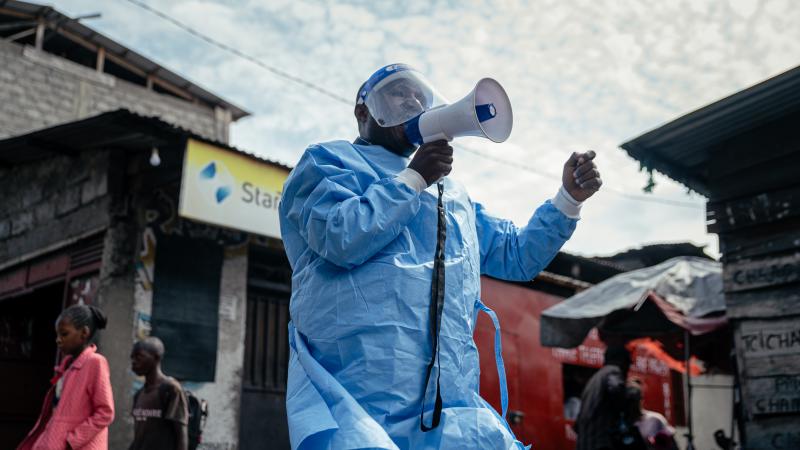
Marie-Roseline Belizaire, Emergency Director for the WHO Regional Office for Africa, stated that the situation in the Democratic Republic of Congo (DRC) remains serious one month after the declaration of the Ebola epidemic.
elchi reports that Belizaire participated online in the weekly press conference of the United Nations (UN) Office in Geneva and presented an assessment of the situation in the DRC, where the Ebola epidemic has occurred. Noting that cases have been recorded in many regions, Belizaire emphasized the importance of continuing and accelerating response measures to new cases, stating: “To date, 896 confirmed cases and 232 deaths have been recorded across 33 health facilities in 3 provinces of the DRC. Uganda has not recorded any cases in the last 12 days.” Belizaire stated that the WHO is supporting the government of the Democratic Republic of Congo and working with partners at all stages of the response, adding that more than 115 WHO experts have been sent to the affected provinces and health districts to support various stages of the response.
Belizaire emphasized that operational requirements have increased with the expansion of the epidemic and that there is a growing need for sustained funding and support.
Noting that access restrictions in some high-risk areas have limited operations, Belizaire said, “While noting that the epidemic remains serious and continues to spread, we know what works to prevent the spread of Ebola. Our shared task is to continue to implement these measures at the speed and scale necessary to stop this epidemic.”
Ebola epidemic
The epidemic was declared in the Democratic Republic of Congo (DRC) on May 15, following the announcement of 246 suspected cases and 65 deaths in the country.
On May 17, the WHO declared an international public health emergency due to the resurgence of the Ebola epidemic.
According to health officials, the current epidemic is caused by the “Bundibugyo” virus, a rare variant of Ebola, for which there is no approved treatment or vaccine.
Şayəstə