
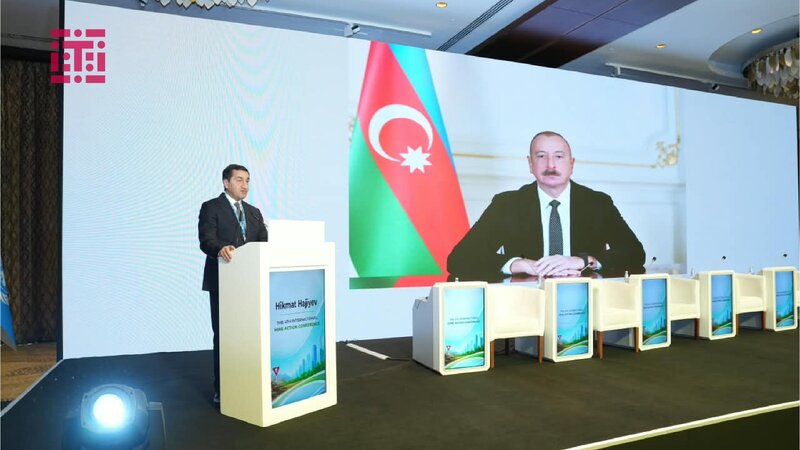
President Ilham Aliyev has addressed the participants of the 4th International Mine Action Conference on the theme “Mitigating Environmental Impact of Landmines: Resource Mobilization for Safe and Green Future”.
“Elchi” reports that the address states:
“Distinguished Conference participants,
I greet you on the occasion of the opening of the 4th International Mine Action Conference on the theme “Humanitarian Mine Action for Urban Reconstruction: Setting Excellence Standards for Safe Settlements”.
For several years now, the International Mine Action conferences hosted by Azerbaijan in close cooperation with the United Nations have served as an important platform for addressing the most serious humanitarian, security, and development challenges of our time.
Regrettably, landmines and unexploded ordnance continue to threaten human life and safety in many countries around the world. Long after conflicts end, explosive ordnance continues to cause loss of life, injury to civilians, damage to infrastructure, and delays in reconstruction projects. In this regard, humanitarian mine action is a vital commitment for safe settlements.
Post-conflict urban reconstruction requires not only the rebuilding of buildings, roads, and public infrastructure but also the establishment of security and trust. Until lands are cleared of mines and explosive remnants of war, no city, village, or town can be fully rebuilt, no school or hospital can operate safely, no family can return to their home with dignity, and no economic activity can develop sustainably. Therefore, humanitarian mine action lies at the foundation of urban reconstruction and the creation of safe settlements.
Azerbaijan has faced the most severe manifestation of this challenge. As a result of Armenia’s approximately 30-year occupation of its territories, Azerbaijan has become one of the most mine-contaminated countries in the world. According to initial estimates, more than 13 percent of Azerbaijan’s territory has been affected by mines and unexploded ordnance. The liberated territories of Karabakh and East Zangezur remain heavily contaminated with mines and unexploded ordnance, which creates serious obstacles for reconstruction, economic activity, safe movement, and the return of former internally displaced persons to their native lands.
Since the end of the Patriotic War in 2020, 437 Azerbaijani citizens, including civilians, military personnel, deminers, journalists, and those involved in reconstruction work, have been victims of mine and explosive ordnance incidents, resulting in 73 deaths and 364 severe injuries. In total, more than 3,500 of our citizens have suffered from mines since the beginning of Armenia’s aggression against Azerbaijan. Among them are children, women, and other civilians whose lives have been tragically affected by this hidden threat.
The fact that the maps of mined areas provided by Armenia are largely inaccurate and incomplete further increases the scale of this challenge. Mines and booby traps have been discovered not only in former military positions but also along roads, near residential areas, in cemeteries, on agricultural lands, in forests, along riverbanks, and in other civilian areas. Nevertheless, Azerbaijan is firmly committed to overcoming these challenges and ensuring the safe, dignified, and sustainable return of its citizens to their native lands.
Humanitarian mine action is an integral and significant part of Azerbaijan’s reconstruction and rehabilitation program in the liberated territories. The rebuilding of cities and villages, the restoration of infrastructure, the development of transport and energy networks, the revival of agriculture, and the creation of new settlements are carried out in close and precise coordination with mine action activities.
Large-scale mine action operations are being carried out in the liberated territories. To date, more than 298,000 hectares of land have been cleared, and 260,147 mines and unexploded ordnance have been detected and neutralized. Azerbaijan is applying advanced technologies, innovative approaches, and modern management systems to increase the speed, safety, and efficiency of mine action.
Mine action in Azerbaijan is directly linked to broader national priorities. This activity supports reconstruction, safe return, agricultural revival, infrastructure development, environmental protection, social reintegration, and economic recovery. It also contributes to the implementation of “Azerbaijan 2030: National Priorities for Socio-Economic Development,” particularly the priority related to the Great Return to the liberated territories.
Cities and villages destroyed during the occupation are being rebuilt within the framework of the Great Return Program, with modern infrastructure, roads, tunnels, airports, energy facilities, schools, hospitals, cultural monuments, and settlements being restored. The practical results of this policy are already visible. To date, approximately 40,000 former internally displaced persons have returned to their homes in the liberated territories. In total, the number of people currently living in Karabakh and East Zangezur has exceeded 90,000.
Azerbaijan is developing and implementing advanced models of post-conflict reconstruction, rehabilitation, and governance that combine mine action, urban planning, infrastructure development, environmental restoration, digital solutions, social services, public administration, and the return of former internally displaced persons within a single coordinated framework. Areas that were destroyed and depopulated during the occupation are being transformed into places that offer housing, jobs, education, and opportunities in a short period of time.
Although many challenges remain, the results achieved so far demonstrate the effectiveness of Azerbaijan’s integrated approach. We are ready to share this experience with countries and regions facing similar consequences of conflict. Because we believe that the Azerbaijani model of mine action, reconstruction, and return can be of practical interest to many partners around the world.
Azerbaijan has also put forward important initiatives to promote mine action at the international level. The importance of safe and sustainable settlement and mine action was at the center of global discussions during the 13th session of the World Urban Forum, which Azerbaijan successfully hosted in Baku.
Furthermore, our country has declared humanitarian mine action as the 18th National Sustainable Development Goal and continues its efforts to have this issue recognized as a global priority.
The mine problem requires stronger international solidarity. Azerbaijan carries out the main burden of both humanitarian mine action and the overall reconstruction and rehabilitation process in the liberated territories at the expense of its own national resources. However, the scale of contamination, the urgency of reconstruction, and the humanitarian importance of safe return require broader and more practical support from the international community. Predictable funding, modern equipment, technical knowledge, training, technology transfer, and long-term partnerships are essential to accelerate mine action and reduce the difficulties caused by mines.
I am confident that this Conference will serve as a valuable platform for open dialogue, exchange of experience, and the development of practical cooperation. The discussions held in Baku will contribute to strengthening international mine action standards, promoting innovation, and achieving our common goal of supporting the reconstruction of safe cities and building safe, resilient, and sustainable communities.
I convey my best wishes to all participants and wish the Conference success in its work.”
***
11:12
President Ilham Aliyev has addressed the participants of the 4th International Mine Action Conference on the theme “Humanitarian Mine Action for Urban Reconstruction: Setting Excellence Standards for Safe Settlements”.
The President’s address was delivered by Hikmat Hajiyev, Assistant to the President of the Republic of Azerbaijan and Head of the Foreign Policy Affairs Department of the Presidential Administration.