
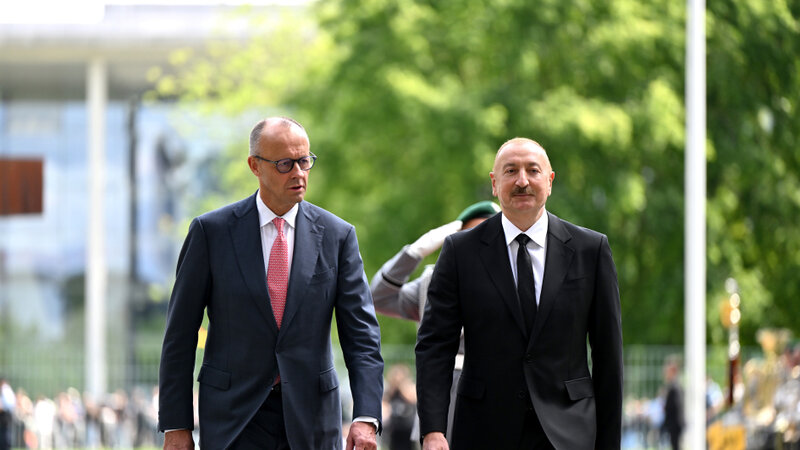
On July 21, a ceremony for the signing of German-Azerbaijani documents was held in Berlin. President of the Republic of Azerbaijan Ilham Aliyev and Federal Chancellor of the Federal Republic of Germany Friedrich Merz signed a Joint Declaration on a Strategic Agenda for Bilateral Partnership between the Republic of Azerbaijan and the Federal Republic of Germany. During the event, a Joint Declaration on the establishment and activities of the Azerbaijan-Germany Business Council was also signed.
“Elchi” reports on the political, economic, and geopolitical significance of the elevation of Azerbaijan-Germany relations to a strategic level.
One of the main priorities of Azerbaijan’s foreign policy is the development of relations with various power centers based on mutual respect, national interests, and equal cooperation. The multifaceted and multipolar foreign policy course implemented under the leadership of President Ilham Aliyev has significantly strengthened our country’s position as a reliable partner at both regional and global levels in recent years. The next important result of this policy was the “Joint Declaration on a Strategic Agenda for Bilateral Partnership between the Republic of Azerbaijan and the Federal Republic of Germany,” signed with Chancellor Friedrich Merz during President Ilham Aliyev’s official visit to Germany. This document lays the foundation for a qualitatively new stage in Azerbaijan-Germany relations. The Declaration moves cooperation between the two countries beyond individual sectors into a unified strategic framework, uniting political dialogue, economy, energy, security, science, technology, education, and humanitarian cooperation around a long-term development concept.
Germany is the second country after Italy with which Azerbaijan has signed a strategic framework document among the major powers of Western Europe. This demonstrates that the deepening of Azerbaijan’s relations with Europe’s leading political and economic powers has taken on a consistent character.
Germany, as the leading political and economic locomotive of the European Union, holds special importance for Azerbaijan. For this reason, the formation of a strategic agenda with Berlin is of significant political importance not only for the development of bilateral relations but also for the prospects of Azerbaijan-European Union relations. It is no coincidence that the signed Joint Declaration separately emphasizes the strategic importance of the Azerbaijan-European Union partnership. Germany’s open support for this approach is an expression of significant political backing for the further expansion of Azerbaijan’s cooperation with Europe. Furthermore, the expression of clear support in the Declaration for the updated Azerbaijan-European Union Partnership Priorities can be assessed as a contribution to a new stage in Azerbaijan-European Union relations. This approach creates additional opportunities for deepening political dialogue, expanding economic cooperation, and developing collaboration in areas such as energy security, transport and communication links, green energy, and digital transformation.
Germany’s support for the expansion of Azerbaijan’s cooperation with Europe is also an indicator of our country’s growing influence as a reliable partner for this region. In recent years, the role played by Azerbaijan in ensuring energy security, developing the East-West and North-South transport corridors, and promoting regional stability and cooperation is highly valued by European states. In this regard, the establishment of strategic partnership relations with Germany can be considered an important step serving to further consolidate Azerbaijan’s positions in the European political and economic space and to give new content to mutually beneficial cooperation with the European Union.
One of the most important features of the Joint Declaration is the strengthening of the institutional foundations of cooperation. The document provides for the continuation of high-level political dialogue, the holding of consultations between ministers, and the expansion of the activities of the Germany-Azerbaijan High-Level Working Group. These mechanisms will ensure the sustainable and systematic development of relations.
Energy remains one of the main directions of the strategic partnership. However, the new document does not limit this cooperation to traditional gas exports. Green energy, low-carbon hydrogen, energy efficiency, renewable energy sources, and the climate agenda are identified as new priorities for cooperation. This approach strengthens Azerbaijan’s role as an important partner in Germany’s energy transition strategy and demonstrates that the policy implemented by our country toward the transition to a green economy is gaining international support.
Economic cooperation is also gaining new content. In addition to increasing trade turnover, the document envisages the promotion of mutual investments, industrial cooperation, logistics, transport links, and the expansion of cooperation in the field of sustainable economic development. Germany’s experience in high technologies and innovation aligns with Azerbaijan’s economic modernization policy and creates new opportunities.
For the first time in the Joint Declaration, cooperation in the field of security and defense is reflected as a separate strategic direction. Cooperation in the defense industry, between military educational institutions, expert and student exchanges, demining, cybersecurity, and joint action against transnational threats show that relations have moved to a broader security plane. Germany’s support for the Azerbaijan-Armenia normalization process and the ensuring of lasting peace in the region is also of particular importance in this regard.
One of the important directions of the document is the fields of science, education, and innovation. The expansion of projects on digital transformation, artificial intelligence, scientific research, inter-university cooperation, and vocational education serves the long-term development of human capital. This shows that the relations are calculated not only for current interests but also for the cooperation of future generations.
The Azerbaijan-Germany strategic partnership is, in fact, a logical continuation of the successful foreign policy our country has implemented in recent years. Azerbaijan is already developing strategic partnership relations with the USA and China, cooperation with the European Union is continuing on an upward trajectory, and at the same time, strategic partnership documents have been signed with ten European Union countries. The signing of such an important document with Germany after the strategic partnership with Italy demonstrates that Azerbaijan has raised its relations with Europe’s two leading industrial and economic states to a strategic level. These facts once again confirm that the multipolar and balanced foreign policy implemented by President Ilham Aliyev serves to strengthen Azerbaijan’s international positions, form new political and economic partnerships, and increase our country’s reputation as a reliable partner in the fields of global energy security, transport, economic cooperation, and regional stability.
The Joint Declaration on a Strategic Agenda for Bilateral Partnership is not just a document reflecting the development of relations between Azerbaijan and Germany. It expresses a new stage in Azerbaijan’s long-term cooperation policy based on mutual trust with Europe’s leading states and further strengthens our country’s status as a reliable, predictable, and responsible partner in Europe’s political, economic, and energy space. At the same time, this strategic document once again demonstrates the wide scale of the successful foreign policy implemented by President Ilham Aliyev on the global stage and Azerbaijan’s growing influence in the system of international relations.