
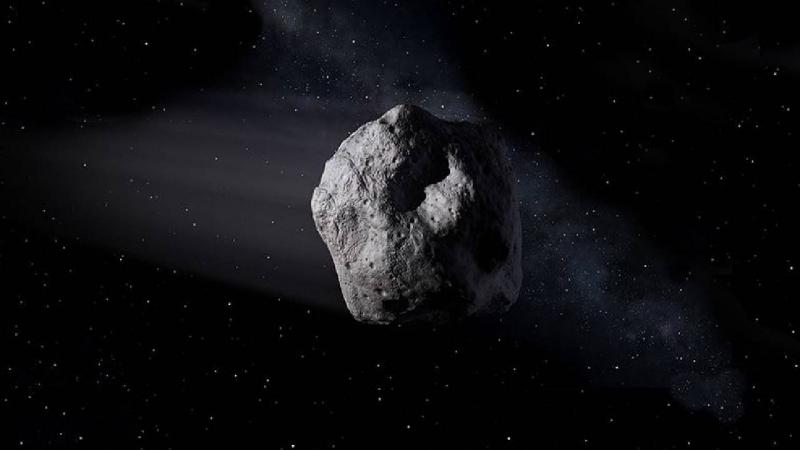
It is reported that the 99942 Apophis asteroid, which is expected to pass at a distance of approximately 32,000 kilometers from Earth in April 2029, poses a risk of collision with artificial space debris.
“Elchi” reports that, according to a study published in The Planetary Science Journal, researchers from the Italian National Research Council (CNR) simulated the trajectory of Apophis and the population of artificial debris in geostationary orbit (GEO).
Although astronomers clearly emphasized that the asteroid poses no threat to Earth, they discovered that there is a possibility of collision between the space debris accumulated around Earth and the asteroid.
May affect observations and scientific data
Experts stated that a possible space debris collision would not change Apophis’s orbit or create a new threat to Earth.
However, it was noted that such contact could create a small crater on the surface and generate a dust cloud.
The European Space Agency’s (ESA) RAMSES and NASA’s OSIRIS-APEX spacecraft aim to study the effect of Earth’s gravity on the asteroid, surface changes, and possible seismic activity during the close flyby. Researchers note that an unexpected debris collision before the flyby could make it difficult to detect Earth’s impact on the asteroid.
High-orbit space debris is being tracked
the study also highlighted shortcomings in tracking small pieces of space debris, especially at high altitudes such as geostationary orbit.
Since new observation telescopes will be deployed within the framework of the European Union’s Space Surveillance System, the goal is to map the high-orbit debris population in more detail by 2029.
Şayəstə