
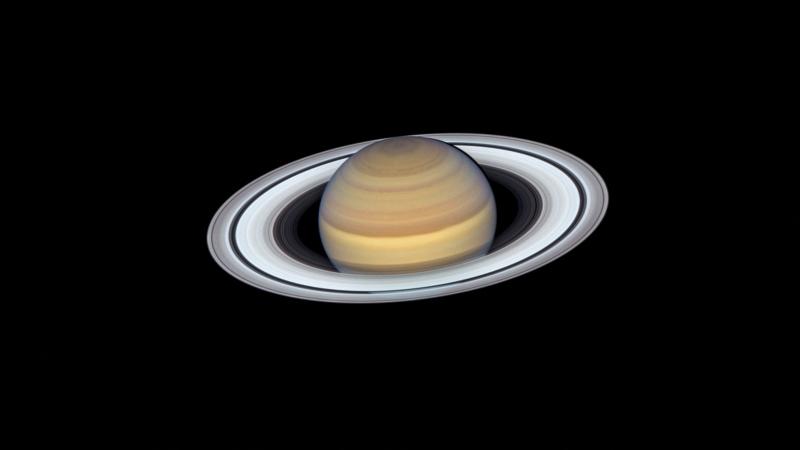
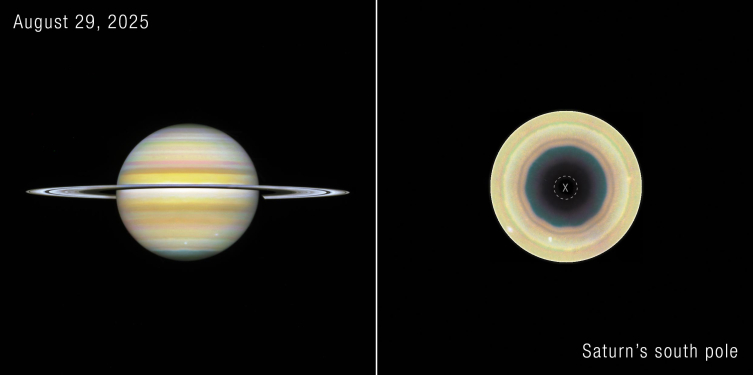
NASA’s Hubble Space Telescope has discovered a giant, 10-sided atmospheric wave forming around Saturn’s south pole.
“Elchi” reports that, according to a study published in the journal Science Advances, this structure, dubbed a “decagon,” extends across various atmospheric layers of the planet and has emerged and strengthened in recent years.
While it resembles the famous hexagonal structure known to have existed at the north pole for decades, scientists are excited by the fact that this new structure at the south pole has 10 sides and has only recently begun to form.
Researchers state that this structure, whose traces have been observed in Hubble data since 2023, creates a unique opportunity to observe the development of a massive planetary weather event from scratch.
A giant, 10-sided atmospheric wave has been discovered at Saturn’s south pole
Background and significance of the discovery
The first serious signs were detected in 2024 in images taken from Earth’s surface by amateur astronomers Trevor Barry and Jean-Paul Oger, as well as the lead author of the study, Agustín Sánchez-Lavega.
The Hubble telescope, which conducts high-resolution observations from space, has clarified the history of the structure dating back to 2023 and allowed it to be analyzed at various wavelengths.
Scientists plan to continue observations using the Hubble and James Webb Space Telescopes to determine whether this 10-sided wave will turn into a permanent structure like the hexagon in the north.
Şayəstə