
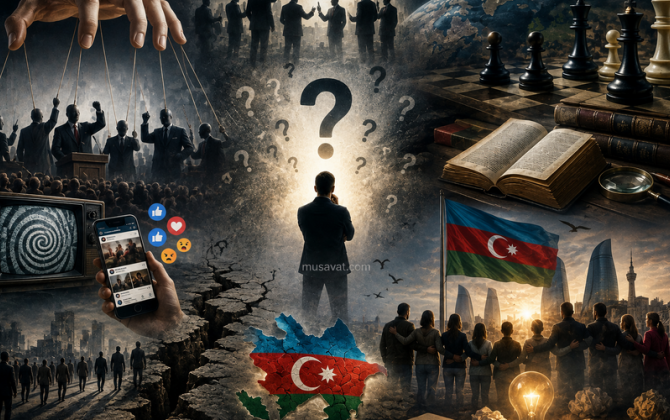
Of course, no idea, approach, or way of thinking can be considered universal, and any idea can be easily disputed. Especially because the emotions experienced during a dispute sometimes make one forget the truth and keep it out of focus. It is also an undeniable fact that secrets will always surround politics. And where there are secrets, there will be unanswered questions. Sometimes, asking the right questions becomes a matter of principle to understand the true essence and cause of events. Because wrong questions can lead to the formation of wrong perceptions.
We do not intend to start an academic polemic in the pages of “Yeni Müsavat”, nor is there any need for it. An academic approach, which is complex by nature, would only confuse people further and naturally increase the number of open questions. Nevertheless, one cannot avoid questions that can make us think; on the contrary, they must be voiced, because thought-provoking questions can protect the citizen from biased manipulations and ready-made foreign thought models forcibly imposed from the outside. In the process of building a healthy society, the issue of neutralizing manipulations, especially ideological manipulations, is a very important task. On the other hand, as the number of unanswered questions decreases, the maneuvering opportunities of “merchant-minded” politicians are also limited.
In the development of the current context, let us note here a few questions that will not tire the reader, but rather make them think, create interest in the topic, and also open the doors to some political truths to a certain extent. Why are we insistently being convinced that multi-partyism is the perfect manifestation of democracy? If so, why is it that in the USA, considered the “cradle” of democracy, the main “competition” in various elections held throughout history has only been between Democrats and Republicans? Why did the “quantity” factor begin to outweigh the “quality” factor in the competition conducted at the level of state, society, and individuals after the popular and modern concept of “rating” was implanted into our working and everyday thinking? Why, as soon as censorship—considered an important “development” stage of “democracy” and a fundamental criterion of pluralism—was abolished, did the number of “masterpiece” works claiming a place in the people’s history hover around “0”, even though “printed waste” increased? Why is television, chasing ratings and struggling for survival, now afraid of its own ideological content and doomed to fight against social networks that have lost all moral brakes? Why did we start moving away from our national identity after “high rating” became the main criterion for quality work in art, while vulgarity advances without stopping? Why were nearly 70 political parties suddenly created in a small country like Azerbaijan immediately after independence was achieved? Why did some circles become very worried and resort to various provocations because more than half of the political parties, which considered their ideological mission finished after the historic Victory, ceased their activities? Why was politics covered with random people precisely in the early, chaotic nineties? Why is the topic of “national minorities” periodically thrown into the spotlight by some irresponsible politicians to put the historical unity of the Azerbaijani people to the test?

Could it be that behind all these questions lie malicious goals such as dividing Azerbaijani society, disrupting national unity, and wounding ideological foundations? Does the creation of nearly 70 political parties in a small country in a short period of time not directly serve the ideological fragmentation of society? Let us note here for “interest” that it is impossible to find even 70 types of ideologies in political theory. We can say that the “blind” hunt for ratings observed in all fields without exception leads not to development, but to the degradation of content. Again, for “interest”, let us recall that one of the main reasons for the collapse of the giant USSR was the competition for fake reports.
An incompetent, unprepared, and fragile state that lost its balance from the oxygen abundance of independence embraced the concepts of fictitious pseudo-liberalism brought by the wind of “imported democracy”. This “wind” also caused various dangers for the young state. Why was the creation of nearly 70 political parties in Azerbaijan, which was experiencing a fragile independence whose name was hard to find on the world’s political map, in the interest of the international community? Could it be so that the ideological unity in society would be prevented and a basis for continuous conflicts would be created?
Today, as a people who have fully restored their territorial integrity, if we look back at our past, we can understand that the distorted perceptions about democracy were dripped into the political thinking of a people who could not even stand freely and walk independently in the early nineties, so that a controlled environment of chaos could be gradually created here. Under the influence of the waves of globalization and total modernization that started in parallel with the restructuring period, the essence of the concept of “national identity” has become so diminished that the issue of the unity of the people has almost lost its relevance.

Of course, the target of such tendencies was to divide the state and the people. The heat of the extreme sense of freedom has increased to such a degree that dangers have again arisen for the environment of solidarity. Why did international organizations preparing political reports, in their “drafts”, bypass the multicultural traditions historically experienced in Azerbaijan and openly and biasedly draw attention to speculative points? Could it be because they want to tear apart a monolithic society with all their might? Why are Azerbaijan’s global initiatives serving the promotion of multiculturalism principles in the international relations system kept in the shadows while Europe is experiencing a period of crisis of multicultural values? Why do the same organizations that prepare reports and should be the heralds of international laws ignore the fact that 11 political parties are represented in the Milli Majlis of Azerbaijan? Let us give just a few examples regarding the issue: 8 political parties are represented in the legislative body of Greece, 11 in Spain, 7 in Germany, and 8 in Sweden. Why does an organization that wishes for the development of Azerbaijan, a full member of the world community, not make such comparisons? Why did these organizations, which are “heralds of democracy”, insistently turn a blind eye to the fact that, in practice, one political party had a monopoly on opposition in Azerbaijan for many years? Could it be because it is easier to reach an agreement with one party to implement their malicious plans? Let us recall that it was precisely as a result of the reforms carried out by the Azerbaijani government in the field of political parties that the aforementioned monopoly was eliminated and the process of development of parties through evolution began.
Of course, we can increase the list of such questions that open the doors to political truths. However, it must never be forgotten that the future of Azerbaijan and its development depend precisely on the will of a united people. “Today is the era of true independence. Because today we determine our own future. Today we make the decisions ourselves. Today, the will of the people prevails in Azerbaijan,” – President of the Republic of Azerbaijan, Supreme Commander-in-Chief Ilham Aliyev. Therefore, every responsible citizen who is a true patriot of this state and nation and wishes for its prosperity must serve the inviolability of the people-state unity with their daily activities.
Asif Adil