
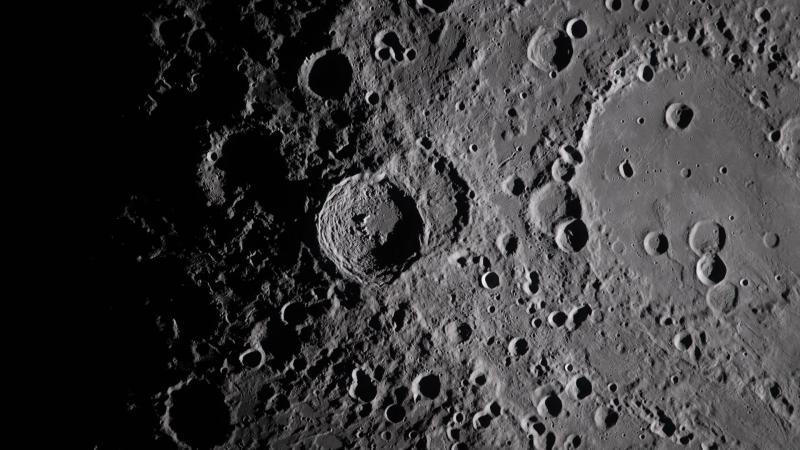
The SpaceX Falcon 9 rocket stage will crash into the lunar surface today. The collision is expected to create a crater more than 17 meters wide.
elchi reports that, according to NASA’s Center for Near-Earth Object Studies (CNEOS), the rocket fragment launched in January 2025 accidentally entered a collision course with the Moon.
It is reported that the rocket stage, discovered by independent astronomers, is hitting the Moon at a speed of approximately 5,400 miles per hour (2.43 kilometers per second).
The event, which poses no threat to Earth, is estimated to result in the rocket fragment, which is about the size of a five-story building and weighs 4,000 kilograms, landing near the Hertzsprung crater.
The collision is expected to create a crater more than 17 meters wide on the surface.
A giant dust cloud will rise
Astronomers say that on the Moon, which has no atmosphere or strong gravity, a giant cloud of dust and debris will be ejected 50 kilometers or more above the surface after the impact. Scientists monitoring the event will study the crater, ejecta, and dust clouds using NASA’s Lunar Reconnaissance Orbiter (LRO) and South Korea’s Danuri spacecraft. The goal is for the subsurface materials excavated by the impact to contribute to models of the Moon’s internal structure and geological processes.
Space debris risk is increasing
The collision has brought the issue of artificial debris accumulated in Earth’s orbit and space back to the forefront. According to data from the European Space Agency (ESA), there are approximately 54,000 objects larger than 10 centimeters in space. Since the beginning of the Space Age in 1957, the total mass of objects sent into space has exceeded 17,000 tons.
Şayəstə