
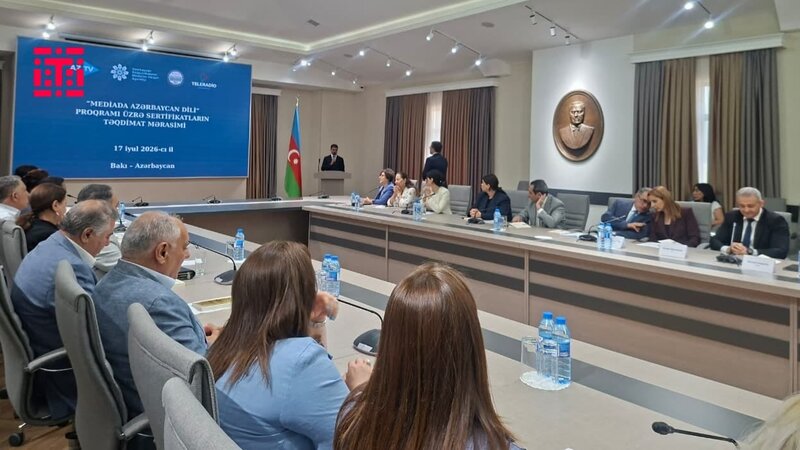
The presentation ceremony of certificates for the “Azerbaijani Language in Media” program has been held.
elchi reports that a number of officials delivered speeches at the presentation ceremony.
Ahmad Ismayilov, Executive Director of the Media Development Agency, stated that in an era where the information environment is changing rapidly and the influence of digital platforms is increasing, it is of particular importance for journalists to have a deep knowledge of the norms and rules of the Azerbaijani language, alongside their professional skills. He noted that the correct application of the state language in the media serves to provide society with reliable information and strengthens the professional journalistic environment.
Ahmad Ismayilov also mentioned that a methodological guide titled “Azerbaijani Language in Media” has been prepared for journalists within the framework of the program.
Rovshan Mammadov, Chairman of the “Azerbaijan Television and Radio Broadcasting” CJSC, noted that since the broadcasting space serves as an example for society, it is essential for presenters, journalists, and other media representatives to pay special attention to the culture of speech. He emphasized that preserving the rich expressive capabilities of the Azerbaijani language and correctly applying language norms on air are of great importance for the development of the national media environment.
Within the framework of the event, the official presentation of the methodological guide titled “Azerbaijani Language in Media,” prepared for journalists, also took place.
The authors of the book – Director of the Nasimi Institute of Linguistics of ANAS, Professor Nadir Mammadli, Head of the Department at Baku State University, Doctor of Philology, Professor Qulu Maharramli, PhD in Philology, Associate Professor Xatirə Hüseynova, and PhD in Philology, Associate Professor Aynur Nəsirova provided information about the purpose of the publication, the most common language errors in the media, and the importance of the guide as a practical resource that can be used in the daily activities of journalists.
It was stated that the guide also includes recommendations and approaches from other linguists and media experts who provided training within the project.
Following this, certificates were presented to the media representatives who successfully completed the training program.