
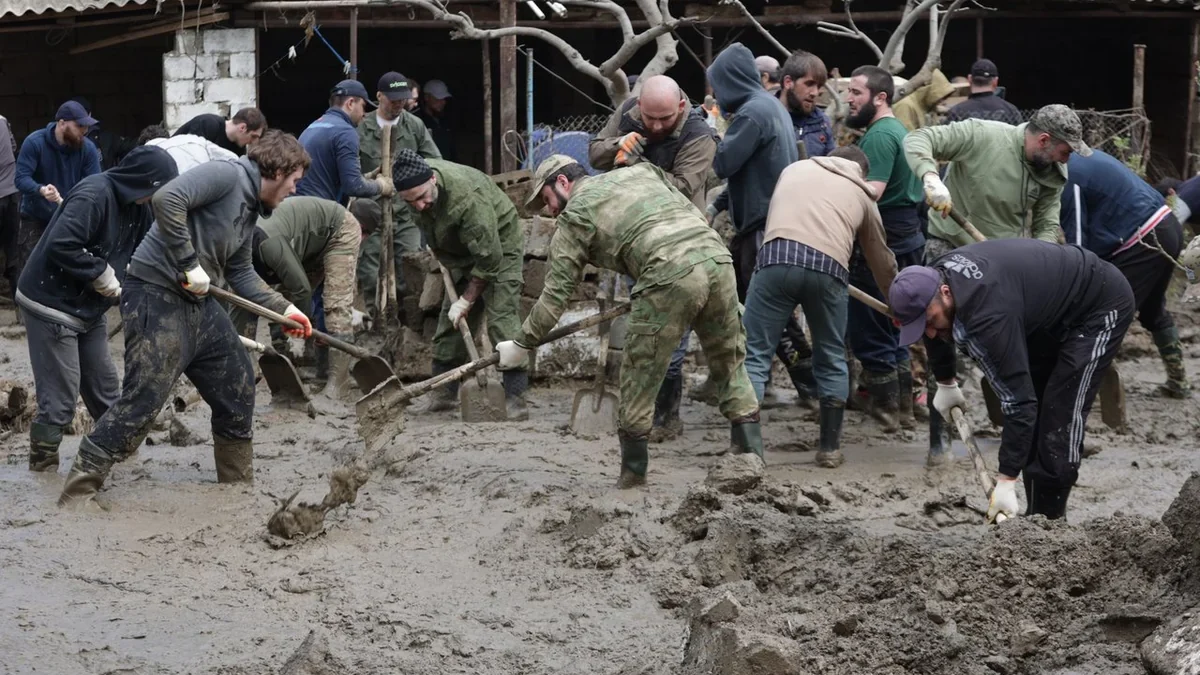
Efforts to combat the aftermath of the most severe flooding in Dagestan in recent decades—or, according to media reports, in 100 years—continue.
“Elchi” reports that, according to preliminary estimates, approximately 15,500 people have been affected by the heavy rains.
The first wave of torrential rains from March 27–29 caused a sharp rise in water levels in rivers and flooding in several districts. In Khasavyurt, spans of a railway bridge collapsed; in Makhachkala and Derbent, residential houses and roads were submerged, and tens of thousands of people were left without electricity. Water currents swept away cars, and emergency services were placed on high alert.
The situation was further aggravated by a new wave of precipitation on April 4–5. The collapse of the Gekhukh reservoir dam in Derbent led to the flooding of residential areas. According to the Russian Ministry of Emergency Situations (EMERCOM), more than 4,000 people were evacuated.
A second wave of flooding was recorded on April 6: in Makhachkala, part of a residential building collapsed due to soil erosion, and landslides occurred in several districts. More than 2,000 houses were submerged, and hundreds of people were placed in temporary accommodation centers.
On April 7, a state of emergency was declared in the region. The head of EMERCOM, Alexander Kurenkov, reported the situation to Russian President Vladimir Putin. On April 8, at the instruction of the head of state, Prime Minister Mikhail Mishustin established a government commission to address the aftermath of the floods. Up to 1.5 million people were in the disaster zone.
According to the latest data, at least 6 people, including children, have died, more than 2,000 houses have been submerged, and over 6,000 residents have been evacuated. Preliminary estimates suggest that the damage exceeds 1 billion rubles ($12.7 million).
In parallel, an investigation into the causes of the events has begun. Regional head Sergey Melikov stated that the severe consequences are largely linked to chaotic construction in protected natural areas. He promised that measures would be taken against those responsible.
At the same time, Russia’s Minister of Natural Resources, Alexander Kozlov, warned of a new danger: a third wave of flooding is expected in the region on April 11. Heavy rains are forecast in mountainous areas, while a storm warning has been issued for Chechnya and Ingushetia for April 10, with heavy precipitation expected. This will cause water levels in the Terek River to rise, subsequently flowing into Dagestan. To minimize the consequences of the potential new strike of the natural disaster, authorities are strengthening protective measures and reinforcing the most vulnerable sections of the rivers.