
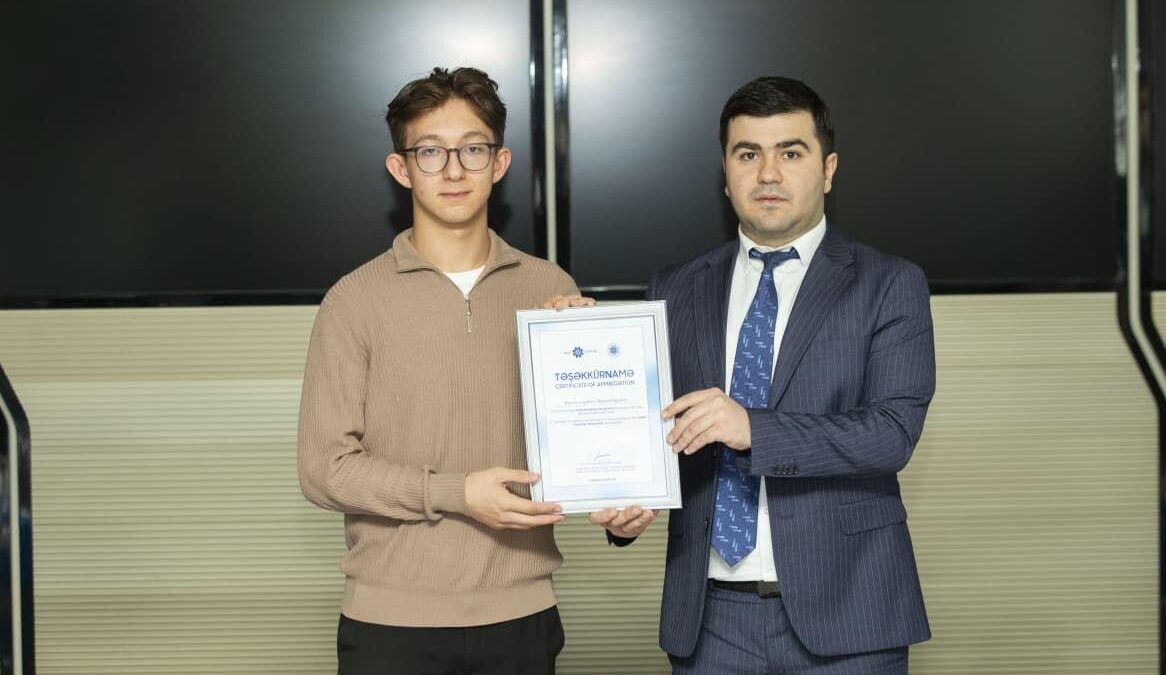
Today, we present to you a young talent who stands out with his international achievements, deep interest in technology, and strategic mindset — Bayram Eyyubov.
His story is not limited to medals and certificates; it is a path of development shaped by purposefulness, analytical thinking, and a desire to create real impact. Bayram has not only achieved success in international science olympiads but has also acquired professional knowledge in Data Science and provided innovative solutions to real-world problems through entrepreneurial initiatives. He does not settle for theoretical knowledge alone — he applies this knowledge in real projects to achieve concrete results. His main goal is clear: to study at the University of Pennsylvania’s Wharton School, the world’s most prestigious business school, to have a say in the global financial system and be at the center of strategic decision-making. In this interview, we will get to know Bayram Eyyubov’s success story, his unique perspective, and his future vision.
– Among the successes you have achieved in international competitions, which one is the most valuable to you and why?
The most valuable for me are the two gold medals I won at iSTEM. This success was not just an award, but the first major step proving that my knowledge is valid in world-class competition. In addition, being part of the National Economics Team is strategically more important because it forms the direct foundation of my future career — the field of finance and economics.
– What new perspectives did participating in platforms like iSTEM and Exporecerca give you?
These platforms taught me about multiculturalism and that science knows no borders. Especially at the Exporecerca exhibition in Spain, I realized that young people from different countries can offer completely different yet complementary approaches to solving the same problem. This experience showed me the real power of teamwork and global networking.
– By combining Mathematics and Data Science, what problems do you plan to solve in the future?
My main goal is to minimize risks in financial markets through predictive models. My experience has shown that with the correct analysis of large volumes of data, it is possible to solve real business problems in a very short time. In the future, I want to build systems that can predict economic crises in advance and optimize the decision-making process.
– How did your interest in Data Science arise, and what are the main skills that set you apart?
My interest arose from the desire to find patterns behind seemingly chaotic data. The main feature that distinguishes me is the synthesis of speed and analytical intelligence. My high typing speed allows me to realize my thoughts operationally. Furthermore, the technical education I received has formed a complex and systematic approach to problems.
– How did the idea for the “Lumeni” startup arise, and what was the biggest challenge you faced?
The “Lumeni” idea arose from the desire to apply technology to everyday problems. The biggest challenge was to create a real product with a limited budget. This process taught me the importance of proper resource management and the “lean startup” approach.
– What was your main goal when building the CCIA project?
My goal was to make life easier for foreigners living in Azerbaijan and to present the country’s hospitality in a digital environment. In the future, I plan to turn this project into an AI-based platform and create a fully integrated ecosystem.
– What did the charity campaign teach you about leadership?
This experience showed me that leadership is not just about managing, but about uniting people around a common goal. Transparency, accountability, and trust play a key role in this process. At the same time, I realized how important emotional intelligence — empathy and effective communication skills — is.
– What did your volunteering experience at ASAN Service gain you?
The 180-hour volunteering activity was a real school of management for me. As a team leader, the coordination, task distribution, and motivation of a 15-person team were on me. This experience gave me operational decision-making, working under stress, and leadership skills.
– What is the main feature that distinguishes you for admission to a highly competitive university like UPenn Wharton?
The main factor that distinguishes me is my “hybrid profile.” This profile is based on three pillars: analytical depth, entrepreneurship, and athletic discipline. I do not just possess theoretical knowledge; I have also applied this knowledge in real projects. This synergy makes me a more agile and strategic-thinking candidate.
– Where do you see yourself in 10 years?
I see myself in one of the global financial centers, especially in a leadership position at one of the major investment banks. For me, this is not just a title, but an opportunity to participate in global economic decisions. My biggest motivation is not just personal success — it is to create real value for society. I believe that a person’s true value is measured by the benefit they provide to others.