
The blackmail-warning addressed to Russia by the Speaker of the Armenian Parliament, Alen Simonyan, yesterday has sparked interesting reactions in our northern neighbor. The Armenian speaker stated that if Moscow raises gas prices, his country will withdraw from the CSTO and the Eurasian Economic Union. However, he hopefully added that the situation would not reach that point.
Such a statement has caused a mix of irritation and anxiety in Russian political circles. Because in the Kremlin, they are aware that in every evil deed, there is a beginning of good – for those who seek it, of course. Or, agile and intelligent politicians can turn some risk (threat, pressure) into a chance or an opportunity…
“The claim by Armenian Parliament Speaker Alen Simonyan that Armenia will withdraw from the CSTO and the Eurasian Economic Union if Russian gas prices rise is wrong.”
This was stated by the Deputy Speaker of the Federation Council of Russia, Konstantin Kosachev.
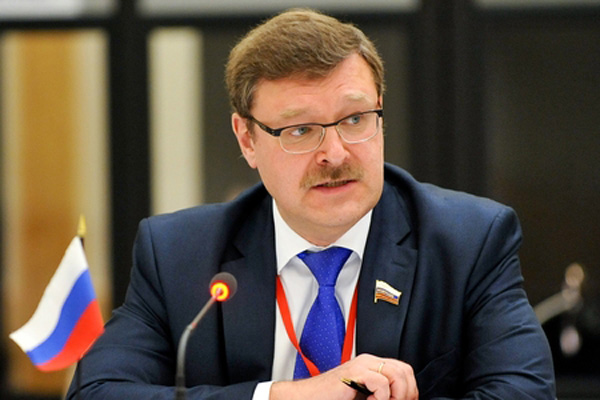
In his opinion, the very way the issue is “posed” is wrong.
Let us recall that on April 1, in the Kremlin, President Vladimir Putin told Prime Minister Nikol Pashinyan that while gas prices in Europe are above $600 per thousand cubic meters, Russia sells gas to Armenia for $177.5.
Recalling this point, Kosachev then used threatening words. Quote: “The current price of Russian gas creates a strong stimulus for the development of the Armenian economy and is an important factor for social and political stability in the country. And this is happening alongside a serious energy crisis in Europe and the world. It would be fair and honest for Armenian politicians to consider the scale of Russia’s support for Armenia instead of speculating about hypothetical changes in price policy.”
In other words, gratitude aside, the Pashinyan government should first and foremost be grateful for cheap Russian gas for the “social and political stability” within the country and should not be ungrateful. A threat doesn’t have “horns,” after all.
True, pressure with gas seems like a powerful weapon in Moscow’s hands. But this weapon can also “cut” and wound Russia itself. The issue is not just about finding alternative energy sources, including Azerbaijan. In a “force majeure” situation, Baku would provide this help to Yerevan. More importantly, there is the prospect of the remaining trust in the Kremlin within Armenian society being shaken…
“In Russia, they understand that this issue is not only the view of the current government but also of the entire society; Armenian society is reconsidering its relations with Russia and the CSTO.”
This was said by Armenian political scientist Styopa Safaryan.
“Russia’s plan to put Armenia in its ‘left pocket’ and Azerbaijan in its ‘right pocket’ did not work; this policy of theirs regarding the Caucasus has been destroyed,” the Armenian expert emphasized (Teleqraf.az).
In his opinion, Russia does not know what to do regarding Armenia: “Punishing Armenia means forcing it to move faster in a direction Russia does not want, and not punishing it means allowing Armenia to continue what it is doing within the framework of sovereign policy. If they close Armenia’s access to the Eurasian market – which they are threatening to do – that would also be a problematic step. Because closing the Lars road means closing Russia’s only road to the Caucasus. Moreover, such steps could push Yerevan to make decisions that Moscow is deathly afraid of.”
Touching upon Putin’s statement regarding pro-Russian forces in Armenia, Safaryan stated that the Russian leader actually harmed those forces with this speech: “It is a disgrace for the president of another country to say that he has forces in another country that interfere in internal affairs. This means the burial of those political forces.”
According to Safaryan, that statement by Putin is enough for the Central Election Commission of Armenia not to register those forces.
Is it clear now who the winner of the tense April 1 negotiations in the Kremlin is? It means that physical pressure methods against Nikol Pashinyan may intensify…