
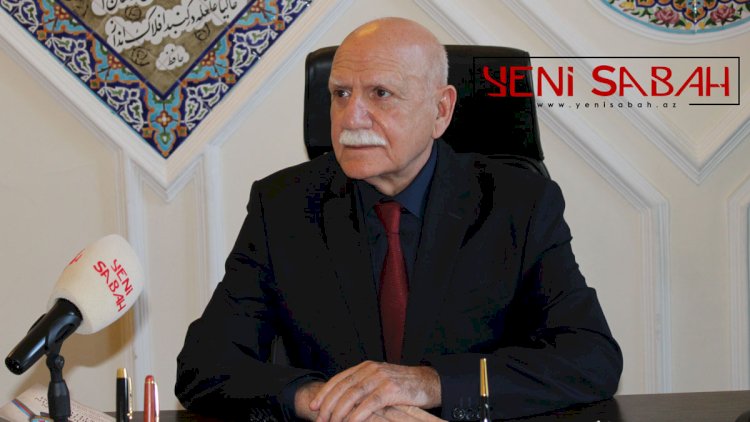
Interview given to “Yeni Sabah” by Isa Najafov, judge of the Constitutional Court of the Republic of Azerbaijan, former First Deputy Prosecutor General of the Republic of Azerbaijan, and State Counselor of Justice, 3rd Class:
— In 2010, Ramiz Mehdiyev sharply criticized the work of the Constitutional Court at the ceremony introducing new judges and demanded that the situation be corrected. What was the reason for this statement?
— Ramiz Mehdiyev, by his legal status, was the head of the apparatus. There are three heads of apparatus with equal status: the head of the apparatus of the Constitutional Court, the head of the Presidential Administration, and the head of the apparatus of the Milli Majlis. They are equal in terms of authority. As a citizen, he could express his opinion about the Constitutional Court. But as a state official, he should not have spoken that way about another branch of government. Because some time after those remarks, many things were said about Ramiz Mehdiyev himself being corrupt, and several facts came to light.
— Was the Constitutional Court confident that Ramiz Mehdiyev had expressed not the President’s position, but his own personal views?
— Most likely, it was his personal position. Because, as I just noted, Ramiz Mehdiyev was engaged in a struggle for power.
In August 2002, a presentation of my book Midnight Murder was held at the “Gulustan” Palace. I was the first to speak there. I spoke about two facts. The first was about Namig Abbasov’s failure to carry out the President’s instructions and his destruction of documents related to the January 20 events. Because at a meeting I attended, National Leader Heydar Aliyev instructed that all documents related to January 20 be preserved. In February 2000, the criminal case related to the January 20 events was brought to my desk. At that time, I reopened the case — we arrested Sadiq Aliyev, a former employee of the State Security Committee in 1990, and declared a wanted search for a man surnamed Mirzayev.
Acting on orders that had come from Moscow, they had deliberately provoked disturbances in areas where people had gathered in large numbers, and then opened fire on soldiers, thereby creating the appearance of a mass killing of civilians by Soviet troops.
At that time, I appealed to Namig Abbasov to obtain the documents from the Ministry of National Security. He did not accept my request. Left with no other option, I asked the National Leader for help. And the National Leader, in my hearing, instructed Namig Abbasov to give me the necessary documents. At the presentation of my book, I said that by doing this, Namig Abbasov had betrayed the nation and the state. All deputies, heads of departments of the Presidential Executive Office, and heads of directorates of ministries were present at the event. There, I also mentioned a second fact: in 1995, although the Turkish government knew that an assassination attempt would be made on Heydar Aliyev, Suleyman Demirel, while in Copenhagen, did not tell the National Leader that when you return to Baku, they will kill you. The National Leader himself told me this. “Suleyman Demirel told me, ‘Heydar, go back to Baku, the situation there is bad.’ But he did not tell me anything about the assassination attempt.” I also wrote this in my book.
The day after my speech at the book presentation, I saw that everyone was avoiding me. In this regard, I called the National Leader. I told Presidential aide Tariyel Valiyev that I wanted to speak to the President.
It was 7 p.m. The National Leader spoke with me. He asked what the matter was. I said, “Mr. President, after my speech the situation has changed, people are looking at me differently. Your officials do not want to receive me; for some reason they are afraid.” He asked, “Who are they?” I named them. At that moment, on another phone line, the National Leader told someone that my speech at the book presentation should be shown in full on television that evening.
After my speech was broadcast on television, people’s attitude toward me changed again.
Years passed. One day, Nizami Khudiyev called me. By that time, he had already left the post of chairman of AzTV. He said he wanted to meet with me. We met in Fountain Square. He said that the morning after my speech, Ramiz Mehdiyev had called him and told him not to broadcast Isa Najafov’s speech. I told him, “How can I not broadcast it? It is his position, I must air it.” After that, Ramiz Mehdiyev became angry with me. Nizami Khudiyev said that later that evening, the National Leader called him and said, “His speech is not in the newspapers; they made a mistake, air Isa’s speech.” He said that Ramiz Mehdiyev called him five times that day and told him not to air Isa Najafov’s speech.
Ramiz Mehdiyev had a purpose in this as well. Everyone knew that the National Leader’s condition was not very good. Ramiz and others were struggling for power. They wanted to come to power. Groupings had already formed. Ramiz was in that grouping, Namig was there, Eldar was there. This game was underway, do you understand? And there were also forces working against them.
Heydar Aliyev had a saying: nothing can move from its place without God’s decree. We had to wait for favorable conditions for war. And favorable conditions mean that when you wage war, external forces should not be ready to act against you. The situation must be in your favor; conditions must be favorable for you.
In 2020, such conditions emerged. On the one hand, there was the coronavirus — everyone was preoccupied with it. On the other hand, Russia did not interfere in those processes. The main issue was Russia. Russia stood behind the Armenians. We took advantage of this situation and won victory in a short time. This was the result of both our President’s foreign policy and the work carried out domestically. War itself is a game. In this game, unity among political forces is necessary. Your strength must be greater than that of the other side. The roads were blocked — where were the Armenians going to get ammunition from? They brought part of it through Iran, but there were Azerbaijanis there too. Since the right conditions had formed, the President skillfully used them and we won. We left behind 30 years of negotiations. If we had agreed to the plans proposed by the OSCE Minsk Group, that is, if we had signed those agreements — first 2 districts, then several more districts — we would not have been able to fully ensure Azerbaijan’s unity and independence. There still would have been a wound somewhere. Now no such wound remains in Azerbaijan. The President healed all of our wounds. His work in this direction still continues.
— You said that the Ramiz Mehdiyev–Namig Abbasov–Eldar Hasanov grouping wanted to remove Safar Abiyev from the game…
— In 2003, Ramiz Mehdiyev and Namig Abbasov supposedly invited Safar Abiyev somewhere as a guest. There, two army generals had spoken by phone, and they wanted to use that to put him in a bad position. But it did not work. Safar Abiyev was a force standing behind the government. He did not participate in the meetings held by that grouping.
— What was the subject of the generals’ conversation?
— While speaking to the other, one general, expressing his dissatisfaction, said something approximately like: “It is impossible to live under this government.”
— Which generals are we talking about?
— One was Rovshan Akbarov, commander of the 4th Corps, who was arrested in 2021, and the other was another general serving in the General Staff. Their phone conversation had been recorded. But it was not heard very clearly.
— Was there talk in that phone conversation of overthrowing the government?
— There was such an element.
— Was Safar Abiyev involved in this as well?
— No. I do not know what they had done there. They were saying that there had been a phone conversation and that Safar Abiyev had also said that such a thing could not happen.
— At the time, the press wrote that in his speech sharply criticizing the Constitutional Court, Ramiz Mehdiyev accused the court of disorder and bribery. After that speech, were there any attempts to supervise or interfere in the Court’s work?
— The Constitution does not provide for anyone to supervise us. No one can supervise us. We are the body that exercises constitutional oversight. We examine whether other bodies comply with the provisions of the Constitution. The Constitution grants us this authority.
— What was the President’s attitude toward this situation? Did he support Ramiz Mehdiyev?
— The President’s attitude toward the Constitutional Court was good. After Ramiz Mehdiyev’s speech, no reaction was expressed.
— After Ramiz Mehdiyev criticized the Constitutional Court’s activity, it seemed that he was trying to expand his influence over the Court…
— Nothing of the sort happened. There was no interference in our work, and we continued our work as before.
— So the criticism ended with just a statement? There were no attempts to interfere in your activity?
— No. The Constitution does not allow that. He has no authority for that. He came, introduced three people as judges of the Constitutional Court, said what he had to say, and left.
— What is your workload as a judge? In general, how is work distributed in the Court?
— There are inquiries and applications related to the interpretation of laws. Then there are complaints concerning violations of citizens’ rights. This is our main work. The Chair distributes these applications among the judges. Unlike the Supreme Court and appellate courts, our work is creative. Most of all, we interpret laws and eliminate problems in the application of laws. We отменe Supreme Court decisions in cases where someone’s constitutionally protected rights have been violated. Then the Supreme Court re-examines those cases on the basis of our decisions and adopts the relevant rulings.
If the Supreme Court reviews 10,000 cases a year, we review 15–16 cases.
Ten years ago, the Chairman of the Constitutional Court of Turkey came to Azerbaijan. We asked him how many cases he had in proceedings. He said about 300,000. It is a large country.
— The Constitutional Court of Turkey hears many political cases…
— There are an excessive number of political cases there. We do not have political cases.
— Why not? Is this an indication of political activity, or a lack of trust in the Constitutional Court’s ability to influence politics?
— Turkey has a great and ancient history. The ombudsman institution was first created in Turkey. After the Norwegian king Charles XII was defeated by Peter I, he took refuge in the Ottoman Empire. During that period, he observed the Ottoman administrative system and saw that there were officials there who examined complaints through institutions such as the divan and the qadi system. That system later developed and influenced the creation of the ombudsman institution in Europe. In other words, Turkey’s judicial structure has historically functioned very well.
We have only recently gained independence. If you ask our people today about what happened in our recent past, many will not know. In the 1990s, people could not go outside after 10 p.m. Now the state has been built, and security has been ensured, in such a way that the city of Baku does not sleep until morning. No one is afraid to go outside at night. This is a major achievement of our Ministry of Internal Affairs. But in 1995–96 we used to work in the city police department until 5 or 6 in the morning. Now the city stays alive until morning. We have achieved this, but current officials do not know how we achieved it. Now the balance of forces within the state has stabilized.
Back then, the late President maintained balance differently. Governance had been organized in such a way that there was mutual oversight. Now there is no need for such mutual oversight.
Guests had come from England. I asked them: “Can you go out into the city in London?” He said, “After 10 p.m., women cannot go out into the city because of fear.” This peace, comfort, and calm are therefore a great blessing for the nation and for the people. All of this has been created through the President’s efforts.
— You came back to this topic after my question about political activity, so let me clarify: why does the Constitutional Court not consider cases with political content?
— Do you know about the beginning of the 1990s? They call it national revival, they call it a people’s movement. How was this movement created, who created it, in what direction was it created? What forces did it gather, and which did it disperse? Are you aware of these processes? There is no state in whose affairs major powers with an interest in that state do not interfere. How do they interfere? First of all, they identify the people they need. After finding those useful people, they create groups, then direct them and finance them. They tell those groups that they must establish democracy. But the democracy they speak of is aimed at destroying the existing peace so that chaos will arise.
After the USSR collapsed, the balance in the world was disrupted. When the balance in the human body is disrupted, when metabolism is disrupted, a person becomes ill, right? In 2003, Lucius Wildhaber, Chairman of the European Court of Human Rights, came to Baku. One day, while we were going to lunch, I asked him a question. I said: “The USSR has collapsed, the balance in the world has been disturbed; what does Europe think?” He said that the answer he would give was not for the press. “We are trying to unite and create a balance in the world with America.” They united, but they could not create that balance.
Now the forces that gather and finance the people they need here are trying to upset the balance that exists here. They want chaos to emerge and to achieve their own goals. What are their goals? I do not want these people to remain in power. Let others come to power, let the country weaken. If they had broken this balance, would we have been able to win the war?! No, absolutely not! We would have been preoccupied with ourselves. So, in order to defeat the enemy, you must create balance, you must create a united force. And everyone must move in the same direction.
— So do you believe that low political activity serves our national interests?
— Not low activity. Rather, activity that corresponds to the wishes of the majority — that is, the State. Political forces must serve our interests. In 1992, in the Milli Majlis, Arif Hajili said in a speech that 9 foreign states support us. He did not say that the Azerbaijani people support us. The National Leader used to say that the Azerbaijani people support me. The people demonstrated that support to him on October 4, 1994. Our President has never once said that some foreign state supports him. Therefore, some of the politicians you speak of have realized their mistakes.
All forces must be united, not set against one another.
— Doesn’t society also need an opposition?
— Opposition is needed. But there must be no insults or obscenity. Opposition opinions should be expressed through criticism. If you stand there cursing and saying whatever comes into your mouth, that is not a political force. One of those figures is Gurban Mammadov. In 1997, Gurban Mammadov wanted to do something together with Namig Abbasov. They had arranged it in such a way that an attempt would be made on Heydar Aliyev. Although I, as First Deputy Prosecutor General, supervised the Ministry of National Security, I knew nothing about this matter.
One day Eldar Hasanov was absent. Namig Abbasov called me and said, “There is an instruction from the President, come here and let us look at it.” I went. He put two sheets of paper in front of me and I read them. When I moved on to the second page, I said, “They have devised a plan to kill the President.”
There was the head of the investigation department of the Ministry of National Security, Rufat Mansurov. He said, “Isa muallim, I have been telling them this for two weeks, but they do not want to listen to me.” I said, “Quickly open a criminal case and prepare a decision regarding Gurban’s arrest, bring it to me and I will sign the sanction.” He went, initiated the criminal case, drafted the decision, brought it, and I signed the sanction. Namig Abbasov then said, “Isn’t Gurban Mammadov your fellow student?” I said, “I graduated in 1979. Gurban entered the law faculty in 1981 or 1982. How is he my fellow student?” He said, “But Eldar Hasanov says Gurban is your fellow student.” I replied, “Then the fault is Eldar’s. He is not my fellow student.” Such games were being played, do you understand? They wanted to link Gurban Mammadov to me. He ended up receiving a 7-year sentence. He is capable. But he uses his abilities for his own interests. A person who loves his homeland and his State must first of all protect the interests of the state and the homeland.
— After his harsh criticism of the authorities on his internet channel, his properties in the Narimanov district were demolished…
— If he has property in the Narimanov district, then why does he not want to benefit from the state? The state created the conditions for him, and that is how he came to own those properties. Not everyone can have such opportunities. He is a very ungrateful person.
To be continued…