
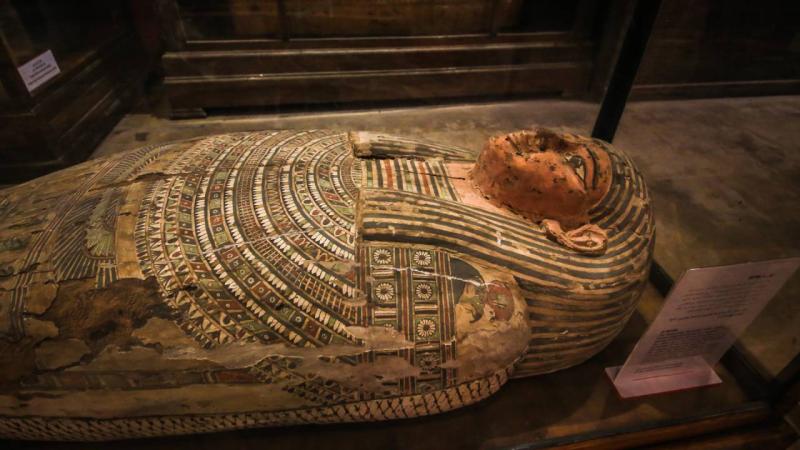
The distinct woody, spicy, and sweet scent of ancient Egyptian mummies is opening a new avenue of research for scientists. Organic geochemists at the University of Bristol have developed a new technique that analyzes the odor molecules released into the air by “smelling” them, instead of using traditional methods that damage the mummies.
“Elchi” reports that archaeologists typically cut pieces from mummy wrappings and dissolve them in a solution for analysis, but this process both damages the integrity of the mummy and causes some molecules to break down.
The new method involves sampling volatile organic compounds (VOCs) in the air around the mummy.
In this way, the materials used can be identified without touching the mummy, simply by tracing its emitted odor signatures.
Mummification recipes that evolved over time
Studies on 19 mummies found in museums in Europe and England, dating from 2000 BC to 295 AD, revealed how mummification recipes evolved over time. Early periods: Simpler animal and vegetable oils were used. The process continued: The recipes became more complex; expensive oils derived from plants such as juniper, pine, and cedar, as well as beeswax and bitumen (tar), were added to the mixture.
Şayəstə