
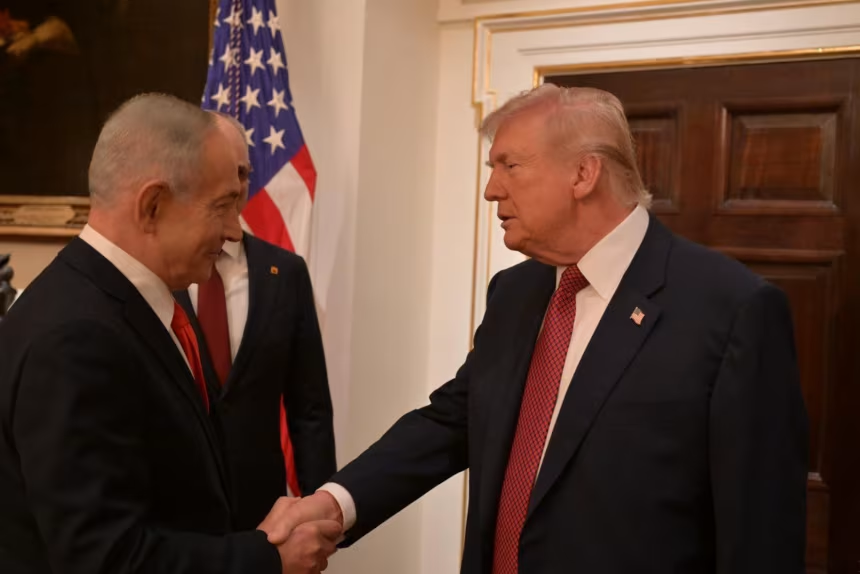
Only one photo was released to the public from the meeting between Donald Trump and Benjamin Netanyahu on Wednesday: a moment of shaking hands in the Oval Office. The photo was shared by the Israeli Prime Minister’s office. Apart from that shot, there were no reporters, no statements, and no spontaneous “gaggle” where questions are usually asked.
This secrecy added extra interest to the meeting, which already seemed urgent against the background of United States–Iran tensions. The meeting was brought forward by a week at Netanyahu’s request. While the US is trying to continue the line of negotiations with Tehran on the one hand, it continues to increase its military presence in the Middle East on the other.
Trump, who usually doesn’t shy away from cameras, only made a social media post after the meeting. Netanyahu’s office issued a brief statement emphasizing the continuation of “close coordination and relations,” without going into detail.
Trump’s post on Truth Social showed that he insisted on continuing the talks. This seems to contradict Netanyahu’s position, who has long opposed the nuclear deal and is said to have wanted to discuss possible new strike plans against Iran during his visit to Washington.
Netanyahu later admitted that he had conveyed his concerns to Trump. He said this on Thursday before leaving for Israel: “He wanted to hear my opinion. I will not hide from you that I expressed my general skepticism about the quality of any agreement with Iran.”
He emphasized that any future agreement should cover not only Iran’s nuclear program, but also its ballistic missile program and “proxy networks” in the region. According to Netanyahu, these are critical not only for Israel’s security, but also for regional stability in a broader sense.
Whether the closed format of the meeting and the absence of cameras allowed the parties to hide their differences, or, on the contrary, they quietly coordinated their future steps, is not yet clear.
But even without cameras, any meeting in the Oval Office serves Netanyahu’s domestic political needs: especially against the background of the election year, this is a message to the domestic audience. Netanyahu often emphasizes how many times he has met with Trump since he returned to office — seven times, which is more than any other world leader. News of each meeting with the president remains on the agenda for days, allowing the prime minister to escape from the growing political problems in the country — at least for a short time. But those problems “catch” him again when he returns to Israel.
Reportedly, the parties did not share extensive details about what was discussed between Trump and Netanyahu on Wednesday.
Elections are required to be held by the end of October, and Netanyahu has told his inner circle that he wants to serve his full term. However, the coalition faces the risk of splitting due to the looming crisis over the 2026 state budget: the budget must be approved by March 31. If it is not adopted, the parliament — Knesset — is automatically dissolved and elections are usually held within 90 days; this increases the possibility that the vote may take place around June.
The ultra-Orthodox parties, one of the main partners in Netanyahu’s coalition, have linked their support for the budget to the preservation of their electorate’s long-standing exemption from compulsory military service. They are demanding the adoption of a controversial bill that would legalize this. Months of negotiations have failed to create a compromise between the coalition and the demands of the Supreme Court; the court wants to ensure enforcement against evasion of military service. Since no concrete compromise is in sight, many political observers believe that the Netanyahu government’s time is already running out.
Political consultant Nevo Cohen (who previously advised far-right politician Itamar Ben-Gvir) believes that even if the budget is passed, the coalition will break up and elections will be announced in a few weeks.
“The Haredim (ultra-Orthodox) need money, so the budget will most likely pass,” Cohen said. “But they won’t be able to get the conscription (military service) law, and therefore they will break up the coalition. I think that in about a month and a half, the Knesset will be dissolved.”
According to Cohen, one of the main pillars of Netanyahu’s re-election strategy is to highlight his relationship with Trump — presenting it as proof that he is in a “different league” from his rivals.
Some officials within Netanyahu’s Likud party believe that the timing of the elections depends heavily on contacts with Trump. A senior Likud source said: “Netanyahu will only make a decision on how far he will go to protect his coalition after returning from Trump.”