
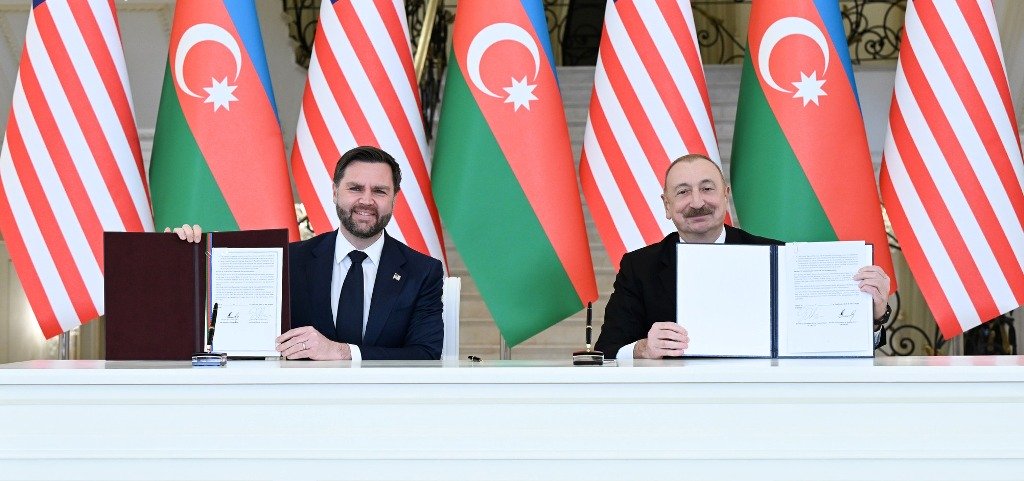
The official visit of the United States Vice President J.D. Vance to Azerbaijan on February 10-11 and the signing of the “Charter on Strategic Partnership between the Government of the Republic of Azerbaijan and the Government of the United States of America” officially transformed the relations into a strategic partnership, bringing them to the highest level.
This document is a logical continuation of the historical meeting between the President of Azerbaijan and his American counterpart Donald Trump in Washington six months ago, and the manifestation of the intense and result-oriented work of the delegations, the triumph of a successfully completed dedicated activity. Thus, new opportunities have been created for comprehensive bilateral cooperation based on mutual trust between Baku and Washington.
The discussions held during the one-on-one and expanded meetings between the President of Azerbaijan and the US Vice President are of great importance in terms of evaluating various aspects of the bilateral agenda, as well as the directions of regional development. This is also a demonstration of the desire of the second leader of the US, based on the future vision of the Trump-Vance administration, to strengthen partnership between countries and contribute to bilateral relations, and to work for successful cooperation.
Vice President Vance’s statement that “unfortunately, one of the mistakes made by the last administration was the pursuit of a very absurd policy towards Azerbaijan. We fixed it under the President’s leadership. We will achieve more in the next three years” is perceived as a recognition of the high trust and confidence in Azerbaijan and its Leader.
In general, since the period of independence, the US administrations have not had such close and warm contacts with Azerbaijan, and broad cooperation platforms have not been established. The rise of relations to the maximum political peak is the result of the wisdom, will and determination of President Aliyev and President Trump.
As stated in the US Vice President’s statement to the press, a long-term, very important partnership and friendship with Azerbaijan is a fundamental principle for them, and Baku is loyal to this friendship. For this reason, the US, as a global leader, is implementing its decision to open a new page with Azerbaijan in the political-economic, security, information technology and other important fields.
The fact that our country fights shoulder to shoulder with the US and its NATO allies in anti-terrorist operations, and that the Azerbaijani soldier was among the last to leave Afghanistan within the coalition forces, in the words of J.D. Vance, has led to our soldiers gaining a reputation as one of the few most combative and courageous troops in the world. In 2021, against the background of the Biden-Harris administration’s “disgraceful escape” from Afghanistan, the expression of such gratitude to the Azerbaijani state on Azerbaijani soil has great symbolic meaning.
Of course, the main factor in building the architecture of regional development and prosperity is the peace factor. Building sustainable peace trust between Azerbaijan and Armenia creates a regional development boom. This process constantly brings its political and economic dividends, and the peace environment strengthened in six months has created a starting point for economic and trade cooperation between Azerbaijan and Armenia. Our country has removed all restrictions in regional transit and has started supplying oil products to Armenia itself.
One of the important results of continuous efforts in the region is the TRIPP project – the Trump Route for International Peace and Prosperity, which is the Zangezur corridor passing through Armenia. This road will connect the two parts of Azerbaijan, as well as connect Asia with Europe through the territory of Armenia and other neighbors, turning it into a reliable, safe and large-scale transportation corridor.
The document that will be considered a roadmap for cooperation between Azerbaijan and the United States and a concept of long-term joint cooperation is the Strategic Partnership Charter. This strategic document signed by the President of Azerbaijan and the US Vice President reaffirms their support for each other’s sovereignty, independence, territorial integrity and inviolability of borders as the basis of bilateral relations.
The document reflects joint intentions to strengthen relations in areas of mutual interest, including regional connections, economic investment and security, diplomatic, economic, energy, technological and security fields. In this process, special importance is attached to the involvement of not only state institutions, but also the private sectors of both countries, which will increase the incentives for investment in our country by the giant business elite of the United States, which is considered the number one economy in the world – corporations and companies that are leaders of the global economy.
Azerbaijan is becoming one of the most reliable points of the Trans-Caspian International Transport Route (Middle Corridor), ensuring the fluidity of international transportation as a transit hub for transportation in the East-West direction. The international trade and logistics family, taking into account the importance of this strategic and geographical position of Azerbaijan, supports our country in the Middle Corridor. This important factor is widely covered in the Charter document, and it is planned that Azerbaijan and the United States will take joint steps in the development of regional connections, including the land, sea and air transport infrastructure of the Middle Corridor. Even cooperation in facilitating the transit of critical minerals to global markets has been identified as one of the main priorities, which indicates Washington’s trust in Azerbaijan in the transit of strategic products.
America’s special interest in the Zangezur hub, which is becoming the next link in the Middle Corridor, is reflected in the creation of the “Trump Route”. The mention of the importance of TRIPP as a multimodal connectivity project in the Charter, as well as plans to take steps towards the implementation of joint projects such as interconnector projects and the diversification of supply routes through partnership in a bilateral format and with third countries, indicates that Azerbaijan and the United States are building huge transportation models in Eurasia. This is also a new door for diversifying Azerbaijan’s potential resources in the energy supply of the global market.
Currently, Azerbaijan provides energy security to 16 countries with its natural gas. 11 of them are US NATO allies. From this point of view, keeping energy diversification in focus as one of the clauses in the Charter expresses confidence in the further increase of our country’s role as an energy supplier.
The priorities in the document related to deepening civil nuclear cooperation, developing close partnership contacts in the space industry, artificial intelligence and digital infrastructure, imply that the two states will take joint steps in building a digital state, and include the technological renaissance in the South Caucasus-Central Asia region.
The Charter is also a guarantee document for peace in the South Caucasus. Azerbaijan and the United States will advance close contacts on the architecture of peace and prosperity, and will benefit international and regional peace and security on the basis of a security format.
This platform is also an important factor for expanding the scope of cooperation in the fields of defense and security, including the sale of defense industry products, and cooperation in anti-terrorist activities. Also, increasing capabilities in the field of cyber security and protection of critical infrastructure, and combining efforts in mine clearance are based on the security landscape.
In a word, Vice President James David Vance’s visit to Azerbaijan went down in history as a positive stage in Azerbaijan-US relations and defined new geopolitical priorities in the region.
Ramid Namazov
Milli Məclisin deputatı