
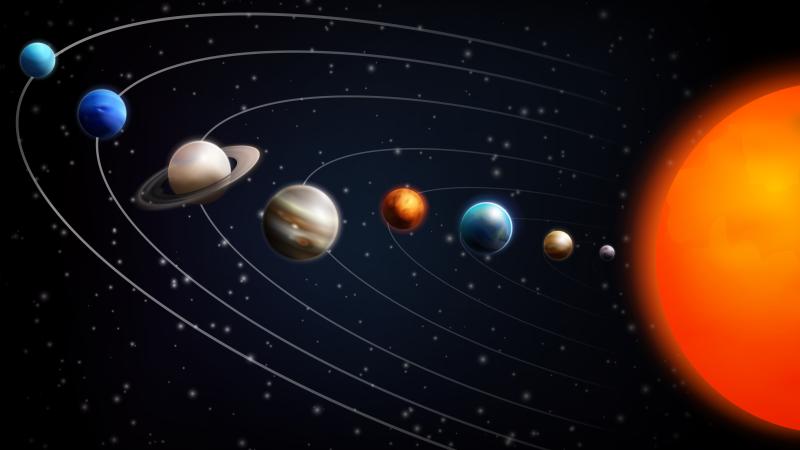
According to researchers using telescopes from NASA and the European Space Agency (ESA), the exoplanet system located approximately 116 light-years from Earth could completely change our understanding of how planets form.
“Elchi” reports that researchers using telescopes from NASA and the European Space Agency (ESA) have discovered the LHS 1903 system, which orbits a red dwarf, the most common type of star in the universe.
The four planets in this system exhibit a rather strange alignment; the innermost planet is rocky, the next two are gas giants, and unexpectedly, the outermost fourth planet is rocky again.
This alignment is completely contrary to the common patterns in our solar system and galaxy, where rocky planets orbit closer to the star and gas giants orbit farther away.
In the common model where planets form from a disk of gas and dust around a young star, astronomers claim that only iron and rock-forming minerals can solidify because regions close to the star are too hot.
In regions farther from the star and colder, water and other compounds freeze, allowing giant cores to form. The cores then attract gases such as hydrogen and helium, turning into giant gas planets.
Thomas Wilson, the lead author of the study published in the journal “Science,” states that this discovery is the first example of a rocky planet in such a distant orbit after the discovery of gas-rich planets.
Şayəstə