
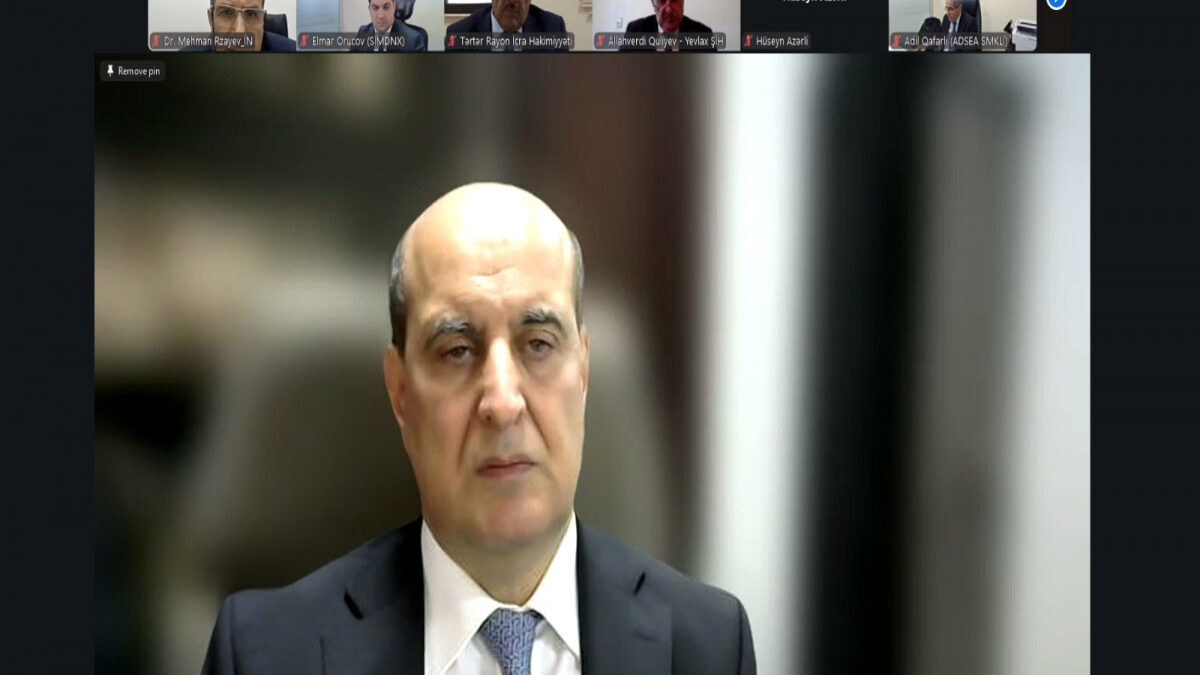
In order to ensure the execution of the Decree No. 85 of the President of Azerbaijan dated April 15, 2024 “On measures related to the reconstruction of the Karabakh irrigation canal”, the next meeting of the Working Group established by the relevant order of Zaur Mikayilov, Chairman of the Azerbaijan State Water Resources Agency (ADSEA), was held online.
This was reported to Elchi.az by the State Service for Control over the Use and Protection of Waters.
According to the information, Rafiq Aslanov, the head of the Working Group, said at the meeting that the Karabakh irrigation canal, the country’s largest main irrigation canal, provides irrigation water to a total of 115,000 hectares of cultivated area in the Karabakh zone and 9 nearby regions, as well as domestic water to residential areas. He also noted that support was provided to the water supply of the relevant cultivated areas due to the additional water transfer to the Bahramtepe hydro junction located on the Araz River, but since the canal is earthen, difficulties arise in its operation, and also due to the loss of approximately 300 million m³ of water per year, certain difficulties arise in meeting the water supply during the vegetation period.
He also noted that the reconstruction of the Karabakh irrigation canal within the framework of the execution of the Order was successfully carried out by the contracting organizations, and that the issues arising in the execution process were promptly resolved together with the members of the Working Group, emphasizing the need to finalize the project-estimate documents for the reconstruction of the canal and implement its construction.
Then, a presentation was made on the current status of the project documents jointly prepared by the project institute under the Azerbaijan State Water Resources Agency and the specialists of PROYAPI and TEMELSU companies involved in the project. The presentation stated that the project-estimate documents of the 26 km first section of the Karabakh irrigation canal are about to be completed, and that the research of possible options for the project has been completed, taking into account the development prospects of agro-industrial complexes in the Karabakh, Mil and Mughan plains.
Representatives of the Ministry of Agriculture, the State Committee for Urban Planning and Architecture, the Ministry of Ecology and Natural Resources, the Ministry of Economy, the Ministry of Emergency Situations, the cities of Mingachevir and Yevlakh, as well as the executive authorities of Barda, Tartar, Agjabadi, Aghdam, Beylagan and Imishli regions, who are also represented in the Working Group along with the Azerbaijan State Water Resources Agency, also spoke at the meeting and expressed their opinions and suggestions, stating that the project was prepared in a timely and professional manner.
In the end, the head of the Working Group noted that the first phase of the Karabakh irrigation canal, i.e. the 26-kilometer section, is planned to be completed in the first half of this year and to receive relevant opinions from the relevant agencies. In general, it is planned to fully complete the project-estimate documents of the Karabakh irrigation canal by the end of the year. Construction work on the first phase is scheduled to begin in the second half of 2026. With the completion of the construction, in addition to improving the water supply in the areas served by the canal, it will also have a positive impact on the ecological and meliorative condition of the surrounding areas.


