
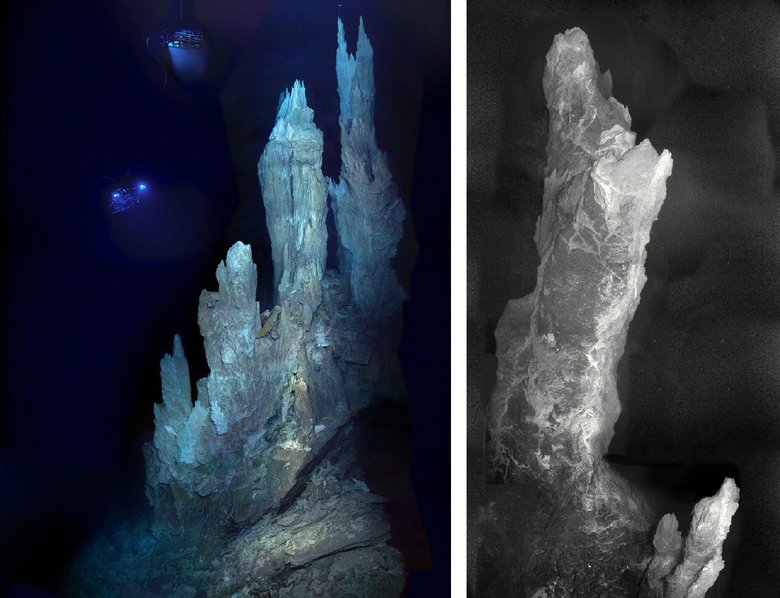
In the depths of the Atlantic Ocean, west of the Mid-Atlantic Ridge, lies one of the most extraordinary places on the planet – the hydrothermal field called “Lost City”. This is a complex of huge calcite towers and columns located at a depth of more than 700 meters in the ocean. The largest of them reaches a height of 60 meters – almost as tall as a 20-story building. Scientists believe that such places may have been one of the cradles of life on Earth.
Elchi.az reports that the “ScienceAlert” portal released information about this.
Lost City was discovered in 2000 by deep-sea research equipment and has since remained a unique object: nothing similar has been discovered in the world. According to researchers’ estimates, hydrothermal activity has been going on here for at least 120 thousand years, perhaps longer. Unlike classic “black smokers”, they exist not due to volcanism and magmatic heat, but due to chemical reactions between seawater and the Earth’s mantle rock layers.
As a result of these reactions, hydrogen, methane and other gases are released into the surrounding water. These serve as an energy source for microbial communities living in the voids and cracks of carbonate towers without sunlight and oxygen. The liquid temperature here is relatively low – about 40 degrees Celsius, but this is enough to support a complex ecosystem. Bacteria, snails and crustaceans live around the sources, while larger animals, such as crabs and eels, are less common.
“Lost City” is of particular interest to scientists studying the origin of life. The hydrocarbons formed here arise only as a result of geochemical processes at the bottom of the ocean, and not from carbon dioxide in the atmosphere or through photosynthesis. Since hydrocarbons are the building blocks of living organisms, this reinforces the hypothesis that life could have arisen in just such conditions – long before an oxygen atmosphere arose.
In 2024, researchers drilled at a record depth in the Lost City area: they were able to take a mantle core more than 1.2 kilometers long. Analysis of these samples may shed light on the chemical processes that occurred on Earth billions of years ago and help understand how inanimate matter turned into living matter.
Scientists also note that ecosystems similar to “Lost City” can theoretically exist outside of Earth. For example, the ice-covered oceans of Jupiter’s and Saturn’s moons – Europa and Enceladus – as well as Mars in the distant past, are examples of this. According to microbiologists, if life can exist somewhere without the sun, then it is in such chemically active environments.
Despite its scientific value, “Lost City” remains a sensitive object. In 2018, it became known that Poland had obtained permission for mineral exploration and extraction in nearby areas on the ocean floor. Although the hydrothermal area is not directly intended for extraction, scientists fear that pollution and waste from mining operations may harm the sensitive ecosystem.
Məryəm