
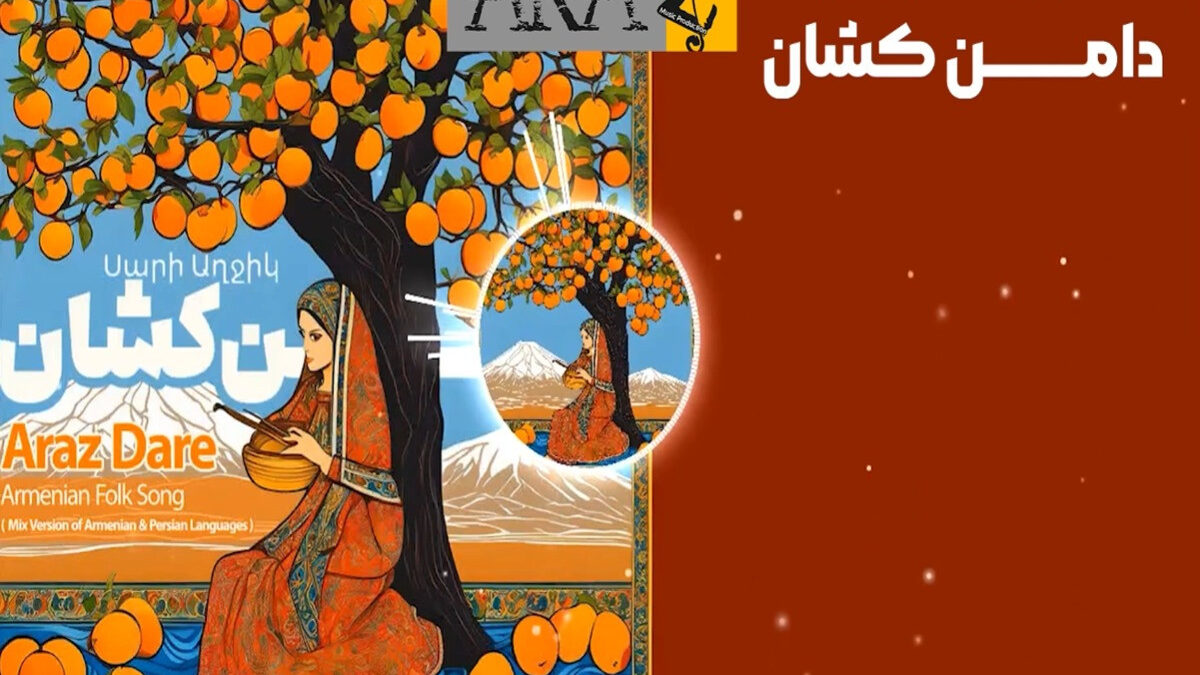
Recently, on a television channel of the Islamic Republic of Iran, singer and composer Araz Torosyan (Araz Dare) performed the Azerbaijani folk song “Sari Gelin” in Armenian and Persian.
According to the Intellectual Property Agency to Elchi.az, a number of Iranian websites presented the Azerbaijani folk song “Sari Gelin” as an Armenian song.
It was reported that Araz Torosyan also shared the song “Sari Gelin” on his YouTube channel as the Armenian folk song “Sari Aghjik”.
In this regard, the Intellectual Property Agency stated that the folk song “Sari Gelin” belongs to the Azerbaijani Turks.
“According to the opinion of the Agency’s expert, composer Javanshir Guliyev, the song ‘Sari Gelin’ was written in the ‘Shur’ mode. The ‘Shur’ mode is one of the seven main modes of Azerbaijani mugham art and is most often used in national musical life. Thousands of Azerbaijani songs have been built on this mode and have been performed at all folk festivals throughout history. In terms of genre, ‘Sari Gelin’ is a long air. ‘Long air’ is a part of the folklore of Turkic-speaking peoples. The form structure from the genre differs from other folk songs: there is no refrain. The function of the refrain is performed by the modulation to the ‘Shur-Shahnaz’ branch of the ‘Shur’ mugham. ‘Shur-Shahnaz’ is one of the main branches of the ‘Shur’ dastgah, which was formed only in Azerbaijan.
It was emphasized that the book “Armenian Alien Tales” authored by Kamran Imanov, Chairman of the Board of the Intellectual Property Agency, published in several languages, extensively analyzes Armenian literary thefts, including facts exposing attempts to Armenianize the folk song “Sari Gelin”: “The book notes that in 1925, a special department was established in Yerevan at the Institute of Science and Arts, whose task was to collect and study folk music and folklore. This department was headed by S. Melikyan, a student of S. Komitas (Sogomonyan), the founder of polyphonic classical Armenian music. S. Komitas himself, who is presented in numerous Armenian studies as the ‘Genius of Armenian music’, according to the ‘Encyclopedic Musical Dictionary’ published in 1959, in addition to his obsession with religious music, transcribed more than three thousand songs, of which about 500 are currently preserved. One of the transcribed folk songs is the very beautiful ancient Azerbaijani song ‘Sari Gelin’ (‘Ethnographic Collection’, vol. 1, No. 56), given as an Armenian folk song under the name ‘Yes keza tesa’. Among other songs, it was also published with commentary by S. Melikyan in Komitas’s ‘Ethnographic Collection’. This compilation, as noted in the ‘History of Music of the Peoples of the USSR’ (vol. 1, 1970), was later given in the processing of composer K. Zakharyan (approximately in the 30s of the last century). We are now faced with a repetition of this musical theft: it is occasionally noticed both on various foreign television channels and in the foreign press that this is an ‘Armenian folk song’. For example, recently, when compiling the ‘European Music Collection’, the Armenians managed to pass off this musical gem as an Armenian song once again. It is unbelievable, but it is a fact that neither the compilers and publishers, nor the Armenians who presented this song were familiar with the etymology of the concept of ‘Sari Gelin’. ‘Sari Gelin’ is not just a fair-haired, radiant, bright bride, but it also has a hidden meaning. In Azerbaijani, ‘gelin’ comes from the verb ‘gelmek’, and ‘sari’ means ‘towards us’, therefore, ‘a bride coming towards us’. Thus, the Armenianized ‘Sari Gelin’ in the ‘European Music Collection’ remained as ‘Yellow Bride’. Not to mention that the unique ‘neylim-neylim’ refrain (meaning ‘what should I do?’) was preserved in Latin letters in Azerbaijani in this publication. The meaning of these words, which is clear to every Azerbaijani, was inaccessible to Armenian plagiarists. It should also be noted that the attempts of Komitas, the founder of Armenian music, to Armenianize the name of this song were in vain. Armenians present and sing this song under the name ‘Sari Gelin’, as it is in the Azerbaijani original,” the report says.
It was noted that every fact related to the appropriation by Armenians of copyrighted works, folklore examples and other examples of non-material cultural heritage belonging to the Azerbaijani people is constantly monitored and investigated by the Intellectual Property Agency, and assistance is provided in restoring the violated copyrights of the authors of the appropriated songs or their heirs: “Investigations are conducted in the Agency for each fact, and references are prepared based on historical grounds and proving with undeniable facts that these works belong to the Azerbaijani people, and are disseminated in the media.”