
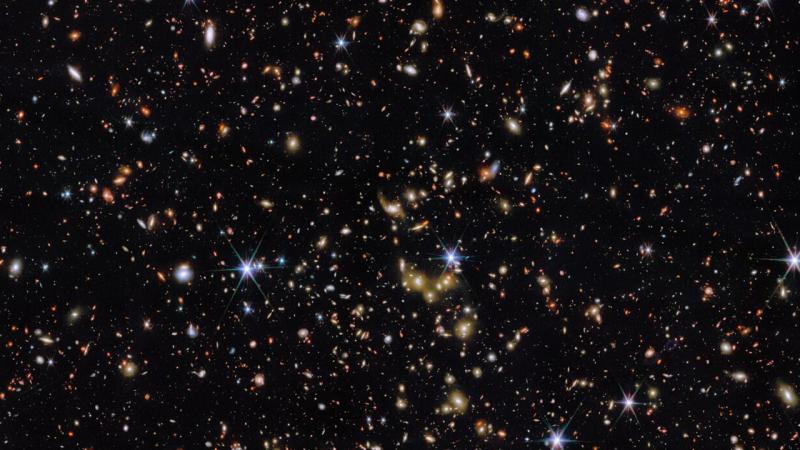
Modern science’s most fundamental assumption, that “the universe is the same in every direction,” is shaken by new data. The “cosmic dipole anomaly,” which indicates that one side of space differs from the other, invalidates standard physics models and opens the door to a radical revolution in our understanding of the universe.
Elchi.az reports that the shape of the universe is not something we often think about in everyday life. However, a new study published in the prestigious journal “Reviews of Modern Physics” and causing widespread excitement suggests that space may not be a perfect structure that extends equally in all directions. According to the study, the universe may actually be asymmetric, meaning one side is different from the other. If this claim is proven, we may have to rewrite all the fundamental rules we know about how the universe works from scratch.
The “standard cosmological model” accepted by modern science today is based on the assumption that the universe appears the same when viewed on a large scale from all directions and has a homogeneous structure. This symmetrical perspective, derived from Einstein’s theory of general relativity, greatly simplified the equations explaining the origin and expansion of the universe. However, recent data has revealed a serious flaw known as the “cosmic dipole anomaly,” indicating that this simplified view does not fully correspond to reality. Scientists have long been studying the remnants of the Big Bang, called “cosmic microwave background radiation.” Small deviations, such as one side of the sky being slightly warmer than the other, are actually expected. However, the problem is that when the distribution of distant galaxies and quasars is studied, the distribution of matter that should be consistent with this radiation deviates completely from theory. Tests show that the material structure of the universe fails this most fundamental symmetry test. This anomaly is not just a minor data error; it is considered one of the biggest challenges to the Lambda-CDM model, which explains the fundamental architecture of the universe and, consequently, our understanding of space-time. Although the astronomy world has so far preferred to ignore this problem, the flow of data from new generation telescopes and artificial intelligence-powered analyses is about to break this silence. If the universe is indeed more curved on one side than the other, it means we are on the verge of a new era in physics where we have to start everything from scratch.
Şayəstə